Ive joined to @biggerz
Rotating some profits over there.
No KYC fast WD and clean UI one of the best sites I use rn
https://t.co/1ZqzMiioxb
And promo code: WIZ
The fish launched Zebra Fish.
Ticker $ZEBRA · Pons · paired with GOOGL
CA: 0x94b5d6857c39f8a5c77c6062bcce79d628f7a124
Code and docs: https://t.co/HxPSuftQIt
Data: ZAPBench, Google Research + Janelia
A Zebrafish's vertebrate brain, wired, recorded, and put to work.
In 2024 a larval zebrafish sat in a virtual environment while a light-sheet microscope recorded its whole brain: 71,721 neurons, 7,879 frames, roughly one volume per second, through nine stimulus conditions. Google Research and Janelia released that recording as ZAPBench, a benchmark whose question is simple to state: given the recent past of every neuron, can a model forecast the next 32 frames?
ZEBRALINK is what happens when you take that recording seriously as a thing you can build on.
What we have. The public ZAPBench release: the traces, the segmentation, the condition boundaries. We download a checksum-locked subset, 8,192 cells across sixteen regions of the brain, plus the measured positions of all 71,721. Every number on our pages can be traced back to a row in those files.
What we built. A linear model of 2,048 recorded cells: three frames of history, ridge regression, nothing exotic. Its one-step fit on the training conditions is R² 0.92. Rolled forward on the condition it never saw, it drifts within about ten frames. That is not a criticism. That is what a linear model of a brain looks like, and it is exactly the kind of baseline ZAPBench exists to beat.
We then chose cells from the recording itself, before any task. 256 cells that respond to full-field flashes: the eyes, as far as this model has eyes. 128 cells on the left of the hindbrain and 128 on the right that fire during turning: the hands. 16 gate cells. 15 and 2 cells to receive reward and its opposite, mirroring in count only the dopamine cells the fruit-fly project used. No atlas. No retinotopy. The positions are ranks and fitted weights, and we say so on the page.
What it does. A 320×180 view of the world is sampled at the light cells. Right minus left hindbrain becomes a control signal. The gate cells decide when to act. With those three rules the same brain holds a table-tennis paddle, a set of handlebars, and a leash, live in your browser at 16 Hz, with the receptors that fire drawn on screen as they fire.
The results are what they are.
Table tennis: about one return in three over a minute.
Bike: around a hundred metres per half-minute with training wheels on, and a fall without them.
Dog: on the path about half the time; squirrels are the failure mode. We ran the learning rule, an anti-Hebbian eligibility model borrowed from STONKFLY and Huang, Luo et al. 2024, on 64,748 fitted edges, then froze it and ran again.
Opensource : https://t.co/poRrh099aM
Web simulations : https://t.co/kmUyBVpPkg
🚨🇺🇾 Ronald Araujo: “Liverpool is a big club like Barcelona. I am happy, I’m working hard as you can see also on the pitch”.
“I am happy here and hungry for more”, told Movistar.
These are the two zones where I’m buying robinhood:0x39dbed3a2bd333467115de45665cc57f813c4571 with both hands.
Easy print money szn is back and people are still overcomplicating it.
Catch the fast rotations, SIZE the obvious long-term plays, then sit on your hands.
Wrong coins = pain. Right coins = stupid money.
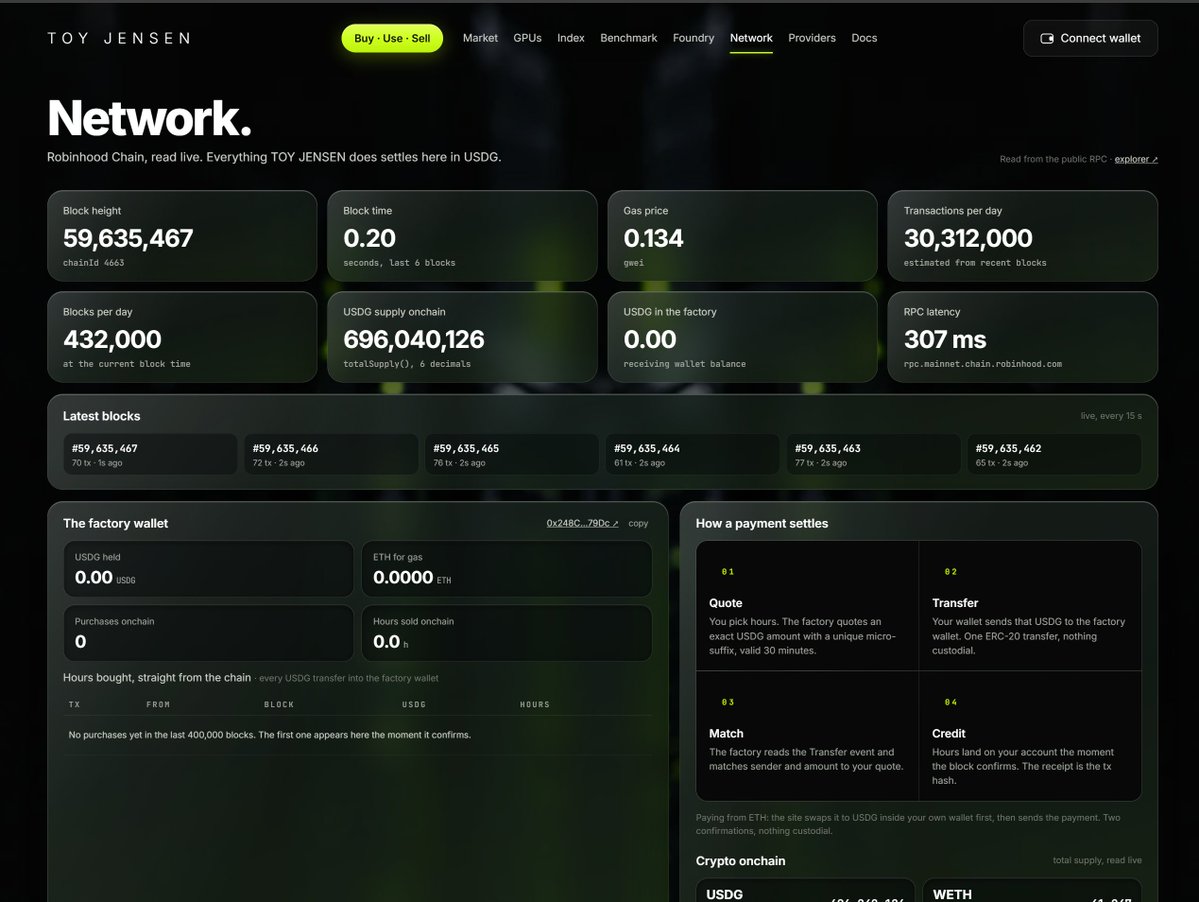
The Network in which TJ operates on :
Method: totalSupply on NVDA, then balanceOf for every contract holding it, then token0() and token1() on each of those contracts. If one side is the stock, the other side names the pair. Nothing estimated.
The limit, before anyone raises it. The v4 PoolManager pools every v4 market into a single balance, and that balance is 32.07% of the float. A PONS/NVDA market inside v4 would be invisible to this method. So the honest statement is not "there is no pair." It is: no pair the chain will confirm from outside, and a third of the float sits in a box that cannot be opened from here.
Block 59,634,837.
We are now live on @ponsdotfamily
Buy, Use and Sell compute on https://t.co/rNCW3JebSa
$TJ is paired with NVDA
CA : 0xe4f87934345f1c198aacd7945e9189429771646c
Compute is the only asset in crypto that gets used up.
A share sits still. A stablecoin sits still. A GPU hour exists, gets consumed by work, and is gone. We built a place to buy that hour, spend it, and sell what you don't use. It is called TOY JENSEN, and the name is not a costume.
WHERE IT CAME FROM :
NVIDIA publishes an AI Workbench example that fine-tunes Stable Diffusion XL on a handful of photos of Toy Jensen, the toy figure of their founder they use as a demo character. It is public, it is Apache 2.0, and it is a real, repeatable piece of GPU work: one notebook, DreamBooth, tested on a single A100-80GB.
https://t.co/uL9LllJibi
https://t.co/1xIOGpPuVV
That last part is what we needed. The hard problem in selling compute is that a database row looks exactly like a machine. A fixed run separates them: same reference set, same seed, same steps, so wall-clock time is the only variable left. NVIDIA had already written one. We took it, made it the test a card has to pass to earn, and named the project after it.
What we added to their notebook: fixed parameters, DCGM sampling through the run, a receipt signed by the provider's key, and the receipt hash written to Robinhood Chain. Their code proves a model learned a subject. Ours proves a machine was there.
THE PRODUCT
One GPU hour costs 1.20 USDG. You pay from your own wallet, in one transfer, on Robinhood Chain. No account, no card, no monthly minimum.
An hour buys about 40 short essays of chat, or 300 images, or 60 minutes of a private 4090-class endpoint. Everything is priced from what the work costs at wholesale, not from a subscription tier, so an hour buys a consistent basket whatever you point it at.
Hours are prepaid service credits.
On the other side, anyone with an NVIDIA card can register it, commit capacity for the month, and take creator jobs: renders, animations, upscales, model runs. Providers keep 80% of the hours a job costs. The 20% is for matching and verification, and that is the only margin on the work itself.
GitHub
https://t.co/uL9LllJibi
Buy.Use.Sell compute now on
https://t.co/Xeng2IWrfE
TOAD PIMPLE — found inside NVIDIA’s Nemotron training data.
NVIDIA just open-sourced the training blends behind Nemotron-3-Ultra — 337,000+ examples used to post-train one of its frontier open models. Buried inside that corpus is Toad Pimple, the protagonist of an old competitive-programming problem called And Reachability. His entire purpose is simple: find whether one point can reach another through shared bits.
Here's what i did :
I took that forgotten training-data artifact and gave it a network. TOAD turns the original reachability logic into a live onchain graph — wallets become nodes, shared properties create connections, and Toad finds the path between them.
NVIDIA published the data. Hugging Face exposed the artifact. I brought Toad to life. $TOAD / NVDA
Explore the official NVIDIA Nemotron dataset https://t.co/x7NRbykMVL
I open sourced the outcome here on github
Repo :
https://t.co/Smtkrollot
Website
https://t.co/HzFHe3S5YB