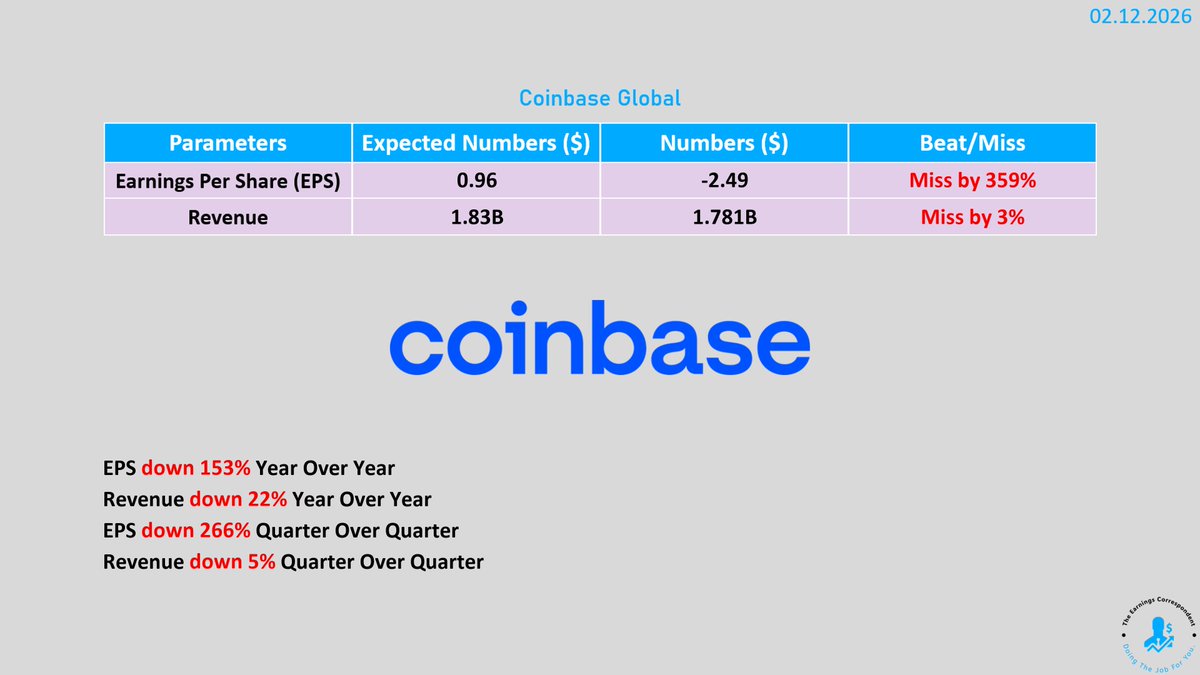
Coinbase just posted one of their most important earnings reports to date, and most people completely failed to see the bigger story at play.
They're all focused on the headline miss:
- Revenue down 22%.
- Consumer transaction revenue down 45%.
- A $2.49 loss per share when analysts expected $1 profit.
Looks terrible, right?
Here's the (bullish) reality everyone seems to want to ignore:
@Coinbase isn't the same company it was in 2021.
They now have 12 (twelve!) different products generating over $100M annually.
Meaning they're not a crypto exchange anymore, they're a financial infrastructure company.
Trading volume hit $5.2T for the year. Up 156% year over year.
Market share doubled to 6.4%.
Their subscription and services revenue reached $2.8B (that's 5.5x higher than the peak of the last bull cycle, btw).
Almost 1M people now pay for Coinbase One subscriptions (tripled in three years).
They acquired Deribit and became the global leader in crypto derivatives by open interest and options volume.
They launched prediction markets.
They launched equities trading.
They're handling crypto custody for over 150 government agencies.
The Q4 "miss" happened because consumer transaction revenue dropped.
Translation: retail wasn't aping into memecoins as hard in Q4.
That's supposed to be bearish?
The entire thesis against Coinbase has always been that they're too dependent on retail speculation during bull markets.
This earnings report shows they've been systematically fixing that problem.
Stablecoin revenue spiked 61%.
Average USDC held on platform hit an all time high of $17.8B.
They're building toll roads, not casinos.
When the next wave of institutional adoption hits, they're the incumbent.
When the next retail mania arrives, they'll capture it too.
But now they don't need either to survive.
This is what transformation looks like.
One quarter's miss during a downturn doesn't change the trajectory.
The "Everything Exchange" thesis is playing out.
Savings: $15,000
Investments: $745,000
Checking: $12.78
Your friend: “do you want to get some food?”
You: “I can’t, I have no money”
Only some will understand
JUST IN: 🇫🇷 Coinbase CEO Brian Armstrong calls out French Central Bank Governor's misunderstanding of Bitcoin.
"Bitcoin is a decentralized protocol...Bitcoin is more independent."
We’re bringing an entire country onchain.
Bermuda is building the world’s first fully onchain national economy, with support from Coinbase and @Circle.
After reviewing the Senate Banking draft text over the last 48hrs, Coinbase unfortunately can’t support the bill as written.
There are too many issues, including:
- A defacto ban on tokenized equities
- DeFi prohibitions, giving the government unlimited access to your financial records and removing your right to privacy
- Erosion of the CFTC’s authority, stifling innovation and making it subservient to the SEC
- Draft amendments that would kill rewards on stablecoins, allowing banks to ban their competition
We appreciate all the hard work by members of the Senate to reach a bi-partisan outcome, but this version would be materially worse than the current status quo. We’d rather have no bill than a bad bill. Hopefully we can all get to a better draft.
We'll keep fighting for all Americans and for economic freedom. Crypto needs to be treated on a level playing field with the rest of financial services so we can build this industry in a safe and trusted way in America.
@CoinbaseDuck Hey @CoinbaseDuck I'm creating a investment spreadsheet for Coinbase & wondered whether you have one & would mind sharing a few tips? Thanks :)
Big banks earn $360B+ annually from payments and deposits. Now they're lobbying to kill crypto rewards because real competition threatens those margins. Congress shouldn't pick winners and losers – especially when the losers are everyday Americans.
The reason nobody is sure why BTC is pulling back is because everyone is looking for a single cause when this is actually a systems failure with multiple transmission mechanisms reinforcing each other.
Here's what actually happened mechanistically:
Bitcoin ran from $40,000 to $126,000 in less than a year on a very specific narrative: Federal Reserve easing cycle plus institutional adoption through ETFs equals sustained bull market. The market built up $94 billion in futures open interest, with some platforms offering leverage ratios as high as 1,001 to 1. That setup alone created extraordinary fragility.
The trigger was simple but devastating. Fed officials reversed dovish expectations completely. The market went from pricing a 90 percent probability of December rate cuts to just 40 percent. Real yields on short term Treasuries stayed elevated above 5 percent. The entire macro story that justified Bitcoin at $126,000 collapsed in a matter of weeks.
Now here's where the structural vulnerability shows up. The new ETF infrastructure that everyone celebrated as bringing institutional money actually created institutional scale sell liquidity that never existed before. When the macro narrative broke, institutions could exit with one click. We saw $1.1 billion in ETF outflows in just days. This isn't retail panic selling. This is professional portfolio managers rebalancing away from an asset whose fundamental thesis just evaporated.
Simultaneously, long term holders who bought Bitcoin between $40,000 and $80,000 started distributing. They offloaded 815,000 Bitcoin in 30 days. These holders aren't selling because they think Bitcoin is worthless. They're selling because they see volatility ahead and they're sitting on 50 to 150 percent profits. Smart money doesn't ride drawdowns when they can step aside and rebuy lower with the same capital.
Here's where it becomes a cascade. When price broke the $100,000 support level, technical stops triggered across the entire derivatives complex. Over $20 billion in leveraged positions got liquidated throughout October and November. Some single day events saw $3.2 billion wiped out. The liquidations themselves created additional selling pressure, which triggered more stops, which forced more liquidations. Open interest collapsed from $94 billion to $68 billion, but there's probably still more leverage that needs to clear.
The critical insight everyone is missing: there are no natural buyers at these price levels. Institutions are rebalancing away from risk assets. Long term holders are waiting for lower prices to rebuy. Retail got scared off by the violence of the move. And new buyers won't step in until the leverage gets fully flushed and price stabilizes.
So the market has to fall far enough to accomplish three things. Clear the remaining leverage completely. Reach prices where long term holders stop distributing and start accumulating again. Find the level where actual value buyers with real capital see opportunity worth the volatility risk.
The $600 billion wipeout you're seeing is mostly the evaporation of unrealized gains that were paper wealth to begin with. When Bitcoin went from $40,000 to $126,000, that represented about $1.7 trillion added to market cap. A lot of that was pure multiple expansion based on a macro narrative that turned out to be wrong. Now the market is repricing based on reality: high real yields, no Fed easing, strong dollar environment.
This isn't mysterious. It's textbook deleveraging dynamics in an asset with no cash flows to anchor valuation, extreme leverage ratios, and a macro thesis that broke. A 25 percent correction after a 215 percent rally with 1,000x leverage in the system is actually normal market behavior when the fundamental story changes. The violence of the move reflects the amount of leverage that was built up, not any change in Bitcoin's long term prospects.
The real question isn't why did this happen. The real question is what price level actually clears the market and brings in genuine buyers rather than leveraged speculators. That's still being discovered.
At the end of the Coinbase earnings call today, Brian Armstrong pulled up the mention market and rattled off all the words that weren't said yet
What a wild time to be alive
Fun math time on $COIN
8% annual APY, 15% fee. Thats 120 bps
To earn 1B in onchain loan management fee, you need 1B/120bps = 83.333B total loan amount (supplied and borrowed)
Assume 50B in lending, and 33B in borrowing, that’s about 66% LTV ratio.
1B management fee on a 30 ps ratio = 30B
That would be $115 added to $COIN stock price.
Not a very distant future guys..
How do we get there? Fully unlock onchain lending and borrowing. Need to be able to borrow against $ETH, $SOL, need to be able to lend out $EURC, $XSGD and etc.
Usually Coinbase product creates synergy, meaning these lender and borrower will be able to transact more on @coinbase adding more trading and service revenue.
You are too bearish, duck is fully locked and loaded.
Working harder ≠ more income
Hard workers don't make more money - they get taken advantage of by society and corporations
In my opinion, if you're a hard worker you'd do better financially as an entrepreneur than you would as an employee