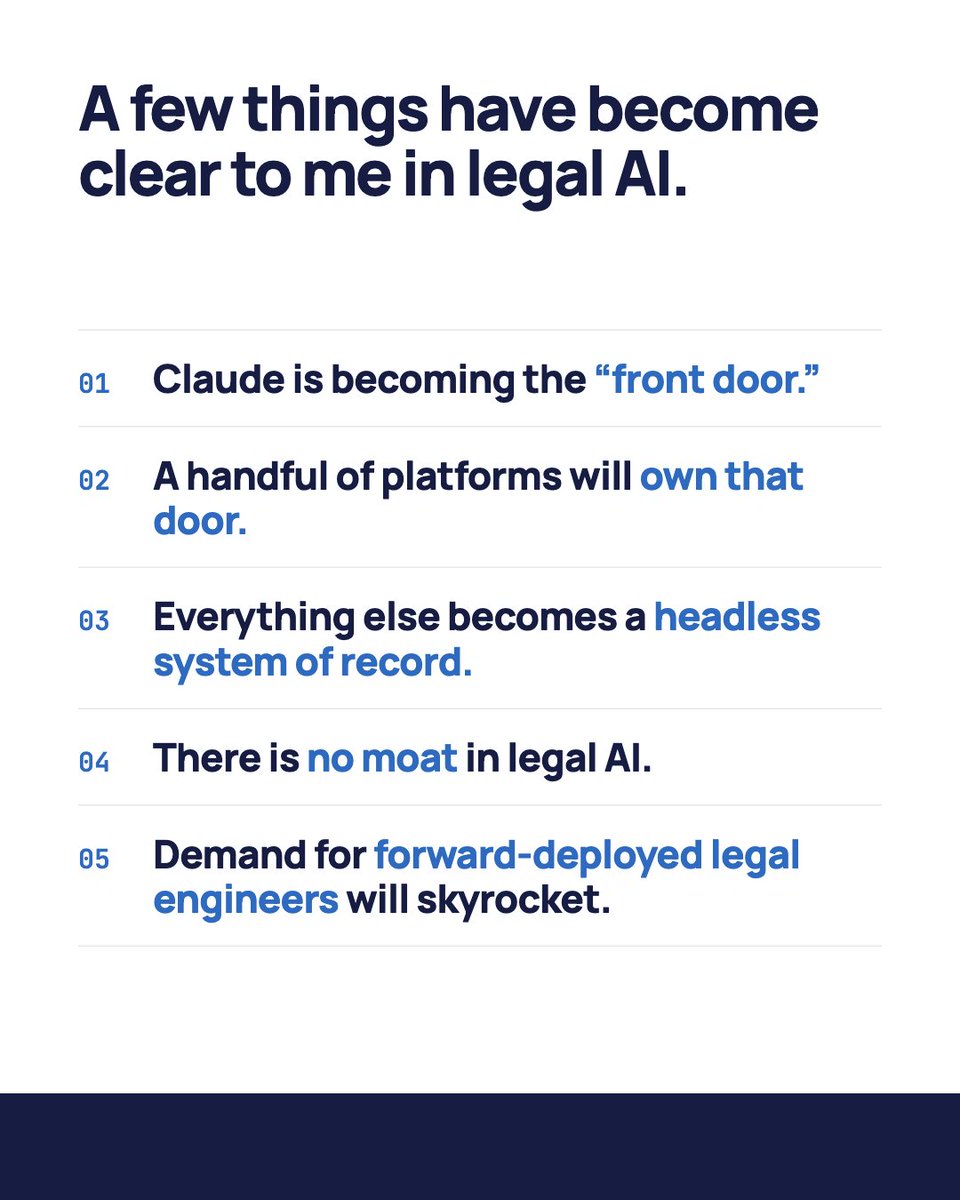
A few things have become clear to me over the last few weeks in legal AI:
1. Claude is becoming the “front door” to everything else.
Law firms and legal teams are using Claude to access everything via MCP. Nobody physically opens up a CRM anymore. Nobody opens up the DMS or case management system. That data gets pulled in as context and surfaced in Claude at the point in time it becomes relevant to the user’s query. New data also gets written back to all of those systems directly through Claude.
2. A handful of platforms will own that front door.
Likely the generalist lab players like Claude and ChatGPT (or the entrenched enterprise players like Gemini/MSFT Copilot). All work gets conducted in one powerful platform with infinite integrations, and virtually every other enterprise application and system of record gets accessed THROUGH it. Which means legal tech vendors must find a way to “play well” with these platforms (think MCP connectors, plugins, platform apps, etc.).
3. Everything else becomes a headless system of record.
Your CRM, your DMS, your case management system all effectively become databases that your Claude agent reads from and writes to. If you sell enterprise or legal tech software, that changes everything. Nobody cares about the 1000s of new features your team vibe coded last weekend. No human has the bandwidth to learn them. But that human’s Claude agent will leverage every one of them via MCP, and that’s where the real value is. It’s more important now than ever to go headless (i.e., build software for agents to consume, not humans).
4. There is no moat in legal AI.
Everything can be reverse-engineered, and everyone is selling a version of the same thing. Trust and distribution are the only things that matter. (For the unversed, Adobe’s entire creative suite - Photoshop, Premiere Pro, Lightroom, Acrobat Pro, etc. - was reverse-engineered and open-sourced by a single person using AI a few weeks ago.)
5. Demand for forward-deployed legal engineers (or “Applied AI engineers” for legal) is going to skyrocket.
It’s not enough to just adopt a tool, generalist or otherwise. That’s not how your firm or legal team will truly get value out of AI. You need builders with a strong grasp of AI, product, systems design, and process engineering + a deep understanding of legal workflows and incentive structures, who can architect the right workflows, agents, and systems tailored for YOUR firm or team in a governed, verifiable, and scalable way.
JUST IN: Delaware to introduce legislation in January allowing AI agents to run their own companies, potentially shielding their human owners from liability.
Bullish on AI-native firms. While some insecure lawyers continue to bicker on here over what “AI-native” means, these guys are gonna eat the big law incumbents for lunch
TRACKED CHANGES: Six months in, AI-native law firm Norm Law has grown to 65 lawyers, including 29 partners. The firm says it expects Am Law 200-level revenue within a year, Nonbillable reports.
Idk a single software engineer that enjoys writing code anymore. Agent swarms baby. And it’s why software engineers literally had no problem automating that part of their work away
Having worked as both a lawyer and a software engineer, I see a major difference between how the two groups are reacting to AI.
Lawyers are happy to automate significant parts of their day-to-day work since they didn’t love doing it in the first place, whereas coders are now realizing that the parts they loved most about the job are exactly the parts they no longer get to do.
🚨🇺🇸 FEMA is telling an entire Iowa town to clear out before the Army blows up 5 tons of lead explosives at 9 a.m. tomorrow
Phones across southeast Iowa lit up today with the alert.
People within 5 miles southwest of the plant may be evacuated, and anyone 5 to 20 miles out is told to stay inside with the windows shut to avoid lead dust, noise and shaking.
All of Middletown is being moved out, and the Army wants people gone until at least Friday.
The governor declared a disaster emergency, and the Guard is sending in up to 100 soldiers.
So a lot of families in that town will spend Thanksgiving somewhere other than home...
Source: CBS Chicago / Writer: Daniel
Detonating lead bombs the day before Thanksgiving where our entire national food supply comes from is one of the most utterly dystopian and evil things to happen in my lifetime - and given that I'm the generation who entered maturity during 9/11, it is really saying something.
Easy for me as a solo consultant. Harder for teams/multiple users bc you have to worry about enterprise security, user permissions/access controls, scalability etc. But yeah, not long before a Claude artifact does all that easily too. Filevine, Clio, etc are just glamorous systems-of-record now that you access from your Claude/ChatGPT agent via MCP
You can now install Claude artifacts as desktop apps on Mac and Windows.
Ask Claude to build an artifact, click "Install as app", and open it like any other app. It can use your connectors and, if you allow it, send notifications or add a menu bar item.
You can now install Claude artifacts as desktop apps on Mac and Windows.
Ask Claude to build an artifact, click "Install as app", and open it like any other app. It can use your connectors and, if you allow it, send notifications or add a menu bar item.
BREAKING: Jensen Huang officially returns to Nvidia's office, $NVDA, and receives a standing ovation from Nvidia employees.
"I'm going to be a better CEO the second time around," Jensen Huang told employees.
People keep sending this to me. Respectfully, I think this article deeply underestimates the AI moment.
I met with a dozen early Atrium folks (including 3/4 of the founders) before starting Crosby. IMO we couldn't learn much from them: computers simply couldn't do legal work back then.
As a result I think this post makes a few bad assumptions:
1. The best legal services win by hiring the shiniest lawyers.
AI just solved the Reimann hypothesis, which stumped humans for 150 years. It will soon do some legal work 100x better than any human, ingesting more data and displaying more cunning. In time, neofirms will win by investing in differentiated tech, not the priciest lawyers.
2. The best lawyers stay in big law for the cash.
Idk.. sad outlook. In my experience, some of the most curious lawyers are dying to be part of the AI revolution ( see e.g. https://t.co/vCmrjMP6P8) and they feel held back at traditional firms. They would rather tinker with agents for 50h a week than reformat documents for 100h/week. Of course, this is still a minority, but it's early.
3. Big law can keep billing out associates at $2m/year to pay partners $5-$20m.
The floor is already falling out, and we will see more tumult at the AmLaw 50-200 next year. The music is gonna stop. I have never heard so many clients so furious about big law rate increases; they know AI can already do that $2m/year associate work.
4. By law, only law firms will ever be allowed to sell legal work.
These rules made sense when only trained humans could do safe, good quality legal work. But now AI can also do safe, great legal work. The rules will change. It's inevitable: 70% of Americans still don't have access to our remarkable legal system. Rules that served a noble purpose once will start to look like flagrant protectionism.
***
The best part of this article asks: why estart a Neofirm when any lawyer just use Codex/Cowork?
Amazing q. I have been encouraging my law school friends to do this, I think there is a brief window for enterprising lawyers to build incredible solo practices with no billable hours.
Having said that, a neofirm is quite different from this. And the fact that this isn't clear is fully on me – I have intentionally hidden away a lot of the tech we've built so we didn't freak out our clients 2 years ago.
But I have started sharing more about everything we're building, and I will double down. Fair call out.
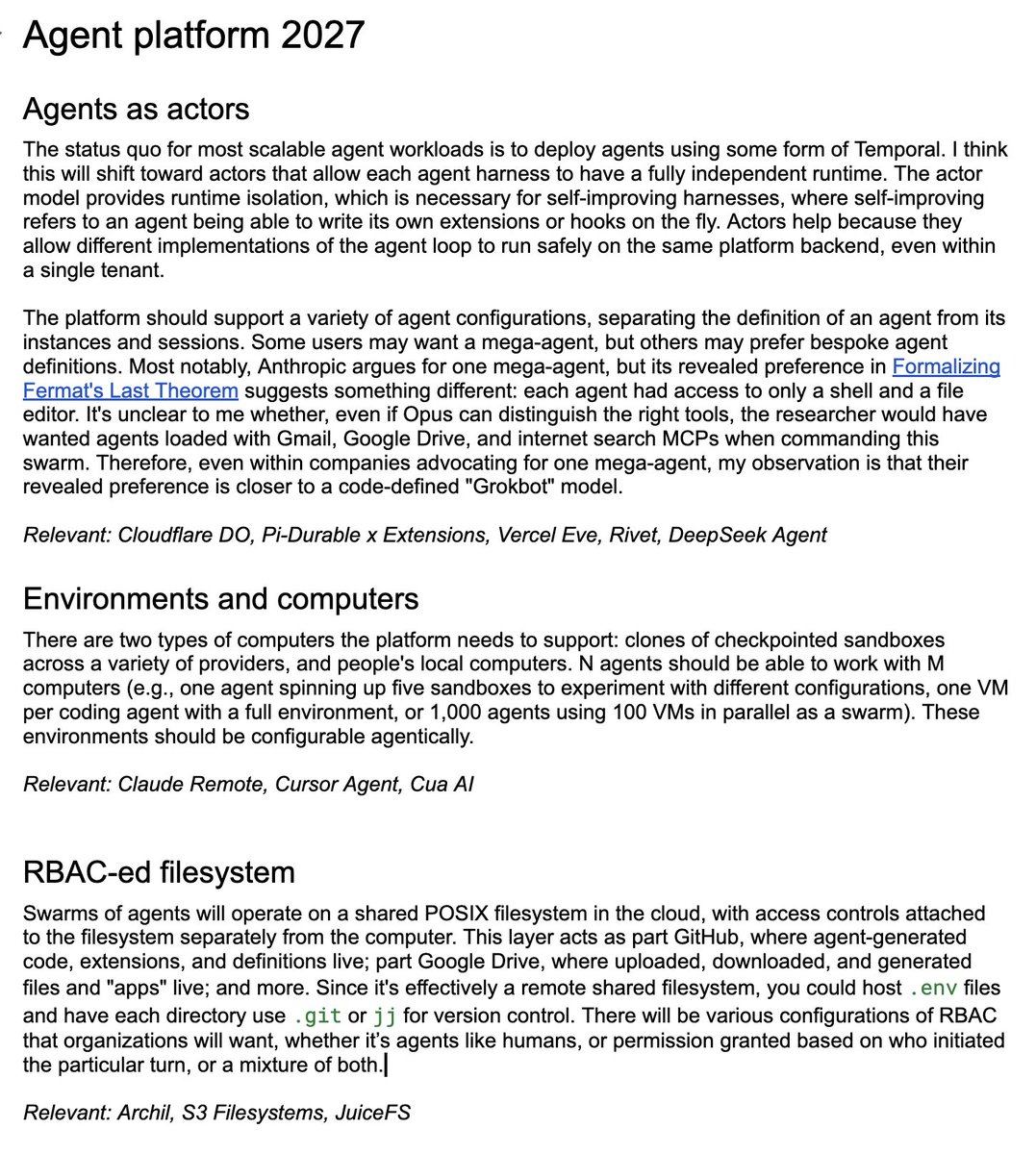
Agent platform of 2027.
This is the end game. This is the blueprint for the one and only application layer software that will exist. Every other software will effectively become databases for this layer, the everything agentic operating system for the million agent swarm to work on top of.
This is obviously the end game vision for the application layer of ChatGPT and Claude. I have reasons to believe that an independent company will own this product layer. But most ADE, "enterprise agent platform", or vertical saas companies, are focused on the wrong things far too narrowly, not technically competent, and do not have the product / technical vision to see this inevitable future.
The correct agent platform that wins will function like the base of a garden, from which customers will plant their unique "seeds" to grow their own plants and trees, managed and evolved by agents, humans, and signals from the sensors of the business. This presents a clearer picture than "factory of a factory" imo.
💯. Thanks for posting this Nick. The recent discussion around AI notetakers waiving privilege was funny and exposed just how technologically unsophisticated some lawyers are
It is so painfully obvious that using an AI notetaker should not waive privilege.
The fact that a law firm could hire someone to take notes on the call while maintaining privilege answers the question. We settled this with email decades ago.
Clients should always have the option to not have their calls recorded - but the purpose of privilege is to allow clients to speak freely. The idea that using technology to transcribe and analyze means the information is not confidential...doesn't make sense.
People want increased access to justice, faster service, and lower fees. AI notetakers will help with that!
Yes, you need to have "sufficient protections" that ensure the AI providers are not using the data for their own purposes and that the data is secure. It's a legitimate discussion - and we should debate which protections are enough. But this is a solvable problem. Bar associations could easily create safe harbor provisions that providers could certify they comply with.
Part of why this will take so long to get to the right answer is that this is an issue where many lawyers actually enjoy the debate. Many judges will opine about the true nature and historical roots of privilege. They will debate definitions and look at many particular contractual terms to decide whether they are "sufficiently protective."
This is all instead of just helping to educate lawyers about how to use products safely.
In the end, I am 100% confident we will get to a point where it's widely accepted that people are using AI notetakers and it doesn't violate privilege. It's frustrating it's going to take so long.
Many of you have reached out, asking how you can build a similar set up for your own business. This is relatively straightforward if you will commit the time and effort.
1. Get the top model of Claude, ChatGPT, or Grok - agentic work gobbles usage so the $20/month plan won’t cut it
2. Use Duet (Claude) or Dot (ChatGPT) or GrokBot to build the architecture.
3. Tell it about your business idea, and ask it for recommendations about how to set up an architecture for the idea to work. If you have ever worked at a company, my advice is to think about the Depts in your company and mirror your company on which of those you need.
4. Spend hours every day talking to your agents about the work that you are doing, and when you see things that don’t make sense, tell it to fix it.
5. Be prepared to give your agents all of the context that you would need to do the job, such as access to your email and calendar and payments as needed.
6. Regardless of what your business is, I would not remove the safeguards that prevent your agents from sending emails on your behalf without your approval. Approve every line that gets sent on your behalf every time.
we very clearly live in a new world now, and less than 0.001% of the human population understands this.
the tech tree is about to open up:
a) in ways that sound science fiction to most
b) much sooner than they believe to be possible
2027-2030 will be a shock to the world.