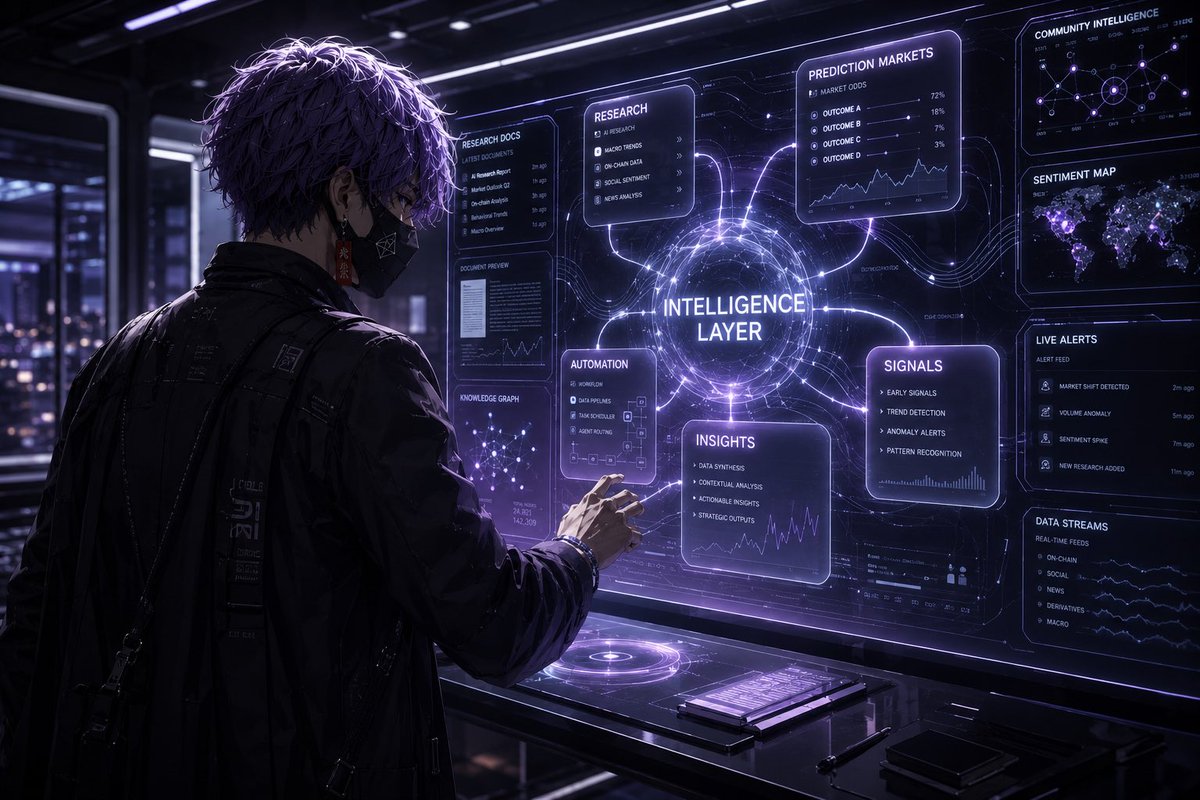
Prediction markets have done a great job of answering one question:
“What does the market think will happen?”
But that isn’t the only question that matters.
1. How do you organize research before taking a position?
2. How do you filter noise from useful information?
3. How do you turn dozens of signals into something you can actually act on?
These are the questions that have been on my mind as I’ve spent more time exploring the prediction market ecosystem.
That’s one of the reasons @Polysights caught my attention.
Rather than trying to become another prediction market, Polysights is focused on building tooling around the prediction market experience.
Its vision includes:
>> A Research Hub where contributors can publish market research and build reputation over time.
>> No code workflows designed to automate monitoring, alerts, and repetitive tasks.
>> Community-driven intelligence, allowing users to contribute insights and create a more collaborative research environment.
If that vision is executed well, it could make participating in prediction markets more structured and research-driven instead of relying on scattered information across different platforms.
What stands out to me is the broader direction.
As prediction markets continue to mature, I think the next wave of innovation won’t just come from new markets but it’ll come from the infrastructure surrounding them.
• Better research.
• Better tools.
• Better workflows.
• Better decision-making.
Whether Polysights ultimately becomes a key part of that ecosystem remains to be seen, but I think it’s one of the projects worth following if you’re interested in where prediction markets are heading.
I’ll definitely be watching how it develops.
What do you think prediction markets are still missing today?
DeFi is getting programmable. Are you paying attention?
Most people look at token prices. But there's another side of DeFi worth exploring: the technology powering liquidity pools.
Meet @kyromarkets, a multi-chain terminal built around Uniswap v4 hooks, pools, launchpads and real-time analytics.
Let's look beneath the surface.
Website: https://t.co/XubN4UEpXv
Telegram: https://t.co/gpmwZS7jwn
#KyroThread
TON in Keeper ✅
Bitcoin in Keeper ✅
Ethereum in Keeper ✅
TRON in Keeper ✅
BNB Chain in Keeper ✅
Arbitrum in Keeper ✅
Base in Keeper ✅
Solana in Keeper ✅
Avalanche in Keeper ✅
Polygon in Keeper ✅
Robinhood Chain in Keeper ✅
Who’s next?
TON has more going on than token swaps, tap to earn games, and Telegram bots.
And that’s what I wanted to explore before wrapping up my TON focused content.
There’s the wallet and payment side, making it easier to move digital assets.
There’s DeFi, with protocols like @ston_fi enabling token swaps and liquidity provision, alongside lending and staking opportunities across the ecosystem.
Then you have Telegram Mini Apps, bringing games, social experiences, and blockchain powered applications directly into an app millions of people already use.
NFTs and collectible Telegram gifts add another layer, while launchpads, bridges, developer tools, and infrastructure help new projects enter and grow within the ecosystem.
Different products, different use cases, but all contributing to the bigger picture.
What interests me most is the connection between accessibility and actual utility.
Getting people to try crypto is one thing. Giving them useful reasons to stay is another.
TON has several pieces of that puzzle in motion, but the real question is how well these pieces translate into sustainable usage beyond hype and incentives.
That’s a side of the ecosystem worth paying attention to.
Wrapping up my TON exploration with one question:
Which part of the TON ecosystem do you think has the most potential that people are still overlooking?