Wendell Berry sums up our current health predicament perfectly...
“People are fed by the food industry, which pays no attention to health, and are treated by the health industry, which pays no attention to food.”
Colorectal cancer rates in adults under 50 have doubled since the late 1980s.
One in five colorectal cancer diagnoses now occurs in someone under 55, up from one in ten in 1995.
A new study highlights the most concrete factor responsible for this trend.
Using DNA methylation profiles as molecular records of lifetime exposure, the authors compared cancer patients under 50 with patients over 70 and identified the herbicide picloram as a significant new risk factor.
There are converging lines of evidence.
The picloram exposure signature was significantly elevated in early-onset tumor tissue and replicated across nine independent patient cohorts. Across 21 years of US county-level data spanning seven states, higher picloram use tracked higher early-onset CRC incidence, and the signal held after adjusting for income, education, and the use of other pesticides.
Picloram associated tumors also showed a distinct molecular profile, with APC mutations at 74% versus 90% in low-exposure tumors, suggesting these cancers follow a different biological pathway than classical CRC.
Picloram entered commercial use in 1964. Patients now diagnosed in their 70s were already adults before meaningful exposure was possible. Patients now diagnosed in their 30s and 40s were exposed across childhood and adolescence, the developmental windows when epigenetic programming is most plastic.
This study delivers the first triangulation of molecular, ecological, and temporal evidence pointing at a specific environmental driver of one of the steepest cancer trends in modern epidemiology.
The phyllosphere, the microbial community on leaf and stem surfaces, covers roughly one billion square kilometers globally. It is Earth’s largest terrestrial habitat for microbes, and it’s been overlooked by agriculture.
A single gram of leaf tissue carries ten million bacterial cells that fix nitrogen, mineralize phosphorus, produce siderophores outperforming synthetic chelates, and synthesize B vitamins plants depend on.
Broad-spectrum fungicides, antimicrobial surfactants, and other conventional and organic ag practices strip out these beneficial microbes, narrowing diversity and driving pathogen pressure higher each cycle.
The full essay covers the mechanisms, trial data, and practical considerations for fostering beneficial leaf-surface biology in the field.
https://t.co/FS2lGLZAs9
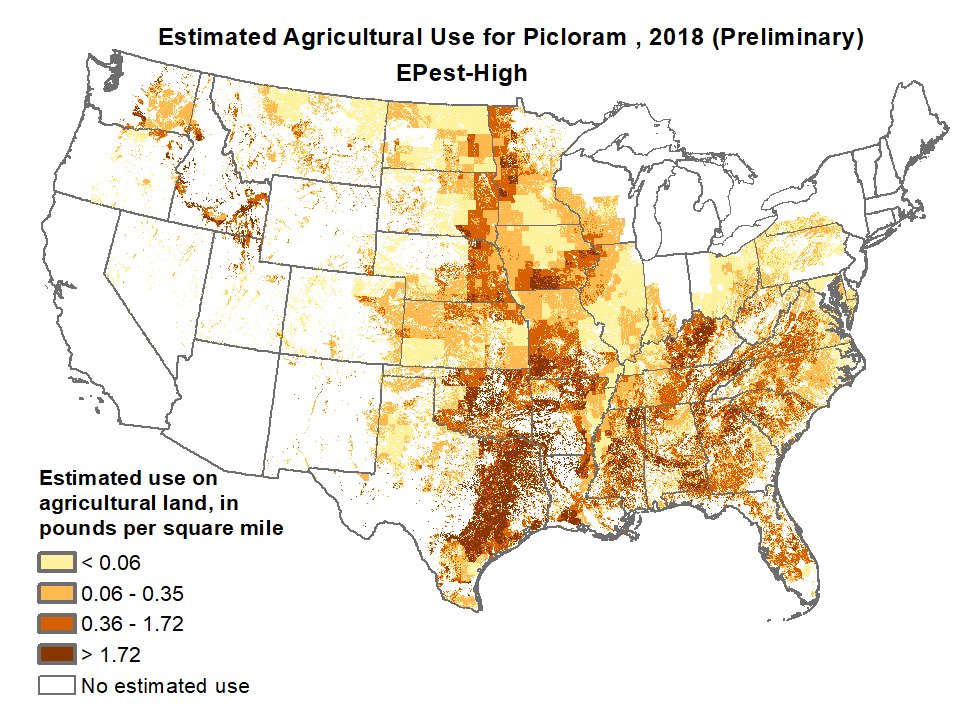
Picloram use is heaviest in the Northern Great Plains and Mountain West, on two land uses: spring and winter wheat (plus oats and barley) and rangeland and pasture managed for noxious weed control.
The highest-intensity counties are in Montana, North Dakota, South Dakota, Wyoming, Idaho, and eastern Washington and Oregon, with a another cluster in Texas and Oklahoma for mesquite and brush control on cattle range.
In Montana picloram is registered for direct application on the wheat crop itself.
Picloram is among the most persistent and mobile pesticides currently registered, has been detected in groundwater in at least ten states, and resists degradation once it reaches aquifers.
The exposed population includes downstream and downgradient communities drawing from contaminated water tables for years after application.
The time to stop applying picloram was 40 years ago.
Glyphosate is neither safe nor effective when you look at the whole picture.
The most common defense of glyphosate compares its acute lethal dose (LD50) to caffeine or table salt. The comparison is technically accurate and functionally irrelevant.
The actual issue is not acute toxicity, its chronic, low-dose exposure over years via food, water, and contact. This is a different toxicological question, and LD50 cannot address it.
IARC classified glyphosate as a probable human carcinogen, citing sufficient evidence of cancer in animal studies, consistent evidence linking it to non-Hodgkin lymphoma in exposed human populations, and strong mechanistic evidence that it damages DNA and generates oxidative stress.
Glyphosate defenders cite the European Food Safety Authority (EFSA) and EPA over IARC without explaining why these agencies reached different conclusions. EFSA assessed pure glyphosate using unpublished, industry-submitted studies.
IARC assessed the commercial formulations actually used in the real world, including surfactants that increase absorption and toxicity -- using only peer-reviewed data.
Beyond carcinogenicity, peer-reviewed studies associate chronic low-dose exposure with fatty liver disease, endocrine disruption, impaired male fertility, and neuroinflammation.
The quoted thread also ignores glyphosate's declining field efficacy. Decades of over-reliance have selected for herbicide resistant weeds across well over 60 million acres of US farmland and cause an estimated $43 billion in damage to corn and soybean crops in the US and Canada.
The industry has responded by stacking additional herbicides onto failing programs, accelerating the cycle of resistance.
Compounding this, glyphosate disrupts soil microbial communities, increasing colonization by pathogens, suppressing beneficial bacteria and fungi, and reducing plant immune function.
When the health evidence is contested because regulators relied on different data, when field efficacy is eroding under resistance pressure, and when measurable harm to soil biology continues to accumulate -- the response should be serious scrutiny, not a lethal dose chart.
Reminder:
Glyphosate is both safe and effective.
It's very good that the White House followed the science and endorsed stockpiling it to protect our wonderful American agriculture!
Colin, once again you are trying to put words in my mouth and continue to mischaracterize me. As I said, bring something of substance or move on, look down your nose at someone else.
Nobody is calling regulators corrupt or stupid. BfR copied Monsanto's analysis of independent peer-reviewed studies and presented it as the authority's own evaluation. This is not normal. The European Parliament found 50% of the health risk chapters were lifted directly from the industry submission, including BfR's stated assessment methodology itself. This wasn't rebutted by BfR or EFSA. The independent scientific evaluation that the process requires didn't occur for significant portions of the report. This is the entire purpose of the regulating body.
Hey Jimmy, you might notice I'm not one to respond much in general. Nothing personal or specific to this comment.
That said, I agree that disclosure failures are fair to criticize. However, there are a few important detail here:
–Portier signed the litigation contract after IARC published its classification — not before. You can't retroactively corrupt a decision that's already been made.
–IARC limited him to "invited specialist" because of his EDF affiliation. The classification was made by 17 independent scientists from 11 countries. One non voting advisor didn't change the outcome.
–If we're looking at conflicts of interest let's not do it selectively. The EFSA report had passages written verbatim by herbicide manufacturers. Monsanto's internal documents acknowledged that IARC conducted its evaluation properly. If financial conflicts disqualify, the industry funded studies EFSA relied on are much more egregious.
@HelieHarvey@simonmaechling This is all a bunch of hand waving. Say something of substance or move one. You might also consider all these assumptions show you know much less than you put on. And again you're trying to put words in my mouth. That was not my conclusion.
I certainly have a bias as we all do. I’m not a Bayer salesman like Simon.
Refer to the tweet I’m quoting for context on LD50. Regulators have added safety by leaving out other components of the formula actually used in the fields and they have relied on data that was cherry picked, fabricated, and paid for by Bayer/Monsanto. That is fact.