@Ahmed_ElHadidy_ I dont know you personally, but you pop up alot on my timeline. An advise from older collegue who is in the same pathway, Move on, focu on your path, leave it to god, Bad people exist, but only good people win, not today, not tomorrow, but eventually.
a standing ovation for daraxonrasib at asco. over 40k oncologists, entrepreneurs, investors, and patient advocates together celebrating revmed's breakthru in the fight against pancreatic cancer. u never forget these moments. it's what innovation is all about.
Egypt 🇪🇬 sends a medical team to Chad 🇹🇩 to perform 500 free cataract surgeries in N’Djamena.
Egyptian ophthalmologists are working at the University Hospital of Chad-China Friendship, carrying out surgeries and sharing skills with local doctors.
This effort, part of ongoing health cooperation, aims to prevent avoidable blindness and improve vision for many patients in the region, offering significant relief and strengthening medical collaboration between the two countries.
هقولكو أماكن ممكن تتبرعولها وبتتنسي.
مستشفى أبو الريش للأطفال.
مستشفى القصر العيني الجامعي.
مستشفى الدمرداش الجامعي.
مركز الطب النفسي في الدمرداش.
مستشفى العباسية والخانكة للأمراض النفسية.
معهد الأورام.
وحدة غسيل الكلى في الدمرداش والقصر العيني.
مركز غنيم للكلى بالمنصورة.
🤍
🚨This is wild: CRISPR gene-editing removed HIV DNA from infected cells — and those edited cells didn’t get infected again when exposed. Science is starting to rewrite the rules. 🧬⚡
Competitive gamers: 6h of sleep is a hidden nerf.
6h/night for 2 weeks → reaction time & attention decline to the equivalent of pulling MULTIPLE all-nighters.
Worst part: subjective fatigue plateaus, so you stop noticing.
If you're not getting 7+ hours/night, you're trolling.
People ask me all the time if we'll ever cure cancer. Studies like this are why I say yes.
Barbacid's triple combination eliminated pancreatic tumors completely and prevented resistance, in one of the deadliest cancers we face.
Add this to what we're seeing with immunotherapy, with intratumoral approaches, with combination protocols. The pieces are coming together. We are closer than ever.
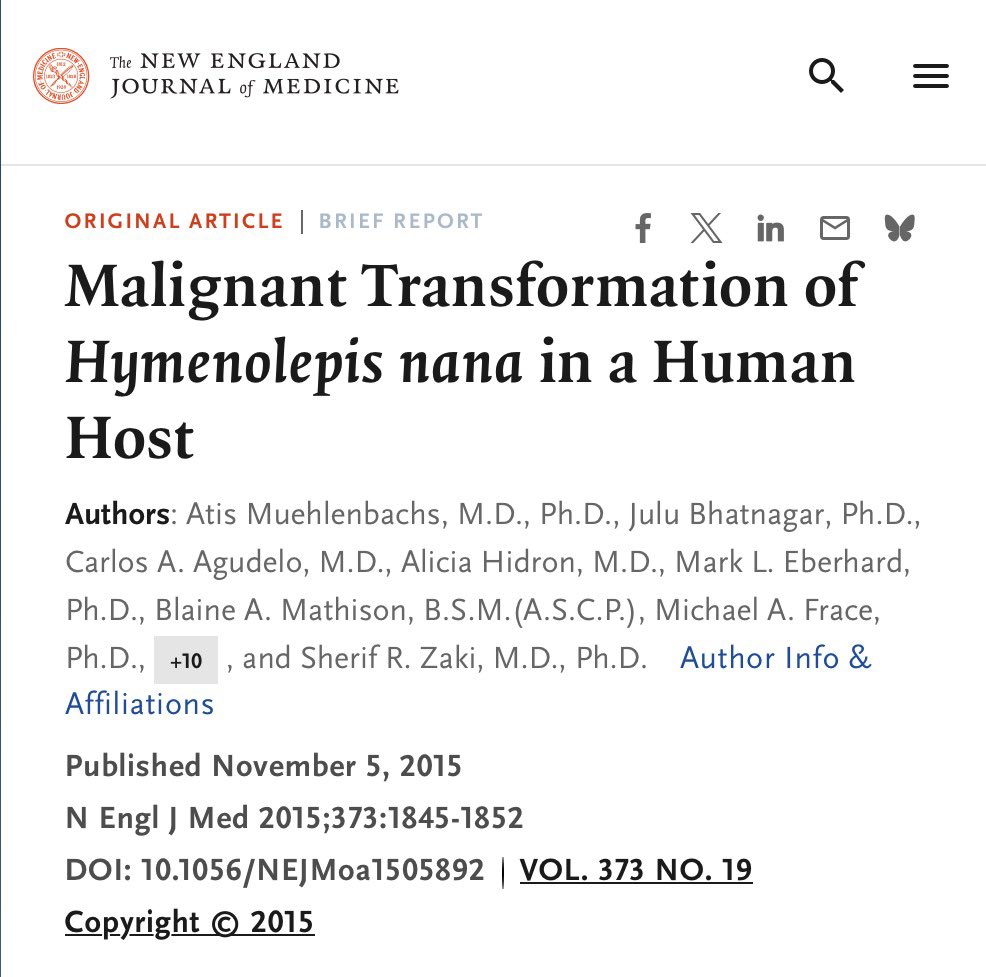
This patient died of a cancer that wasn’t his
When doctors talk about cancer, they’re usually talking about one thing:
your own cells going rogue.
Normal cells follow rules.
Cancer cells don’t.
They grow when they shouldn’t.
They ignore stop signals.
They invade nearby tissue.
They spread to places they don’t belong.
Under the microscope, cancer has a “look” crowded cells, chaotic growth, lots of division, and destruction of normal structures.
So when a 41-year-old man came to the hospital with months of fever, weight loss, cough, and extreme fatigue, doctors were worried.
Scans showed multiple masses:
- In the lungs
- In the liver
- In the adrenal glands
- In lymph nodes throughout the body
This wasn’t one tumor.
This was something spreading.
All signs pointed to aggressive cancer
Biopsies were taken.
Under the microscope, the findings were exactly what doctors fear:
- Cells multiplying uncontrollably
- Invasion into surrounding tissue
- Areas of cell death
- Spread to distant organs
In every way that matters, this behaved like advanced cancer.
But then someone noticed something unsettling.
The cells didn’t look human
Cancer cells come from the body, so they usually resemble the tissue they came from, lung, lymph node, liver, blood.
These cells didn’t.
They were unusually small, even smaller than red blood cells.
They lacked the typical markers of human cells.
They didn’t organize themselves like any known human cancer.
They looked primitive.
Undifferentiated.
Almost…foreign
This raised a terrifying question:
If these cells weren’t behaving like human cells…what were they?
The case becomes a mystery
Doctors tested for everything:
- Common cancers
- Rare cancers
- Fungal infections
- Amoebas
- Exotic parasites
Nothing fit.
Meanwhile, the disease progressed. The masses grew. The patient’s condition worsened.
Experts at the Centers for Disease Control and Prevention (CDC) were consulted. Tissue samples were sent for advanced testing.
And that’s when the case crossed into uncharted territory.
The genetic material inside the “tumor” cells did not belong to the patient.
It wasn’t human.
It belonged to a tapeworm.
Specifically, Hymenolepis nana, one of the most common tapeworms in the world, usually harmless and often symptom free.
But in this man, something unprecedented had happened.
➡️ The tapeworm’s own cells had turned cancerous.
Not a parasite causing cancer.
Not an infection triggering cancer.
A parasite developing cancer inside a human body, then spreading like a malignant tumor.
This had never been documented before.
Why this is a big deal:
Until this case, cancer was considered a disease of the host’s own cells.
This shattered that assumption.
It showed that under extreme conditions, especially severe immune suppression, non-human cells can mutate, grow uncontrollably, invade human tissue, and spread throughout the body like cancer.
In simple terms:
The patient died of cancer that he never developed.
The malignancy that killed him did not arise from his own cells.
It came from something living inside him.
This single case forced doctors to rethink some of the most basic ideas in medicine:
- What cancer actually is
- How infections can behave in weakened bodies
- The role of the immune system as a final line of defense
- And what is biologically possible inside the human body.