#RDC: ‼️🚨Exclusif Cable | L’Angola se retire du projet de dialogue intercongolais, invoquant le non-respect des engagements par le gouvernement de Kinshasa
L’Angola ne prendra pas part au dialogue prévu à Kinshasa , apprend-on de source proche du dossier. Luanda estime que les engagements pris par le gouvernement de Kinshasa n’ont pas été respectés.
« Même après sa victoire militaire contre Jonas Savimbi, l’Angola avait privilégié la voie du dialogue inclusif. L’expérience montre qu’une solution durable passe par des discussions ouvertes entre les différentes parties », affirme cette source diplomatique.
June 1994: The rape of Tutsi girls at Sainte-Famille parish by a priest
▶️Sainte-Famille parish in Kigali was not a sanctuary in June 1994. For many Tutsi women and girls who had run there believing that a church still meant protection, it became another chamber of the genocide against the Tutsi: a place of selection, humiliation, abduction, rape and death.
▶️At the centre of the survivors’ accusations stands Wenceslas Munyeshyaka, then a Catholic priest at Sainte-Famille, a man later charged by the ICTR with genocide and with rape, extermination and murder as crimes against humanity. But in France, where he lived and ministered for years, the case collapsed: investigating judges dismissed it in 2015. The Paris Court of Appeal confirmed the dismissal in 2018, and France’s Cour de cassation rejected the civil parties’ appeal in October 2019, ending the French proceedings for lack of sufficient charges under French judicial assessment.
▶️And for the girls of Sainte-Famille, raped under the shadow of a cross by a man who wore the title of priest, it remains an unforgivable insult that the world knows so much yet has punished so little.
Read:https://t.co/2hx5r8oadW
A monument against denial: why Paris memorial matters beyond remembrance
✍🏻In the heart of Paris, Presidents Emmanuel Macron and Paul Kagame unveiled France’s first national memorial to the 1994 Genocide against the Tutsi on June 2, marking a historic act of remembrance and a decisive stand against genocide denial in Europe. Represents far more than a site for solemn reflection; it serves as an active judicial and political eviction notice for the genocide fugitives and denial networks that have lived comfortably in French society for a generation.
✍🏻For the survivors, it is a tangible validation of their memory. For the fugitives still hiding in plain sight, the message carved into the stone is undeniable: the France that once protected you is gone, and the truth has finally caught up.
Read:https://t.co/b9KVzaXZsl
UPDATE: #Rwanda’s teleport facility in Rwamagana has earned Tier 3 Certification from the World Teleport Association, becoming the first fully certified teleport in Sub-Saharan Africa and the first operated by a national space agency anywhere in the world to achieve the recognition, according to the #Rwanda Space Agency.
Washington’s blind spot in DRC
▶️Washington can no longer avoid a hard question: how long will the United States continue treating Congolese President Félix Tshisekedi as a fragile client to be managed, excused, and shielded from accountability while eastern DRC burns?
▶️For months, the language of American diplomacy has centered on enforcement, ceasefires, humanitarian access, and regional peace. On the ground, however, that language has too often translated into selective pressure. AFC/M23 is ordered to withdraw. Rwanda is sanctioned. But when Tshisekedi’s own armed coalition violates ceasefires, bombs populated areas, collaborates with the FDLR genocidal militia, and unleashes Wazalendo militias on civilians, Washington suddenly discovers the convenience of silence.
▶️Every broken ceasefire weakens trust in diplomacy. Every withdrawal followed by abuses discourages compromise. And, every unchecked violation entrenches impunity. If Washington continues to shield Kinshasa from accountability, eastern DRC’s crisis may not end in negotiation, but in rupture; driven by a population exhausted by war, hunger, disease, and militia rule, and increasingly turning its anger toward the center of power.
Read more: https://t.co/ScqrQntf3E
The war Tshisekedi promised to end is now reshaping DRC's constitution
▶️Congolese President Félix Tshisekedi is recasting the war in eastern DRC as more than a security crisis; it is becoming a political argument.
▶️Elected in 2023 on a promise to defeat the AFC/M23 rebellion and confront Rwanda, he now points to the same conflict as a reason the country may not be ready for elections in 2028, and why the constitutional debate should be reopened.
▶️The war may justify urgent security reform, genuine dialogue, and national mobilisation, but it does not automatically justify reopening constitutional safeguards on executive power. In DRC’s recent history, when leaders turn crisis into a tool for extending their tenure, the crisis does not end. It becomes the system of rule.
Read more: https://t.co/HxiLj9WINk
On Thursday, 4th June 2026, H.E. the President will deliver the State of the Nation Address, providing an update on the country's achievements, challenges, and future aspirations.
Ebola, war, and a VIP trip: Tshisekedi’s Budapest embarrassment
▶️As the Democratic Republic of Congo battles a deadly Ebola outbreak and a relentless war in its eastern provinces, President Félix Tshisekedi has found himself at the center of a controversy that captures everything many Congolese believe is wrong with their country's leadership.
▶️Reports that he and his delegation were delayed at Budapest Ferenc Liszt International Airport over health concerns linked to Ebola triggered outrage at home, turning what might have been a routine travel incident into a powerful symbol of a government increasingly seen as detached from the suffering of its people. Tshisekedi was traveling to Hungary to attend the UEFA Champions League final between Paris Saint-Germain and Arsenal at Budapest’s Puskás Aréna.
▶️For Tshisekedi, the shame is not simply that he was delayed at an airport in Europe. Budapest did not create DRC's crisis. It merely exposed it. The image of a president delayed abroad while his country battles Ebola, war, and displacement has become more than a moment of embarrassment. It has become a metaphor for a government increasingly disconnected from the people it serves.
Read:https://t.co/F2FQKqfCfJ
Protests have broken out in Kenya over plans for a US-government Ebola isolation facility near a US air base in Nanyuki.
A court has temporarily halted the project, which supporters say would strengthen Ebola preparedness but critics argue could put local communities at risk.
#RDC: Lucha Butembo appelle à la journée ville morte le mercredi 03/juin 2026 pour protester contre le changement de la constitution. “Est-ce que c’est la constitution qui empêche aux FARDC de sécuriser la population ?” disent-ils.
#RDC: ‼️🛑🚨Patrick MVI (@PPatraooo), Rapporteur national de la jeunesse d’Ensemble pour la République.
Engagé et déterminé à porter la vision du chairman @moise_katumbi dans la défense de la Constitution, le rapporteur Patrick MVI mène une campagne de sensibilisation dans son fief de la #Tshangu en vue de la journée « ville morte » du 3 juin et pour s’opposer à tout projet de changement de la Constitution.
#RDC: #C64 | Journée ville morte | Le parti de @moise_katumbi mène une campagne de sensibilisation en porte-à-porte. Ses militants appellent les parents à garder leurs enfants à la maison ce mercredi, annonçant qu’aucune activité ne sera organisée. Selon eux, cette journée « ville morte » a été décrétée pour manifester leur opposition au président Félix Tshisekedi et à son projet de modification de la Constitution.
#EXCLUSIF 👉@AP : Le département d’État prévoit de réduire considérablement le nombre d’ambassades et de consulats américains en #Afrique habilités à traiter les demandes de visa des étrangers souhaitant se rendre aux États-Unis.
Selon trois responsables américains et une note interne obtenue par Associated Press, #AP, près de 50 ambassades et consulats américains qui traitent actuellement les demandes de visa verront leur nombre réduit à seulement 20 dans les semaines à venir.
Selon la note interne, les 20 centres régionaux qui resteront ouverts pour le traitement complet des demandes de visa sont les suivants : Abidjan (Côte d’Ivoire), Accra (Ghana), Addis-Abeba (Éthiopie), Le Cap (Afrique du Sud), Dakar (Sénégal), Dar es-Salaam (Tanzanie), Djibouti (Djibouti), Johannesburg (Afrique du Sud), Kampala (Ouganda), Kigali (Rwanda), Kinshasa (République démocratique du Congo), Lagos (Nigeria), Lomé (Togo), Luanda (Angola), Malabo (Guinée équatoriale), Monrovia (Libéria), Nairobi (Kenya), Port-Louis (Maurice), Praia (Cap-Vert) et Yaoundé (Cameroun).
Rwanda warns peace efforts in DR Congo risk failure without concrete action
🔹Rwanda has called on the international community to ensure that efforts to resolve the crisis in eastern DR Congo are matched by concrete action from Kinshasa, warning that peace initiatives risk failure if they are not backed by accountability and effective implementation.
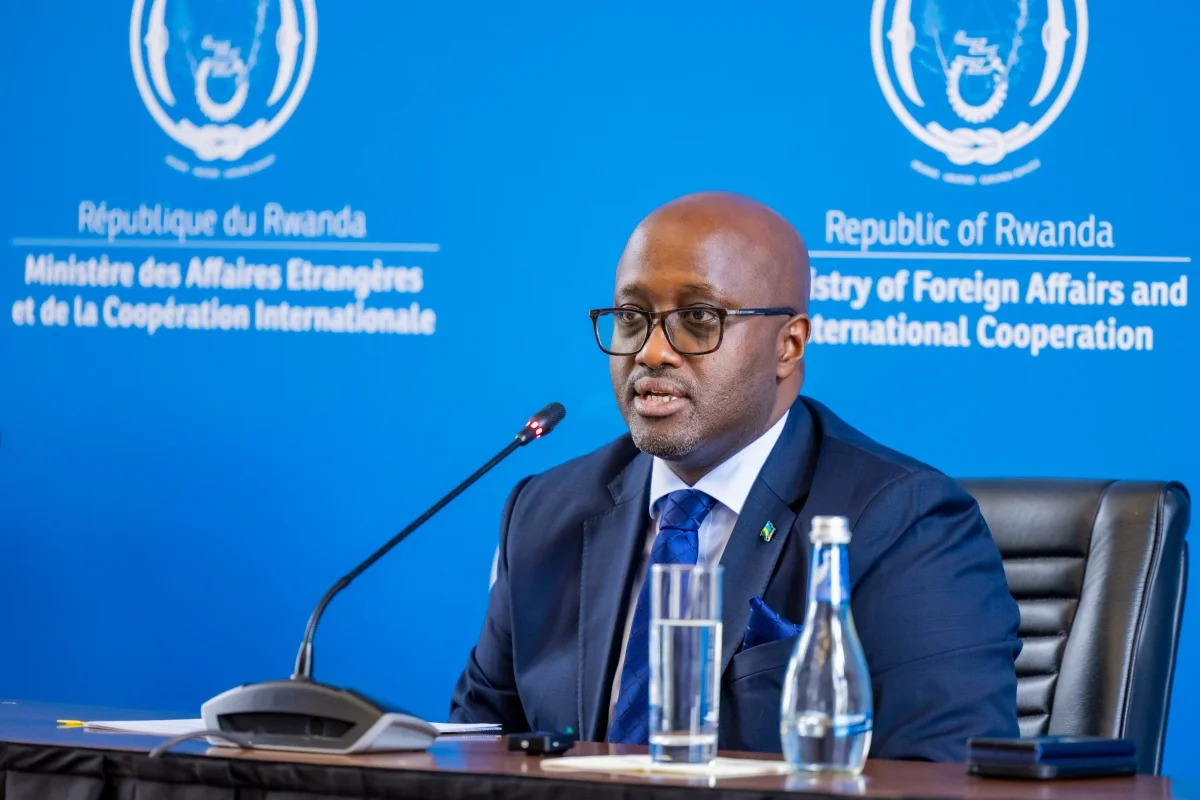
🔹Addressing members of the diplomatic corps accredited to Rwanda on Friday, May 29, the Minister of Foreign Affairs and International Cooperation, Amb. Olivier Nduhungirehe, reviewed key diplomatic developments and regional security issues, including the situation in eastern DR Congo and Rwanda’s security cooperation with Mozambique.
🔹On the conflict in eastern DR Congo, Nduhungirehe said Rwanda remains committed to the peace process but stressed that progress will depend on whether all parties fully meet their obligations.
🔹“Rwanda calls on the international community and all partners to engage DR Congo in a constructive manner that produces tangible results in implementing its end of the bargain,” he said.
🔹“Failing to do so would amount to supporting DR Congo’s never-ending military approach. Without even-handed pressure and follow-up, we cannot create the conditions and incentives necessary for lasting peace in the Great Lakes region.”
🔗Read more: https://t.co/rNTwX3L0iR
🔴Update: Incoming information that #Mutayomba was evacuated to Kinshasa, being severely wounded and is in intensive care at this moment.
https://t.co/te7cJ9LYLR
Inside Operation Amaryllis: As Tutsi were hunted, killed France evacuated the presidential clan
🔴During the 1994 genocide against the Tutsi, the identity of the enemy who was to be hunted in every corner of Rwanda had already been made clear. It was the Tutsi. As roadblocks multiplied and killings spread, French authorities launched an operation whose priority was not the rescue of those marked for extermination.
🔴The mission was called Operation Amaryllis. Officially, it was a unilateral French military operation to evacuate French citizens and other foreign nationals from a collapsing security situation. It began in the early hours of April 9, 1994.
🔴The first evacuations did more than remove expatriates from danger. They also carried out of Rwanda members of President Juvénal Habyarimana’s family, relatives of the powerful Akazu network, and figures later accused or convicted for their roles in the political, financial, and propaganda machinery of the genocide.
🔴The question is not only why Agathe Kanziga Habyarimana, the former first lady and central figure in the Akazu circle, was evacuated by French forces. The deeper question is who else France helped remove from Rwanda while Tutsi civilians, moderate politicians, and many Rwandan employees of foreign missions were left exposed to the killers.
🔴Kanziga was flown out of Kigali with her eight children and close relatives. Her evacuation formed part of a wider extraction of people linked to the former presidential clan, including individuals whose names would later appear in investigations, court records, and accounts of the networks that sustained the genocide.
🔴One of the most notorious figures associated with the evacuation was Ferdinand Nahimana, co-founder and director of RTLM, the hate radio that preached genocide ideology. RTLM was not merely a radio station but one of the genocide’s most powerful weapons of mobilization, helping identify, demonize, and incite violence against the Tutsi.
🔗Read more: https://t.co/HLPcuTGW6B
Here’s is my full quote on Rwanda’s nuclear energy agenda, it was unfortunately chopped up to fit the writer’s storyline:
“Rwanda is working with a variety of global partners to develop our civil nuclear capabilities. In addition to Russian company Rosatom, a world leader in construction of nuclear power plants, last week at the Nuclear Energy Innovation Summit in Kigali, Rwanda signed an MoUs with the US Government, to advance civil nuclear cooperation between the two countries, as well as other agreements between Rwanda’s Atomic Energy Board and companies from the United States, South Africa and Austria.
In Rwanda, feasibility studies for both the construction of a facility using SMR technology and establishing the Centre for Nuclear Science and Technology are ongoing. Historically, these kinds of projects have been financed by governments, but more recently multilateral development banks have started discussions around financing frameworks to expand access for emerging economies embarking on nuclear energy development.”
Here’s why Tshisekedi funds militia commanders as clashes escalate
🔹Fresh concerns are mounting over Kinshasa’s growing reliance on Wazalendo - “patriots” in Swahili – militias, following reports that Brig. Gen. Fabien Dunia Kashindi, the commander of the FARDC’s 33rd Military Region, recently met Wazalendo commanders operating in Uvira Territory and handed them USD 70,000.
🔹Made up of – among others – local self-defense militias formed in villages and communities, and former fighters from earlier armed groups who switched sides, the Wazalendo are not formally part of the regular army, FARDC, but many operate in coordination with it. They are not a single organized army, but a loose umbrella label used in eastern DRC for pro-government local militias that Kinshasa mobilized to fight the M23 rebellion which resurged in late 2021 and has since expanded its territorial control. The rebels are fighting to protect Congolese Tutsi communities and other minorities and defend against hostile militias operating in the region such as the Rwandan genocidaires known as FDLR.
🔹The cash delivery comes amid worsening insecurity in eastern DRC and follows the recent visit of Deputy Prime Minister and Defense Minister Guy Kabombo Muadiamvita to Uvira on May 24.
🔹Officially, Kabombo’s mission was to assess the security situation and review FARDC operations in South Kivu. Local reports indicate that he visited the headquarters of the Uvira operational sector and attended a briefing with officials from the 33rd Military Region.
🔹Sources say the funds given to Wazalendo commanders originated from Kabombo’s visit and were intended to boost morale among militia commanders as fighting intensifies. The episode has revived a deeper and more urgent question: why does President Félix Tshisekedi continue to place Wazalendo militias at the center of the security crisis in eastern DRC?
🔹Kinshasa portrays the Wazalendo as “patriotic” local defenders fighting to protect their communities and land. However, critics argue that this marker masks a dangerous proxy strategy. By relying on irregular armed groups rather than exclusively on formal FARDC units, the Congolese state can benefit militarily from militia operations while attempting to distance itself from abuses committed on the ground.
🔗Read more: https://t.co/m4ppd20iOi
Burundi’s unanswered question: Who wanted Nkurunziza dead?
🔴The official account of former Burundian president Pierre Nkurunziza’s death was swift, tightly controlled, and politically convenient. On June 8, 2020, Burundi’s outgoing president died suddenly after 15 years in power. Authorities said he had suffered a heart attack after a brief illness. But almost immediately, speculation spread that COVID-19 had killed him, especially after reports that his wife had been flown to Nairobi for treatment linked to coronavirus symptoms.
🔴Five years later, a darker question continues to circulate within Burundi’s political underground: was Nkurunziza merely a victim of illness, or was his death part of an internal operation to remove a man who still intended to rule from behind the throne?
🔴Burundian sources close to the CNDD-FDD ruling party and the Nkurunziza family say he did not die of COVID-19, that his tests were negative, and that he was poisoned.
🔴🔴President Évariste Ndayishimiye, Nkurunziza’s successor, has been linked to the network alleged to have eliminated him. Several developments since 2020 make it politically difficult to dismiss the matter as mere gossip. At the time of his death, Nkurunziza was not simply retiring. He was expected to become Burundi’s “Supreme Guide of Patriotism,” a status that would have allowed him to retain influence over the ruling party and the security apparatus even after leaving office.
🔴Nkurunziza had been forced to step aside by opponents within the CNDD-FDD. But he was still due to assume a powerful honorary role with extensive benefits and undefined influence.
🔗Read more: https://t.co/zvjzVWwKm7
The White House has confirmed that the U.S. is setting up a health facility in Kenya to receive Americans who are exposed to the Ebola virus while in regions affected by the ongoing outbreak. https://t.co/x13zurcDmq