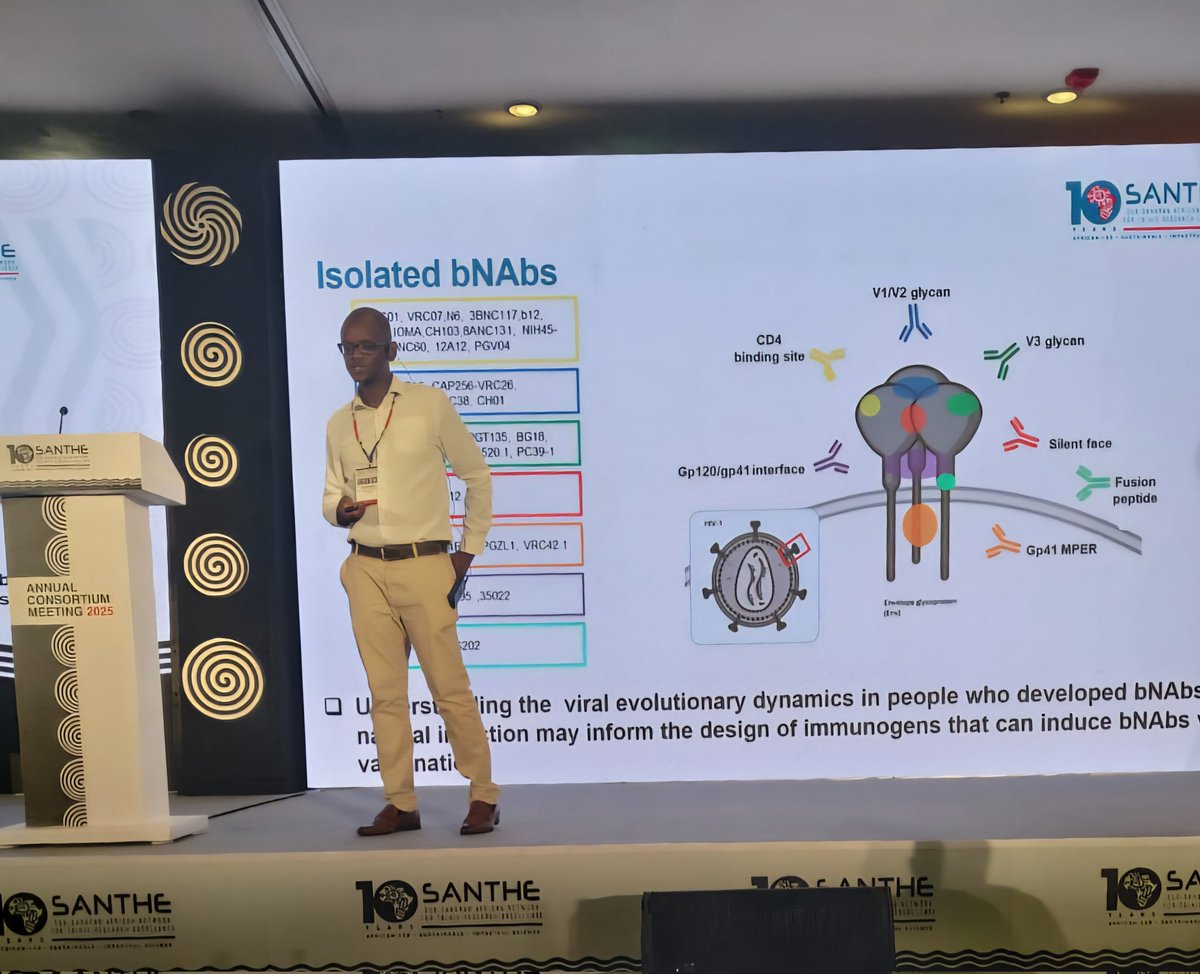
Proud to be part of the SANTHE family as we celebrate 10 years of impactful, African-led science. Grateful for the PhD scholarship and the support that has shaped my journey. Here’s to continued growth, collaboration and innovation.
A Decade of Impact – Celebrating 10 Years of Outstanding Science in Africa
It’s been a decade of delivering African-led, sustainable, impactful science. Thanks to every scientist, partner & supporter who’s been part of our story.
Here’s to the next chapter of innovation/impact.
Zimbabwe's global HIV success story.
In Zimbabwe, at least 95% of people who are living with HIV know their HIV status while 95% of people living with HIV are on medication and 95% of those on medication achieved viral load suppression- meaning they cannot transmit HIV to the next person. A milestone!
Zimbabwe is among 5 countries, in the world, which had already (in 2023) achieved the above targets known as 95–95–95 meant to be reached by 2025 in order to end AIDS by 2030.
With such stories of success, what's your reason of defaulting medication, what's your excuse of hesitating to be on medication, hesitating to be tested. Isn't it awesome to be part of the Zimbabwe's success story.
Honoured to present my work on HIV viral evolution & broadly neutralizing antibodies at the #SANTHEACM2025 in Kigali 🇷🇼. Grateful for the engaging discussions & the vibrant community of African scientists driving innovation in HIV research. #bNAbs#HIVScience#SANTHE
Logistic Regression is for binary outcomes, like Yes or No, 1 or 0, Black or White.
Imagine you're trying to predict if it will rain or not.
You have data about the past, like the temperature, humidity, and whether it rained or not.
You want to use this data to predict if it will rain tomorrow.
Logistic Regression is a statistical tool that helps you with this prediction.
It's used for binary outcomes, like yes or no, 0 or 1, or in our case, raining or not raining.
Here's how it works:
Sigmoid Function:
Logistic Regression uses a special function called the sigmoid function. Think of it as a way to squash any number between 0 and 1.
It's like making a probability. If the sigmoid function gives you 0.7, it means there's a 70% chance it will rain.
Data and Weights:
You have your data (temperature, humidity) and some initial guesses called weights.
These weights are like how important each factor is for the prediction. You start with random weights.
Combine and Squeeze:
Logistic Regression takes your data, multiplies it by the weights, and adds everything up.
Then, it pushes this through the sigmoid function. This gives you a probability, like our 0.7 for rain.
Training:
At first, your predictions will be far from reality. But you have the actual results (did it rain or not) from your past data.
You compare your prediction with reality and see how wrong you are. Then, you adjust your weights to be less wrong next time.
You do this again and again until your predictions are quite accurate.
In a nutshell, Logistic Regression helps you make predictions when you have data that falls into one of two categories.
It turns your data into a probability, and with a bit of training, it can make pretty good predictions.
---
That’s all for now!
- Smash the LIKE button and REPOST
- BOOKMARK because you’ll definitely want to revisit this again
- Follow me for more posts like this
I used to feel very guilty for not working & learning in my free time.
It took me 3 burnouts to learn how to deal with this.
Here’s what I do nowadays: