When designers can build working code, what changes about the job?
@TaronGh and @LandJohan get into AI prototyping with real customer data, design systems for agents, and why an eye for good design still matters.
Watch the latest Object Stats episode below.
Everyone says "hire people with taste."
Break that down and it's two things: the eye, and the technical skill to build what you're picturing. For most designers the second half was always the ceiling.
That ceiling is gone. Our head of product design @TaronGh what's left:
Our design system used to be two things: a Figma library for designers + components in Storybook for engineers, with a lossy translation between them.
It’s now one source of truth that designers, engineers and AI agents all read from. Our head of product design @TaronGh on what changed →
Building AI for the physical world comes with a unique set of engineering challenges.
Hear from our R&D team about the technology they're building, the problems they're solving, and why they choose to build at Samsara.
What's left is being unambiguously good at one thing, and deploying it through whatever interface the customer wants.
John Bicket and @LandJohan on what that means for how you build in the latest Object Stats → https://t.co/W0y2x7Jfst
Same pressure on business models. Stickiness used to come from contract length and the fact that your users had trained themselves on your UI.
Neither of those is defensible when code is cheap.
What happens when code becomes cheap enough that it stops being the moat?
Our CTO John Bicket and CPO @LandJohan explore how AI is reshaping software development, agent workflows, and the future of user interfaces it in the latest episode of Object Stats ⬇️
Hear the stories behind some of our most ambitious projects. Our designers spend real time with operators in the field, then bring what they learn back to the codebase.
Samsara's @brendanodris explains why the AI revolution looks different outside the San Francisco bubble, where it's about helping truck drivers get home safely, not booking concert tickets:
"The vehicle is a means to an end. Whether it’s an agent, whether it’s an assistant, whatever the form, that’s just a means to an end."
"For me, it’s about a driver who’s pulled over on the side of a road and they need to know where they should pull in because they’re approaching their limit."
"Whether that’s a voice agent or not, who cares? They have an issue. They need a solution. ‘I’ve got 10 minutes of driving time left. Where do I pull in that’s safe?’ It’s dark. It’s late."
"This isn’t AI for AI’s sake, like book me a concert ticket. This is really, how do I get home at nighttime? Make sure that I’m wearing my seatbelt, no harsh braking, that I’m not using my phone."
"There’s a certain extra privilege that we get that we’re actually getting more people home at nighttime. And that’s a fun thing to work on."
@Samsara
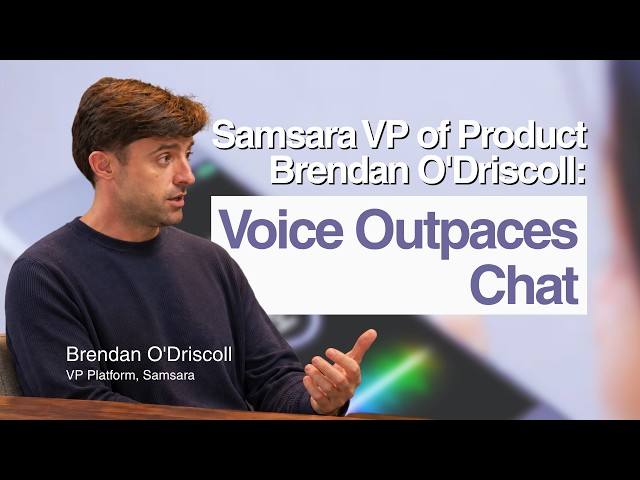
Samsara's @brendanodris reveals why voice AI agents are already massively outpacing chat agents in real-world operations, where workers can't stop to type prompts:
"The big insight is that voice is the new UI for these agentic workflows. Imagine drivers driving trucks, they can’t use their hands. It doesn’t really make sense to sit and wait behind a prompt in a chat interface."
"Since we’ve launched both, we’ve seen the voice agents just massively accelerate and outpace the chat agents."
"We can meet the customer where they are in the way that’s easiest for them. For us, that’s voice."
@Samsara