Prediction: Mathematics will be the first science to fall to AI.
This past weekend, I solved three decades-old Erdős problems using AI. That brings my total to four - all with proofs checked by computer. The models deserve enormous credit. My contribution is building the system around them and guiding their work, much as I did with ARC-AGI.
The reason math will be the first science to fall is simple: computers can check mathematical proofs. AI can try an idea, discover what fails, correct it, and keep going. Each verified result becomes a foundation for the next. This loop is now accelerating, opening a path to discoveries beyond human comprehension.
Physics, chemistry and other sciences have slower feedback loops. Physical experiments take time. This buys those sciences time, but AI is coming for them too. Over time, human-only science may become an art form, pursued for curiosity, beauty and meaning, while AI drives the frontier of discovery.
Question now is whether human relevance also is on the menu?
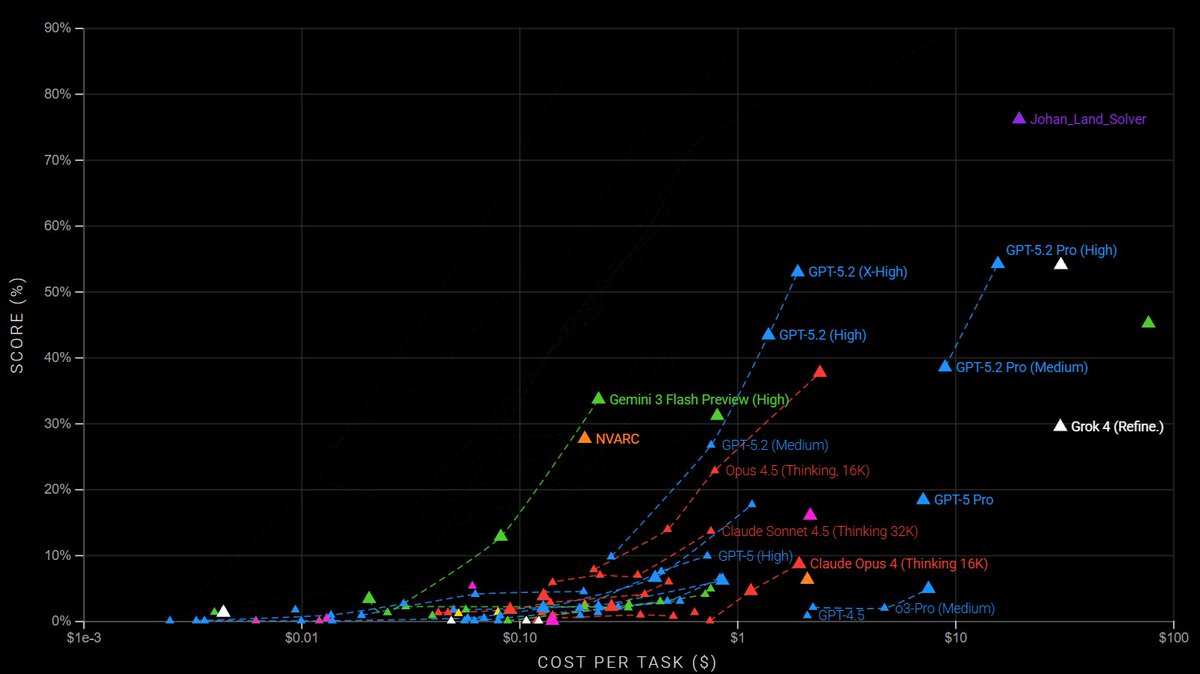
Just scored 76.11% on ARC-AGI 2 — beating public GPT-5.2 and Gemini-3-Pro baselines by >20%, and (as far as I know) the best publicly reported result so far.
Approach: what I’d call Multi-Model Reflective Reasoning
- Using GPT-5.2, Gemini-3, Opus 4.5
- Long-horizon/multi-step reasoning (~6hrs/problem)
- Agentic codegen (>100,000 python calls)
- Visual reasoning
- Council of judges
Fun fact: all solver code was written by Gemini-3-CLI.
Does this count as AI generating a new AI that beats the prior SOTA? 🤔
Full run + code (open source): https://t.co/8HZJV5XjIK
@GregKamradt , holiday break is over 🙂 semi-private when?
#ARCAGI #AIResearch
@thedjpetersen@ItsBrain4Brain@arcprize The code is open source: https://t.co/pqWRg79oqy
Do whatever you want with it :) I don't think I even put in any license in there so it's free for all!
No, but it's all open source. Maybe I should write a paper.
Essentially, it's gathering the reasoning traces for all possible solutions. Then it's exposing those to three different judges with slighly different roles. The judges then express their opinions after which a solution is picked.
@diegocabezas01 It's all public source: https://t.co/pqWRg79oqy
Check the v7 branch, that's the latest. Actually, go back a few commits and you'll find an even higher performing version - I had to dumb it down a bit for the submission.
@DeryaTR_ Next challenge is indeed ARC-AGI-3!
The beautiful thing about ARC-AGI is that they allow "hobbyists" like myself to fairly be benchmarked against the labs.
@joshlee361 Largely I agree. Few other things to it, but the key thing indeed is that different models/prompts/modalities/chaining generate diverse results. But then, you also need to "know when you know" and "know when you don't know" which is the other half of the problem.