🧵- I've argued with claude code & codex at 2am more times than I'd like to admit..
Somewhere between broken builds, energy drinks and two little kids needing to be fed in middle f the nght, I, a non-coder built @curoyou in 3 months
I missed the "build in public" for the first part of it, so here's the three-month-late version and catch up👇
@theo Nice! Couple of feature requests: anyway possible to get multi-window support to open up threads in separate windows?
Also a hotkey to quickly jump between projects?
🙏🏽
@peptideuniverse Will get bigger especially once people are tired of paying $200 a month for BPC... And how do I know that? Less than 5% of our ROU customers ever click to check COA's....
People want cheap products and this will open the door for lots of people to turn to RUO
@RCIllingworth Interesting, we have our mail server set up via Mautic that runs three different domains. From my research I understood that you don't want to use subdomains
Today we're launching the Sunra API.
Every leading image, video, audio and 3D model through one key, each at its maker's own API price. Pay as you go, with no subscription and no markup.
The models are ready. Your app is next.
@ZachShurtleff@strivepharmacy Thank you for the clarification. We are building an online telehealth brand. I'm assuming you tailor to that in addition to brick-and-mortar clinics. Is that correct?
TL;DR: HHS will not take enforcement action against licensed pharmacies, federal facilities, or physicians that compound six peptides, as long as they meet strict conditions. This is a temporary policy that lasts while FDA decides through rulemaking whether to add these peptides to the official 503A bulks list. Compounded drugs are still not FDA-approved.
Which ones "passed"
None has been formally approved or added to the 503A list. These six are covered by the interim policy, and each is limited to certain routes:
Peptide Allowed routes
BPC-157 (acetate) Subcutaneous, intramuscular, oral, topical
TB-500 (acetate) Subcutaneous or intramuscular injection
Epitalon (acetate) Subcutaneous or intramuscular injection, intermittent courses only
MOTS-c (acetate) Subcutaneous or intramuscular injection
Semax (free base) Intranasal only
KPV (acetate) Topical and oral only (no injection)
For all six, FDA's drug review center (CDER) recommended against listing them. The advisory committee (PCAC) voted in favor. HHS sided with the committee, citing three things: new lot-level testing certificates from FDA-registered manufacturers, documented history of use, and its view that the safety concerns are theoretical rather than based on observed harm.
Key conditions
- Supply: The API must come from an FDA-registered manufacturer that follows good manufacturing practice (CGMP). Each lot needs a full certificate of analysis covering identity, purity, endotoxin, microbial and impurity testing.
- One peptide per product: Blends aren't allowed.
- Prescription: Each product needs a valid patient-specific prescription.
- Reporting: Serious adverse events and quality problems must be reported to FDA's MedWatch.
- Label: It must say "This is a compounded drug product. Not for resale."
- Oral forms: The compounder must document that the formulation is adequately absorbed when taken by mouth.
- Devices: Only an FDA 510(k)-cleared syringe may be packaged with the drug.
HHS says it may revisit the policy if a safety or quality problem comes up.
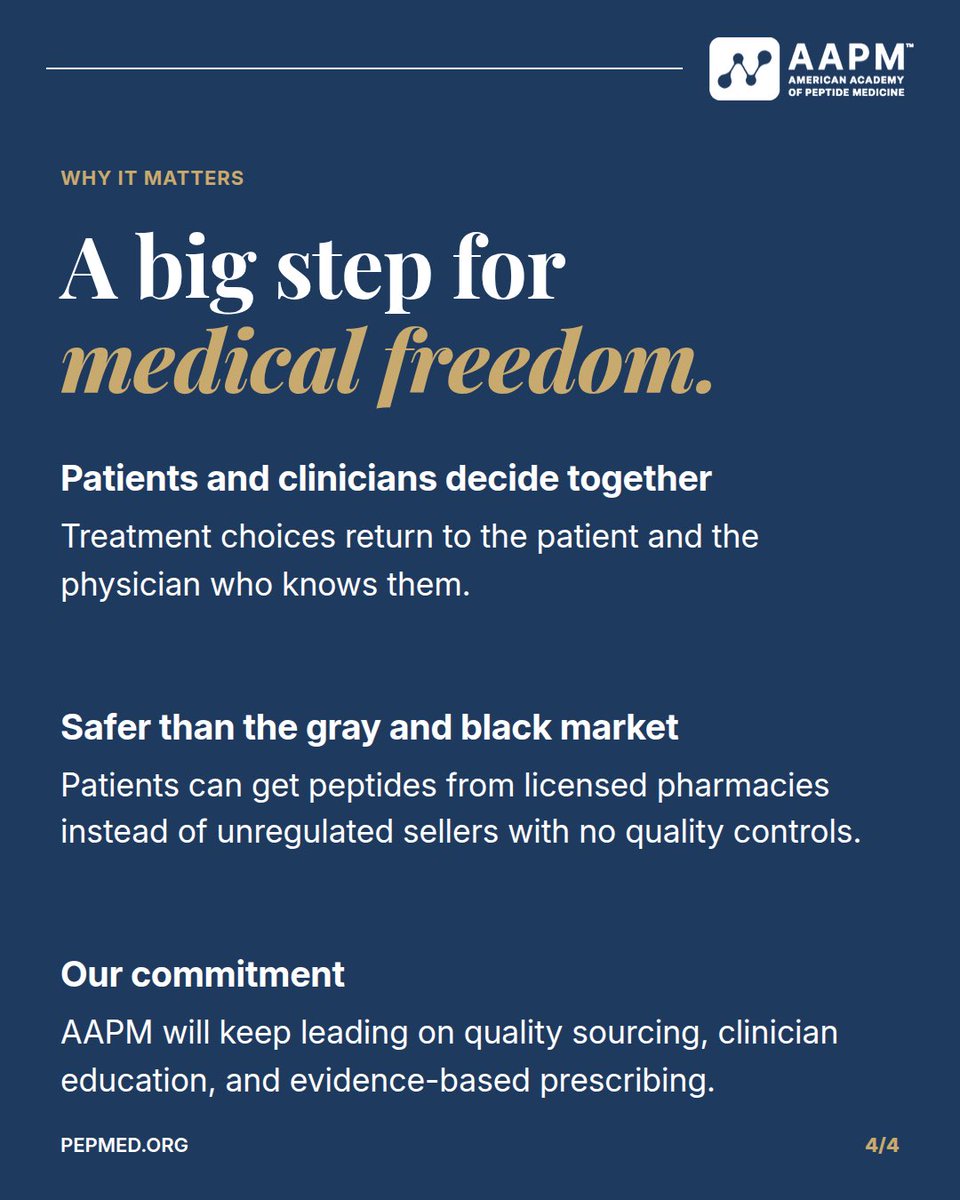
Thank you, @realDonaldTrump , @RobertKennedyJr , and the administration for supporting medical freedom. As peptides move to Category 1, AAPM remains committed to quality sourcing, clinician education, and evidence-based prescribing. #PeptideMedicine#AAPM
@ZachShurtleff@strivepharmacy Zack, to confirm you guys don't offer an entire telehealth platform, including telehealth provider visits, but a fulfillment pharmacy side only?
TL;DR: HHS will not take enforcement action against licensed pharmacies, federal facilities, or physicians that compound six peptides, as long as they meet strict conditions. This is a temporary policy that lasts while FDA decides through rulemaking whether to add these peptides to the official 503A bulks list. Compounded drugs are still not FDA-approved.
Which ones "passed"
None has been formally approved or added to the 503A list. These six are covered by the interim policy, and each is limited to certain routes:
Peptide Allowed routes
BPC-157 (acetate) Subcutaneous, intramuscular, oral, topical
TB-500 (acetate) Subcutaneous or intramuscular injection
Epitalon (acetate) Subcutaneous or intramuscular injection, intermittent courses only
MOTS-c (acetate) Subcutaneous or intramuscular injection
Semax (free base) Intranasal only
KPV (acetate) Topical and oral only (no injection)
For all six, FDA's drug review center (CDER) recommended against listing them. The advisory committee (PCAC) voted in favor. HHS sided with the committee, citing three things: new lot-level testing certificates from FDA-registered manufacturers, documented history of use, and its view that the safety concerns are theoretical rather than based on observed harm.
Key conditions
- Supply: The API must come from an FDA-registered manufacturer that follows good manufacturing practice (CGMP). Each lot needs a full certificate of analysis covering identity, purity, endotoxin, microbial and impurity testing.
- One peptide per product: Blends aren't allowed.
- Prescription: Each product needs a valid patient-specific prescription.
- Reporting: Serious adverse events and quality problems must be reported to FDA's MedWatch.
- Label: It must say "This is a compounded drug product. Not for resale."
- Oral forms: The compounder must document that the formulation is adequately absorbed when taken by mouth.
- Devices: Only an FDA 510(k)-cleared syringe may be packaged with the drug.
HHS says it may revisit the policy if a safety or quality problem comes up.
yes, and it starts here:
TL;DR: HHS will not take enforcement action against licensed pharmacies, federal facilities, or physicians that compound six peptides, as long as they meet strict conditions. This is a temporary policy that lasts while FDA decides through rulemaking whether to add these peptides to the official 503A bulks list. Compounded drugs are still not FDA-approved.
Which ones "passed"
None has been formally approved or added to the 503A list. These six are covered by the interim policy, and each is limited to certain routes:
Peptide Allowed routes
BPC-157 (acetate) Subcutaneous, intramuscular, oral, topical
TB-500 (acetate) Subcutaneous or intramuscular injection
Epitalon (acetate) Subcutaneous or intramuscular injection, intermittent courses only
MOTS-c (acetate) Subcutaneous or intramuscular injection
Semax (free base) Intranasal only
KPV (acetate) Topical and oral only (no injection)
For all six, FDA's drug review center (CDER) recommended against listing them. The advisory committee (PCAC) voted in favor. HHS sided with the committee, citing three things: new lot-level testing certificates from FDA-registered manufacturers, documented history of use, and its view that the safety concerns are theoretical rather than based on observed harm.
Key conditions
- Supply: The API must come from an FDA-registered manufacturer that follows good manufacturing practice (CGMP). Each lot needs a full certificate of analysis covering identity, purity, endotoxin, microbial and impurity testing.
- One peptide per product: Blends aren't allowed.
- Prescription: Each product needs a valid patient-specific prescription.
- Reporting: Serious adverse events and quality problems must be reported to FDA's MedWatch.
- Label: It must say "This is a compounded drug product. Not for resale."
- Oral forms: The compounder must document that the formulation is adequately absorbed when taken by mouth.
- Devices: Only an FDA 510(k)-cleared syringe may be packaged with the drug.
HHS says it may revisit the policy if a safety or quality problem comes up.