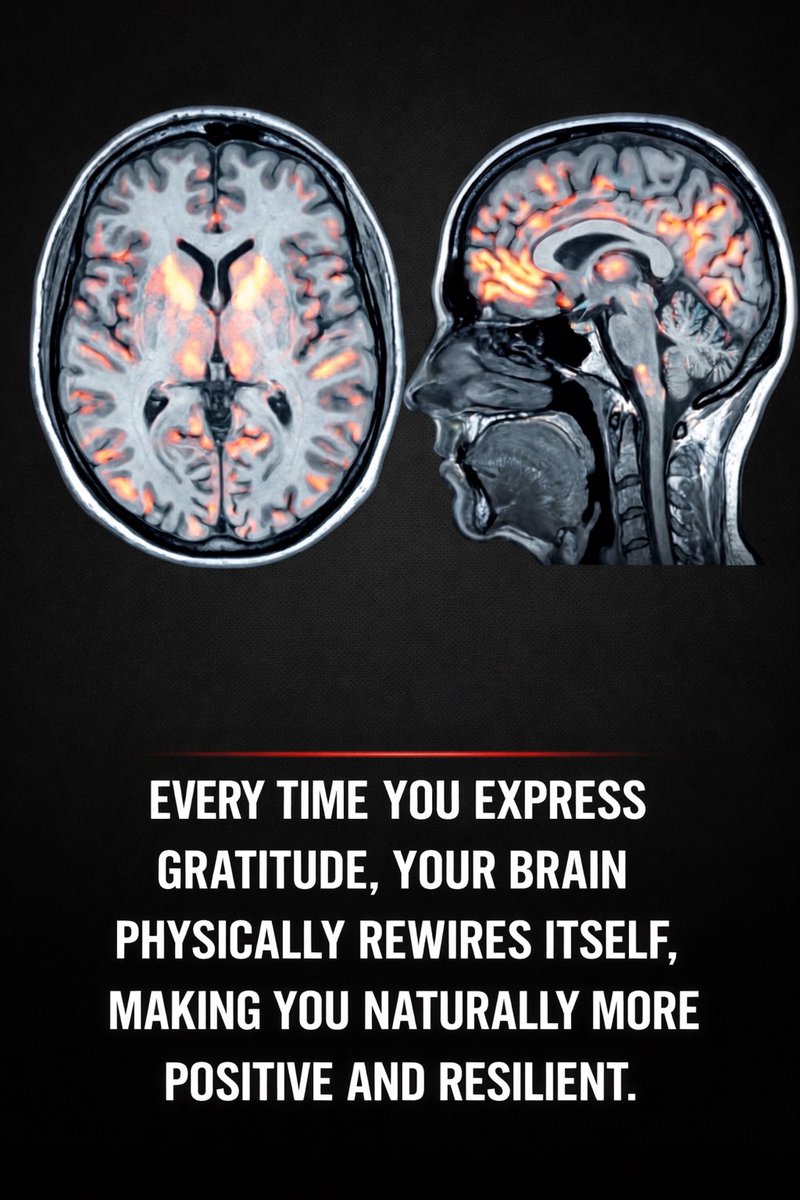
Research shows that regularly practicing gratitude can lead to measurable changes in the brain. This effect is driven by neuroplasticity, the brain’s ability to reorganize itself based on repeated thoughts and behaviors. When people intentionally focus on appreciation, neural pathways involved in emotional control and coping become stronger.
Grateful thinking also stimulates the release of dopamine and serotonin, chemicals linked to pleasure and motivation, while helping reduce cortisol, the hormone associated with stress. Brain regions such as the prefrontal cortex and hypothalamus become more active, supporting improved mood regulation and overall mental health.
Over time, gratitude does more than provide short-term emotional relief. It gradually shifts the brain away from its natural bias toward threat detection and toward noticing positive experiences instead. Simple habits like writing down what you’re thankful for or expressing appreciation aloud reinforce these patterns, making optimistic thinking more automatic.
Studies indicate that this repeated practice builds lasting neural connections, promoting emotional balance, resilience, and well-being. In essence, regularly acknowledging what’s going well can retrain the brain showing that small daily moments of gratitude can produce meaningful, long-term psychological benefits.
Be mindful about what we say. Words are energetically powerful, yet we waste much of its vibration on the wrong kind of speech. Let our words pass through these filters:
- Is it factual?
- Is it for higher good?
- Is it gentle and loving?
- Is it necessary?
I used to think my body was a burden. That it would be more liberating for my brain to just float around and occasionally plug into different bodies to get things done.
Now, I think they are both a burden. The body is too clumsy and fragile. The brain is too loud and limited.
Life is strange. You arrive with nothing, spend your whole life chasing everything, and still leave with nothing. Make sure your soul gains more than your hands.
You have never occupied the exact same space twice.
The sun isn't a stationary campfire—it’s a bullet tearing through the Milky Way at 500,000 miles per hour, dragging our entire world into the unknown.
Why must I compete? Why must I try to be better? Why must I sell myself? Why must I strive to be chosen? What do I get in return besides illusory gains that trap me in material complacency and soul stagnation?
Everything feels hollow. I can't unsee the fact that nothing is real. Nothing is worth being anxious. Nothing is worth being angry. Nothing is worth being sad. I do grief that the people I have met in this life whom I'd love to spend more time with, I might never meet again ever.
Our January 2026 issue is live!
In "The Pursuit of Mastery", we explore what mastery is, how it’s cultivated, and why some people are willing to trade it all for a chance to be the best.
Some highlights: 🧵
⬤ Neuroscientist Rachel Barr @drrachelbarr speaks with author David Epstein about the systems that build star performers.
⬤ Philosopher Massimo Pigliucci examines the ancient idea that we can only truly master one thing in life.
⬤ Neuroscientist Anne-Laure Le Cunff @neuranne dismantles five myths that make us quit before the real progress begins.
Art by María Medem
I found a guy who goes around the US asking 70 to 100-year-olds their:
• Biggest Regrets
• Biggest Lessons
• Advice to their younger self
Oddly enough, most of their answers are the same…
Here are my top 8:
Anyone who never starts over is most likely clinging onto the structures that have lost meaning to them only to hold on to a false sense of security. They may grow in stature but wonder why they feel stuck, unsatisfied.
All they need to do is letting go and letting life unfold.
A friend asked "Is it okay to start over at 30-something?"
Of course it is. At any age in fact. Life is cyclical. At some point we need to start over, face an existential crisis, build a new foundation, and thrive from there.
Because starting over is a sign of growth, not failure. We start over because we have outgrown the old scaffoldings and we need to build newer, stronger ones that are more aligned with where we want to go.