Voter turnout aside for a moment, I will say the premise is not wrong here two reasons:
- Farage having canvassed most of his constituency once over before another by-election would mean he has data on a great deal of who his voters are.
- And importantly had conversations with many before any outside narratives could take place. This evident from the start of the campaign, the narrative being Reform/Clacton against 'the establishment'
The pros being he has gained a great deal of data and locked in voters
The cons that some are picking up in the media, this move has tanked his national ratings and Reforms general confidence is not the behemoth it once was.
This may have saved his bacon for the moment but at cost of future Reform performance.
Instead of last Summer being all about Reform, this Summer has been all about Nigel. His attempt to regain the narrative from the Standards committee may have come at the expense of wider Reform campaigning, pulling resources away from Manchester and other contests.
Locally, he could still face a tougher time if another by election happens, but there is a suitably large file wall to be confident to take refuge in.
What many have overlooked is that Nigel has the opportunity to massively increase his vote share.
A very high margin is difficult to overturn, should another by-election be triggered in the future.
I can't express how much people in the education and arts system should be held in contempt if they believe 'education exacerbates inequality' (no matter where) or that 'tests are useless'
- They are signalling that their education was fine but anything that is establishment is not.
- They have a focus on meaningless critical thinking, and dislike learnt skills and knowledge reproduction. Usual sign of the humanities rot.
- And assessment is the best form of equaliser. We know to balance coursework and tests but anyone favouring just long term coursework disadvantages by and large boys and is probably clever enough to know it.
- Tests can be studied and richer parents have more ability to produce that, but tests can be studied for by any student and family. What is more difficult is coursework, where paid tutoring rips will enable a student to far greater lengths.
In short, not surprising that people like Arday are supported there way through by people that want others like them to build out their vision of academia.
Hilary Cremin, Head of Faculty at Cambridge's School of Education and the woman who told Jason Arday he was the "best in the world" has exactly the views on education you suspected she did. https://t.co/q37Ic0bVGe
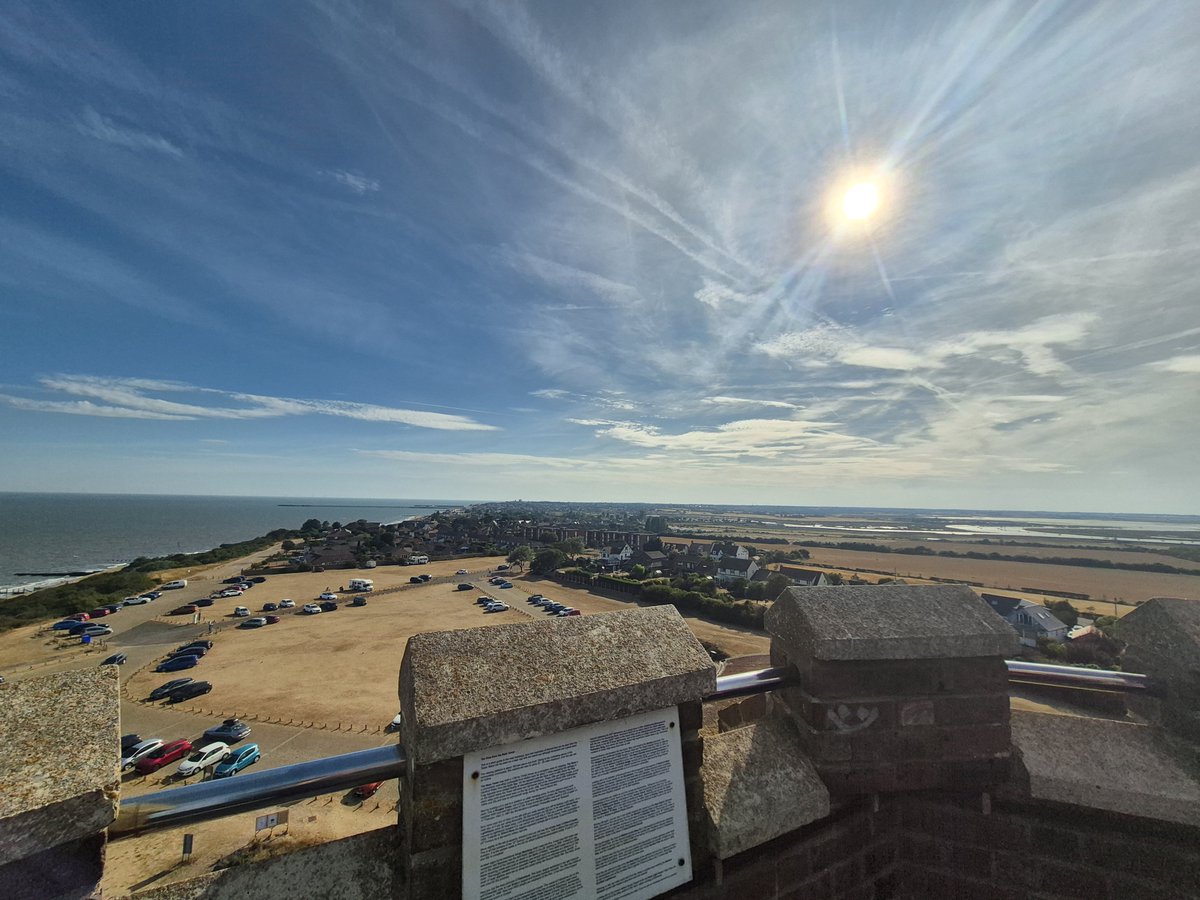
A very respectable choice of place to visit in the Clacton Constituency by @WilliamClouston
The Naze Tower is a Hanoverian navigation tower, turned museum, cafe, and viewing platform.
A lookout against Napoleon as well as being equipped with radar in WW2 alongside the nearby pill boxes.
The musuem features history of the coast and ecology, including dinosaur fragments. A great view with beautiful nearby coastal paths.
Essex heritage on display.
The North Sea is Schrödinger’s oil and gas field. Too small to matter when we talk about energy security, yet big enough to be treated as an existential climate threat!
British labs discover new drugs, yet Ireland reaps most of the profits and we only have ourselves to blame. This needs to change. Read my article in @CapX to find out more 👇
https://t.co/jQYyhznhi8
The UK government seems to leave the taps running on some schemes and not a civil servant or politicians remembers to suggest turning it off for 5 YEARS when labelled late applicants start growing
Neil O'brien doing much needed work as ever
9) Over 160,000 “late applicants” have been granted settled status after the deadline, along with a further 54,000 family members joining them, so 220,000 people. And 124,000 people applying after the deadline got *pre-settled* status, with 202,000 family members joining them.
8) EU Settled Status was supposed to be a one-off. We'd maintain the rights of EU nationals already here & they would do the same for Brits in Europe. Fine. But the Home Office *still* allows late applications five YEARS after the deadline. In fact new grants are going UP again:
Unfortunately, the campaign against the Druze presence in Syria continues. This time, it took the form of a terrorist attack targeting a minibus in Jaramana, a Damascus suburb that is home to the capital region’s largest Druze community.
Caught between the existential trauma of last summer’s massacres and the continued state repression that followed those events, on the one hand, and the ongoing wave of kidnappings, random killings, and other acts of terror targeting Druze civilians, on the other, Syria’s Druze population is likely to decline precipitously in the years ahead.
Over the past year, there has already been a steady stream of Syrian Druze leaving for Lebanon or emigrating to established Druze diaspora communities, particularly in the Gulf states and West Africa. Their rapid disappearance from their ancestral homeland may come to resemble the fate of Iraq’s Christians, who constituted roughly 3% of Iraq’s population on the eve of the Iraq War, similar to the proportion Druze represent in Syria today.
That said, the future of the Druze in Syria, and their fate as a people as a whole, hinges largely on what happens in Suwayda. The outcome there will determine whether the Druze remain primarily rooted in their ancestral homelands in the Levant, as they have been for the past millennium, or whether they become a predominantly diasporic people dispersed across the world.
I'm not against the style. I would perhaps think that we could try a bit better with using less of the land for more density.
Ideally, we shouldn't touch the green spaces if the population wasn't exploding and we could use up some terrible housing to build Haussmannian style housing.
Increasingly given more worry that the UK will quickly head towards something of a generator economy
What do I mean? Everyone privately going out their way to provide their own utilities. In this case, a Westminster school has its own water retention system but we have decent international examples.
Lebanon started failing back in the 2010s and apartment blocks, shops, houses adapted by buying fuel powered generators. Hospitals had already invested heavily in to these as the power system was almost always intermittent.
South Africa also has gained this feature due to frequent brown outs. Caused by an overstretched and poorly managed energy grid thanks to the uncompetitive and crooked government contracting system who favoured paying higher prices for terrible service at tax payer expense so to line African National Congress friend's pockets.
Developing economies have it from the start as an easier way of facilitating energy expansion but what has been interesting is seeing countries go backwards.
It all costs both in the short term and long term - fuel deliveries must be paid for, storage tanks made and maintained, more emissions for goods to be received and used inefficiently. Power plants are far more favourable than everyone running 4 stroke engines non-stop.
For water this isn't as expensive or risky, but the costs being diverted from the common good to just another private expense is one that removes money from growth and investment of what could otherwise be a public asset.
You can already see councils such as Tower Hamlets have shut water off in properties prone to leaking, forcing residents to fill their toilets with bottled water.
In short, the UK keeps giving signs of decline and the warning signals are there. The solution is obvious, either we make building easier across both the state or private sector, or people will not have enough time to wait for new reservoirs before drought hits.
Seriously? Water is scarce. London is in drought but just look at Westminster School's playing fields in Vincent Square. This is not a reasonable use of fast dropping water resources.
1) State fails to perform basic function
2) private sector picks up the slack at no cost to anyone else
3) private sector is seen to be successful, is assumed to be ripping us all off, gets attacked for being competent
Result: competence discouraged
Many such cases.
@agw1437 Syria and Lebanon are both very dear to my medieval and historical heart, but I fear many of the sites I wanted to see are war-torn or just unsafe to see now.
Wars in the Middle East have cost Palmyra and Krak Des Chevaliers severely in Syria, let alone plenty of sites in Iraq. Human life and historic sites have been pulled in to war.
Now maybe even Crusader Era Beaufort Castle may have been damaged in Lebanon:
https://t.co/8m97ds35ts
Reading on Palantir lately given the EU and the UK government are trying to kick it
Two observations:
The UK has nothing replace it except inhouse building which can be productive but if you look at the Civil service, it is requiring many new hires.
EU has alternatives but not as comprehensive as Palantir, such as Poland's DataWalk and ChapsVision.
Overall: Classic case of all in one optimisation vs bespoke product creation. You pay for an easy win with use of public data or pay via staffing and investment for inhouse creation that your economy might not be within typical state structures.
@Starvecrowfeast I'm not going to lie. I love reading Dominic but the amount of time I remember to commit to his bunker busting articles is rare as gold dust for me