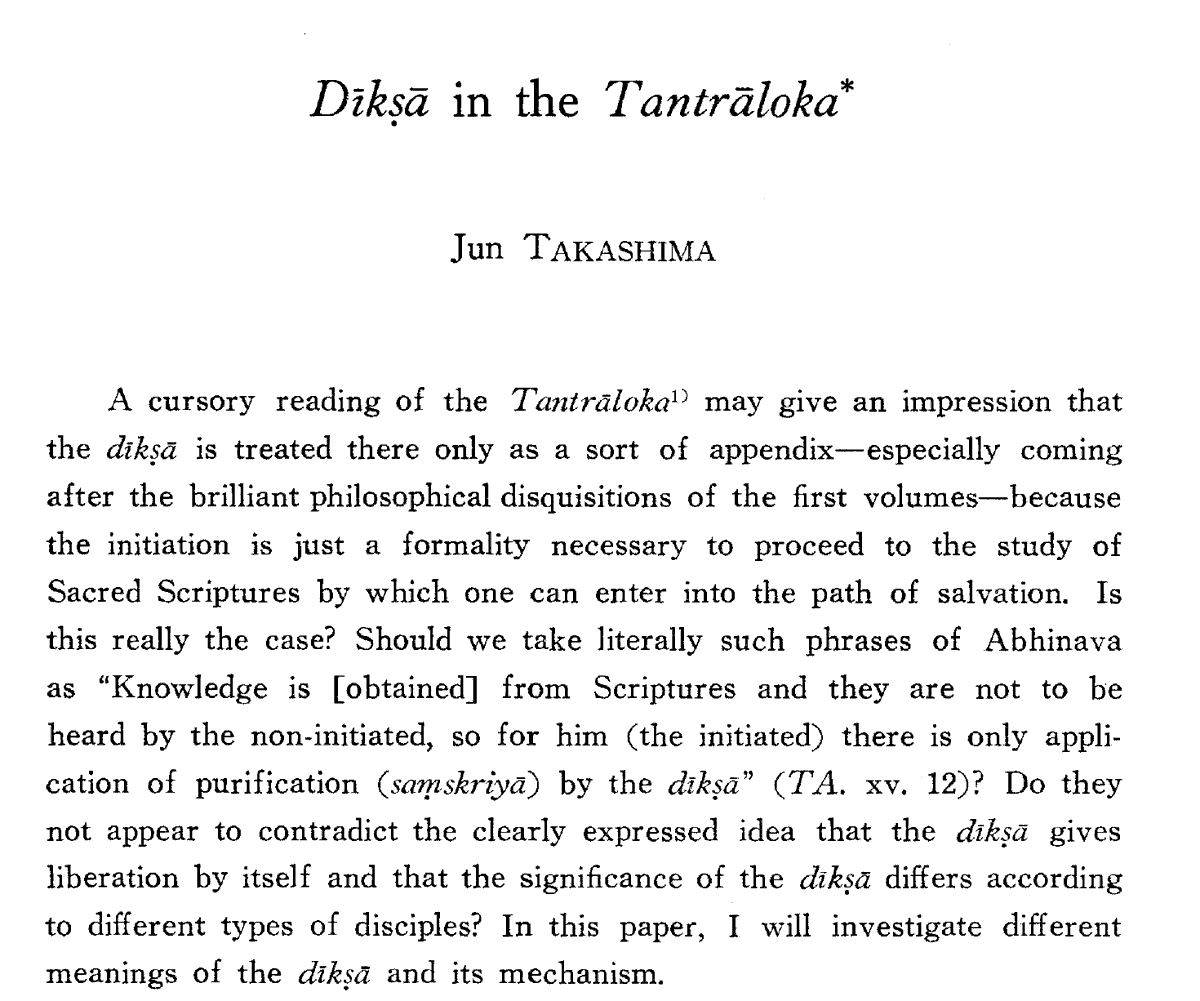
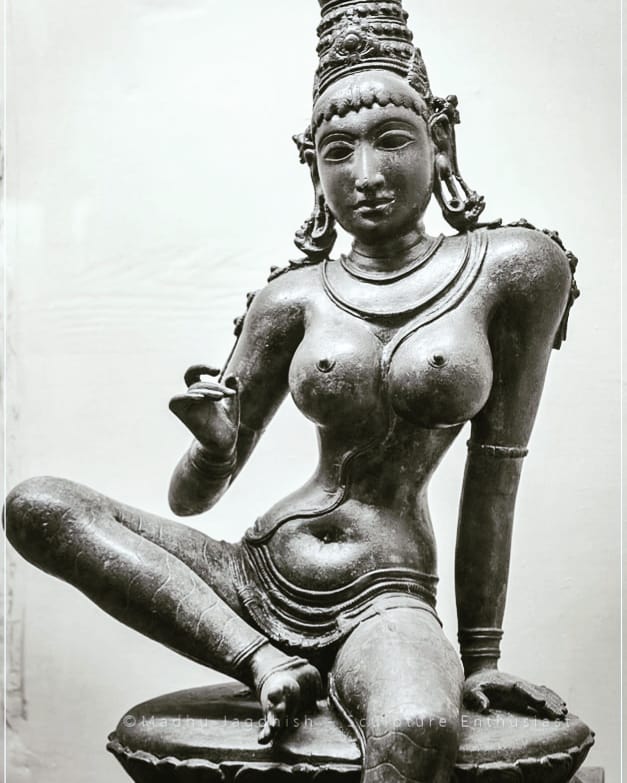
Dīkṣā in its Higher Sense
Śrī Amṛtānandayogin is one of Śrīvidyā's foundational voices, an authority of unparalleled understanding and whose deep words of jñāna are preserved in a number of important works including his Saubhāgyasudhodaya, Dīpikā commentary on Yoginīhṛdaya Tantra, and a short work entitled the Cidvilāsastava which echoes in its 34th verse the deeper Kaula conception of dīkṣā
दीयते परशिवैक्यभावना क्षीयते सकलपापसंचयः ।
येन चिज्जलधिपारसेतुना दीक्षणं गुरुकटाक्षवीक्षणम् ॥
"The rite of initiation, (which is ultimately nothing but the) sudden glance of the Guru, is a bridge over the ocean of Consciousness that bestows (dīyate) meditation on one’s unity with Supreme Śiva and dissolves (kṣīyate) the entire mass of negativities."
@skt_Bharatwasi@thevishnucode you can also read the introduction to the Tantrarāja Tantra and learn quite a lot about Śrīvidyā, and if you understand Sanskrit you can read the entire Tantra also.
https://t.co/UqP1c3h6Xf
@skt_Bharatwasi@thevishnucode you can also read a great work by Śrī Amṛtānandayogin's Gurunātha...Śrī Puṇyānandanātha, entitled Śrī Kāmakalāvilāsa...Both ācāryas are highly esteemed.
https://t.co/18ZLzm5oxC
not sure of your motivation + what the lalita code is. A lot of the time the misinformation must stay as misinformation to give more credit to those who know what is what....hence the entry on wikipedia for srividya is pathetic, but none who know more are really changing it. If you are sincerely interested in Śrīvidyā darśana and learning about the great ācāryas of the tradition beyond Bhāskararāya, I would read one short work called Subhagodayavāsanā of Śrī Śivānandamuni and continue from there. I am unsure if anyone has translated it properly into Hindi, Tamil, English etc. but it can be found online in an etext and a rough translation into english
https://t.co/j7E6G8jDYi
@skt_Bharatwasi we have plenty of Śrīvidyācāryas, not "very less." Actually, Śrīvidyā is a vibrant Kaula darśana with centuries of continual development and deep jñāna through both mūlaśāstra and commentaries by learned ācāryas. I invite you to learn more about them.
One of the outstanding characteristics of the Śrīvidyā tradition is that it features two women in its guru lineage. Despite their names being chanted by those who recite the popular version of the Khaḍgamālāmantra, they are often not remembered as women.
The first is Lopāmudrā, a ṛṣịkā of the Pañcadaśākṣarī Mahāvidyā, as well as the wife of Agastyamuni. The second is Muktakeśinī, an enigmatic yoginī and guru of the "fountainhead" of Śrīvidyā exegesis, Dīpakācārya siddha, author of the first commentary (currently lost) on the Nityāṣoḍaśikārṇava Tantra.
Although some people argue that Muktakeśinī was actually a man, an assertion perhaps based in later sources such as the Śrīvidyārṇava Tantra that lists her by the name Muktakeśvara, there is ample proof that this is not the case.
Śivānandamuni confirms that she was indeed a woman when he states she was Yoginī who graced Dīpakācārya, was a dikṣitā (feminine initiate) and a female adept in mantra sādhana (mantranāyikā). Furthermore, Amṛtānanda confirms her place in the siddhaugha as a female practitioner of yoga, a "yogeśī," named Muktakeśinī.
śrīgurubhyo namaḥ
please use less AI and try to articulate what you are trying to say in a clearer manner, and on another page! At this point, you read like a confused child who is angry about something but isn't sure why. Please don't bring in "original śākta scriptures" unless you are prepared to engage, cite, and share mūla verses with at least 3 of them.
योक्ता संवत्सरात्सिद्धिरिह पुंसां भयात्मनाम् ।
सा सिद्धिस्तत्त्वनिष्ठानां स्त्रीणां द्वादशभिर्दिनैः ॥
"That success (siddhi) which comes about for men after an entire year (of practice) can be achieved by women in just twelve days."
Jayaratha cites this verse in his Viveka commentary on Abhinavagupta's masterpiece, Tantrāloka, thereby echoing a somewhat common theme in Kaula tantra that women can achieve success in spiritual endeavors far quicker than men. Early Trika sources, such as the Siddhayogeśvarīmata, even go as far as to suggest that the पिण्डनाथ mantra was historically transmitted by women, although sometimes can work for men too:
पुरुषेणाधिकारोऽस्ति अस्मिन् स्त्रीविधिकर्मणि ।
स्त्रीयायाः सिद्धिदो ह्येषः कदाचित् पुरुषस्य च ॥
वक्त्राद्वक्त्रगतं स्त्रीणां न च लेख्यति पुस्तके ।
"A man can (also) have the right to perform this ritual act concerning women. For it (mainly) bestows success onto women, and sometimes also onto men. It has traditionally been transmitted from mouth to mouth by women and not written down in books."
The role of women in tantric practice continues to be the subject of heated debates amongst practitioners, ācāryas, and even political actors with no connection to the Dharma. Topics of debate range from a woman's naturally elevated status and power, to their instrumentalization and even dehumanization by men seeking siddhi, and to their role as embodiments of supernatural beings in ritual.
Several Kaula (and related tantric) lineages, not only offered initiation to women, but also to take part in rituals, practice themselves, and, of course, achieve liberation in their life—a shocking declaration that some contemporary practitioners (usually male) still find problematic!
@SreekumarThejas Several. Swami Lakshmanjoo elaborates on it in many places, although the best way to find out isn't through the texts here, but rather to ask a woman 1) if she believes this and 2) why she feels it is true.
yes, the amount of gurus posing as adepts, selling products they are not qualified to teach, and really just creating disturbances is staggering. Social media gives such jokers a loud microphone to attract people. The louder the message and the more "likes" and followers such people have is the "proof" of their qualification, but in truth it is far, far from it. If it is any consolation Abhinavagupta and many others complained about this very thing even 1,000 years ago!
In my estimation, one of the best things practitioners can do is increase the clarity of their inner vision based on sādhana and become knowledgeable so they can recognize the signs and energy of those who do not have good intentions in mind. Sometimes such frauds and ill-intentioned gurus come from authentic lineages, so bonafide saṃpradāya is no longer a strong indicator of a safe, or authentic teacher in 2026. The ability to discern the difference develops with time and association with pure hearted devotees, senior upāsakas, and sometimes heart break. Those with incredible merit can find authentic, adept, and outstanding gurus with little or no effort, that is true.
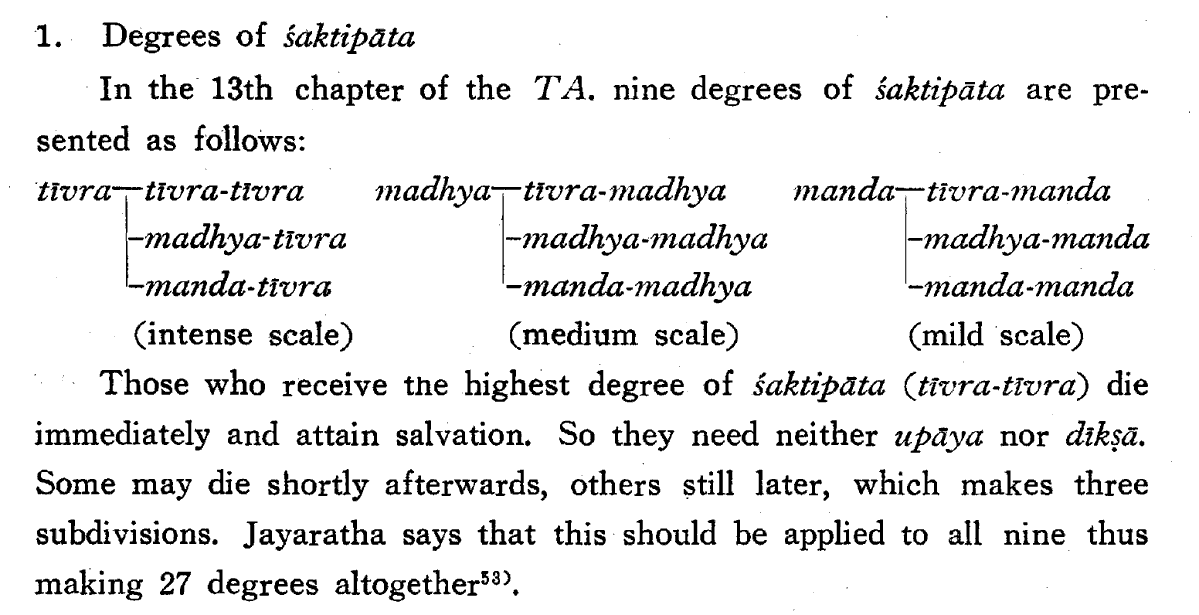
the highest form according to Abhinavagupta in his TĀ is called tīvra-tīvra śaktipāta. He teaches there are three forms of śaktipāta (intense, middle, low) each of which contain the same three levels.
Sadyonirvana is a form of dīkṣā, related, but different, and is spoken about in the context of dīkṣā in general, as well as a special initiation where one can give themselves a liberating dīkṣā towards the end of their life.
@Samudravarman@useoneonly some people, including many scholars, saved it from the days it was available online and they still have it, so it travels that way mostly, through personal connections, although every once in awhile someone will post it online for others to download.
@Samudravarman@useoneonly It is not theirs to upload, although it was online for some years before a break in trust with the scholar, Dr..Mark Dyczkowski, who typed it based on 4 Manuscripts.
Foundational Śrīvidyā teachings on the deeper contemplation of the mantras recited during āvāhana, the invocation of the goddess Tripurasundarī into the vigraha that is worshiped externally in pūjā, with the words कारणानन्दविग्रहे
द्रव्यपानेन तेन य आनन्दः स एव विग्रह आकारो यस्यास्ताम् । कोऽर्थः शोधितामृतीभूतद्रव्यपानपरिस्फुरत्परमानन्दमात्रशरीरामित्यर्थः । भवतीम् अनाश्रितां [मम देवीं विमर्शात्मिकाम् । इच्छाकामफलप्रदाम् इच्छया यत् काम्यते फल तस्य सर्वस्य दात्रीम् ।
"Her body (form) arises from the bliss of consuming the purified amṛtadravya. What does this mean? It means that the goddess' body is solely composed of the supreme bliss that flashes forth from the consumption of the purified dravya and thus becomes amṛta. Unsupported by any (externalities), Her very being is the essence of knowing (vimarśa). She bestows all the fruits of worship and gives everything that is desired."