Gmum
Created this little piece of art for @get_optimum
A stone bridge inspired by Optimum’s vision of building stronger connections across Ethereum.
Sometimes, the biggest ideas start with a simple bridge. Here’s to making Ethereum more connected, one step at a time.
Gmum
The Economics of Faster Block Propagation ⚡
Ethereum's performance depends on more than transaction execution. How quickly block data reaches validators across the network also plays an important role.
A recent research spotlight by @DefiLlama explores how @get_optimum is improving Ethereum's block propagation through mump2p, and why these improvements could have an economic impact.
Here are some interesting findings from the research.
1. Faster block delivery with mump2p
Optimum's mump2p uses Random Linear Network Coding (RLNC) to make data propagation more efficient.
Rather than simply forwarding individual packets, nodes exchange coded combinations of data. Receivers can then reconstruct the original data after collecting enough independent packets.
According to the research, mump2p accelerated block delivery in 91.6% of observed slots between November 4–11.
The measured propagation spread was:
• mump2p: 181.8ms
• libp2p: 388.8ms
That's a substantial difference in how quickly block data propagates across the network.
2. Improving validator performance
Block arrival time matters for Ethereum validators.
When a validator receives block information late, it may vote for an outdated chain head, resulting in a wrong head vote.
Optimum's Impact Report recorded an average 34.3% reduction in wrong head votes across participating operators between its two measurement periods.
This highlights how better network propagation can help validators make more timely decisions.
3. The economic impact on block proposers
One of the most interesting parts of the research focuses on MEV-Boost.
Block proposers face a trade-off: publish a block early to give it enough time to propagate, or wait longer to potentially receive better builder bids.
Faster propagation can give proposers more flexibility.
In six mainnet experiments, blocks could be published approximately 160ms later without an increase in orphaned blocks.
Based on these experiments, Optimum modelled a potential 8.4% uplift in builder bids.
This is a modelled opportunity, not a guaranteed increase in proposer revenue.
4. Growing network participation
The research also highlights the growth of stake connected to Optimum's network.
Connected stake increased from approximately 1.42 million ETH at launch to 3.44 million ETH by November 10, representing around 7.9% of Ethereum's staked ETH.
Operators including https://t.co/oWPLuAEOe8, Blockdaemon, Everstake and https://t.co/5csbL0n05V are among those participating.
The bigger picture
What makes this research interesting is the connection between networking infrastructure and Ethereum's economics.
Better block propagation isn't just about making data travel faster. It can influence validator performance, give block proposers more flexibility and potentially create better economic opportunities.
These improvements happen beneath the surface of Ethereum, but their impact can extend across the entire ecosystem.
It's worth taking a closer look at what Optimum is building.
Full research by DeFiLlama:
https://t.co/pFJQ2AS4pc
@get_optimum@discordflash@CryptoSundayz@tgogayi@aqccapital@TheBl0ckBoy@ada_pegasus
gm CT ☀️
Weekend mode: ON.
A little less scrolling, a little more living.
A little less stress, a little more fun.
Hope your Sunday is filled with good energy, good people, and something worth smiling about.
What’s the weekend vibe today, CT? 👀
Good morning everyone ☀️
gm CT
Good morning 🌿☀️
Fresh air, peaceful thoughts, and a beautiful new day.
Take it slow and enjoy the little things. Have a lovely day everyone!
#GoodMorning
We talk a lot about collecting robotics data. But there's another question worth asking:
Who checks whether that data is actually good enough to train a robot?
A robot demonstration might look perfectly fine at first glance. But does it follow the task correctly? Is the movement smooth? Was the task completed as intended?
These details matter because poor demonstrations can affect what a model learns.
This is where data validation becomes important.
PrismaX is bringing this process into its ecosystem through Verify Quality.
Here's what makes it interesting:
🔹 Score Robot Training Data – Members can evaluate robotics episodes against quality standards.
🔹 Build a Track Record – Each validation contributes to a record of your work and performance.
🔹 Become a Data Quality Validator – Contributors can compete for recognition as founding validators on PrismaX.
🔹 Community Participation – It creates another way for people to contribute beyond collecting demonstrations or operating robots.
What I find interesting is the bigger idea behind this.
Robotics needs people who can collect data, but it also needs people who can evaluate that data carefully.
Collecting the experience is one part of the process. Making sure it's worth learning from is another.
That's the role Verify Quality aims to bring into the PrismaX ecosystem.
@PrismaXai
#PrismaX #Robotics #PhysicalAI
Gprisma
Before a robot can perform a task on its own, someone has to show it how that task is done.
Think about making a cup of coffee.
A person reaches for the cup, picks it up, pours the coffee and places it back. These ordinary movements contain valuable information about how humans interact with the physical world.
For robotics, capturing this experience is an important part of building better training datasets.
But here's the interesting part: you don't always need a robot to contribute to robot learning.
PrismaX is approaching this through two data collection pathways:
🔹 Egocentric Data
People record everyday, hands-on activities using a headset or camera. These first-person recordings help capture how humans perform physical tasks. No robot required.
🔹 Teleoperation Data
Operators remotely control real robotic hardware and perform specific tasks. Each valid session creates a demonstration that can be used for robot learning.
This is where VLA Foundry comes in.
It connects people who can capture real-world demonstrations with the growing demand for robotics training data.
The bigger picture is interesting:
Human actions → Captured demonstrations → Robotics data → Better opportunities for robot learning.
The future of robotics won't be built by machines alone. Human experience has a role to play in teaching them.
@PrismaXai
#PrismaX #VLAFoundry #PhysicalAI #Robotics
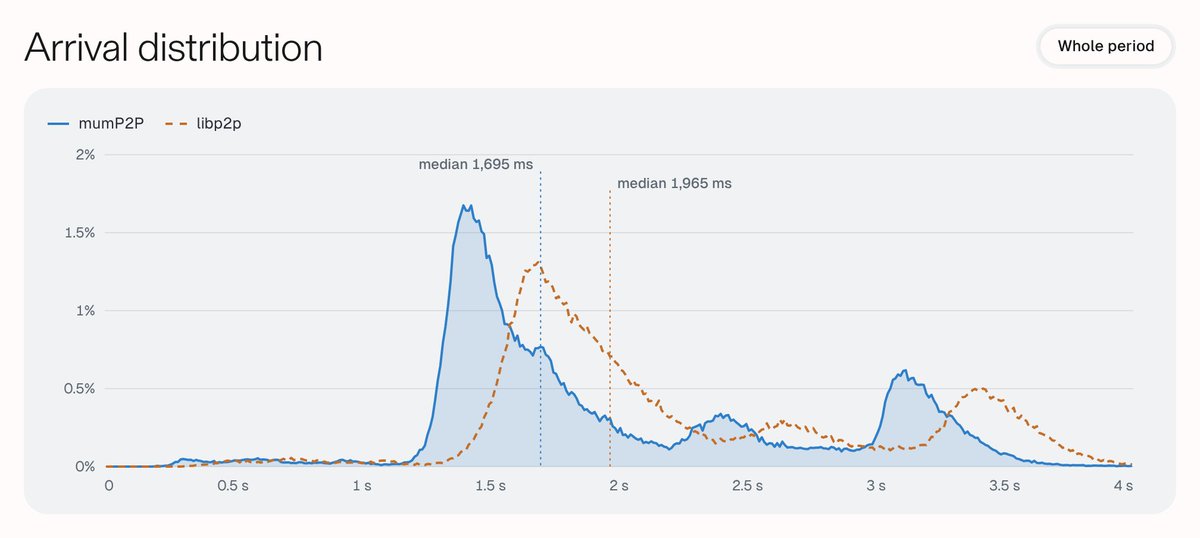
This is what high performance Ethereum block propagation looks like:
- Reliable >200ms latency advantage
- 93% of blocks arrive faster (up from 88% on launch day)
- More favorable arrival distribution
mump2p.
GprismaX
A dataset can contain thousands of robot demonstrations and still fail to teach a robot the skill it needs.
The reason isn't always the model. Sometimes, it's the data itself.
Imagine training a robot to pick up and place an object. Some demonstrations show smooth movements and successful placement. Others contain hesitation, inconsistent grips, unnecessary corrections or failed attempts.
If these differences aren't understood and handled properly, the dataset may not provide the learning signal the model needs.
For robotics, collecting more data is only part of the job. Making that data useful is equally important.
A good robotics dataset needs attention to:
🔹 Trajectory Quality – Smooth, consistent robot movements that demonstrate the intended task.
🔹 Task Diversity – Different objects, scenes and conditions to expose models to meaningful variations.
🔹 Operator Consistency – Demonstrations performed with clear task objectives and repeatable procedures.
🔹 Quality Validation – Reviewing episodes against defined standards before they become part of a dataset.
This is where PrismaX puts its focus.
Through its Robotics Data platform and VLA Foundry, PrismaX brings together:
Structured Data Collection – Tasks, hardware setups and scenarios designed around training requirements.
Teleoperation �� Skilled operators capturing demonstrations on real robotic hardware.
Egocentric Capture – First-person recordings of hands-on human activities.
Quality Review – Episodes assessed against defined standards, with unsuitable data filtered out.
The goal isn't simply to build a bigger dataset.
It's to build a dataset that gives physical AI models something meaningful to learn from.
Because in robotics, data quality isn't a finishing step. It's part of the foundation.
@PrismaXai
#PrismaX #Robotics #PhysicalAI
Gmum
good morning
Huge congratulations to everyone who received a role upgrade this week! 🎉❤️
A special shoutout to @Yuvraj_j2 and @rizuu015 Always great to see familiar faces moving forward and getting the recognition they deserve.
And congratulations to all the new Refined members. Your consistency, creativity, and contributions are paying off.
Keep creating, keep learning, and keep pushing the Optimum community forward.
Well deserved, everyone ♾️
@get_optimum@discordflash@CryptoSundayz@TheBl0ckBoy