@ZEE5India I got the pack for FIFA World Cup and started watching highlights- it’s 720 p max on my iPhone- it’s pixalating - completely ruined the experience- football view is from a distance it needs high res, pls at least give 1080 p on the app!! @subhashchandra Sir!
@flyspicejet@AjaySingh_SG Bought spicemax for PNR JI2FGK, money deducted INR 3489, but no booking, no clarity on refund, this is not professional, pls refund my money, or at least reply to my email, this is very bad and very unprofessional,
@DGCAIndia@MoCA_Go
kindly note, tks
Bought spicemax for PNR JI2FGK, money deducted @flyspicejet@AjaySingh_SG but no booking, no clarity on refund, this is not professional, pls refund my money, or at least reply to my email, this is very bad and very unprofessional, @DGCAIndia kindly note, thanks
@DelhiPolice@dtptraffic Five Elements By Sandoz in B1 https://t.co/pb6OwFuDmv Janak Puri is encroaching 2 lines on main road for their valet. They said you can call police, they cannot do anything. Pls take action, in the meantime I am sending some journalists to cover this!
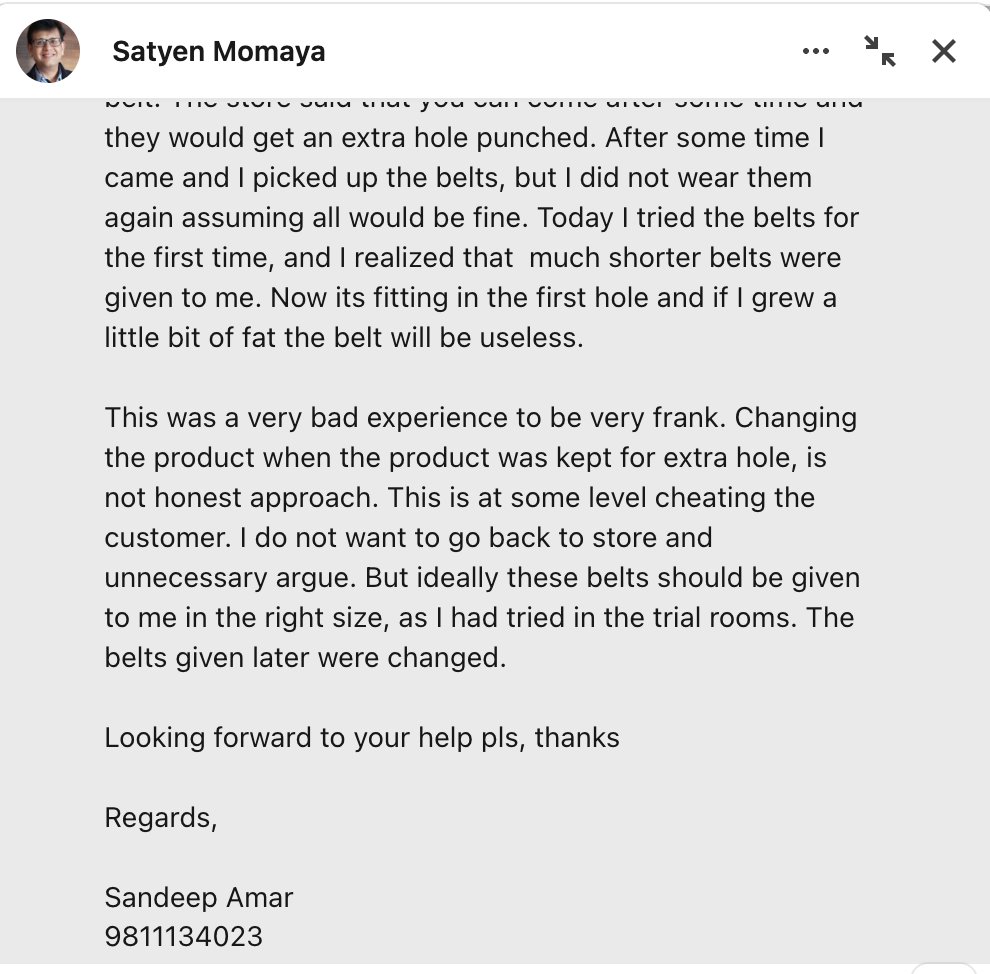
@CalvinKlein@Arvind_Limited I had an issue at a Calvin Klein store in Delhi, pls see the attached message which I have sent to the India Head. Kindly help. thanks
@graphyapp Team, I got multiple calls, for renewal and I told clearly I do not want to renew, still your team has sent me a GST invoice to pay?? There is no support, nowhere to call, what nonsense is this...pls get this sorted, the email id is [email protected], thanks
Hi Deepi, are you baiting me? Sigh. Here we go again:
The phrase “commercial announcements” stands out for me. Which means that you agree that the announcement is done, just not the “commercial” announcement.
You know what’s actually funny...you've chosen to announce:
1. before releasing benchmarking data,
2. releasing preview devices,
3. sharing all the science (as you claim)
4. Making all the claims about brain bloodflow publicly.
Especially for a product that claims to be somewhat scientific, the onus of proof is on YOU, not doctors. No one need to wait for you. YOU need to publish the research and proof in order avoid the criticism.
You need their validation, they don't need yours.
It's pseudoscience until you prove them wrong, and science if and after you do. So their criticism isn’t funny Deepi. It’s valid and needed until you prove them wrong. You don’t decide when someone can or should critique especially once you’ve chosen to put it out there. Free as in speech.
Your launch playbook for creating demand before supply, announcements before commercial announcements, claims before data, maybe even curiosity via controversy… is kinda backfiring, is it? Maybe a little too much bloodflow to the brain isn't a great idea either. Btw I should clarify that this is not a un/scientific claim: it's sarcasm.
It's also fair game. Premature launch will elicit “premature judgement”, and snark will attract snark.
That’s life when you’re not surrounded by confirmation bias. I don’t know if you’re friends, but Bhavish is probably thanking you for giving him a bit of a breather. You seem to be grabbing at his Sasta Elon crown.
Seriously dude, what’s with the “Until then, be curious, and cheer Indian startups? Your skepticism is valuable, but at the right time.” lol. Who are you to decide what the right time is, and what’s with the “Cheer Indian Startups” defense? You know that bit about “Patriotism is the last refuge…” etc etc, right?
I know it didn’t work out well for you the last time you put out data about something, but it might be needed here, since this may be about science and all, and not data for (alleged) algorithmic exploitation that you brilliantly ended up benchmarking publicly as a reference point for all future conversations about the the gig economy. Well done with that btw.
However, I’ll still give you mature advice for an immature tweet. Don't worry...it’s AI generated so it’s more mature than my response here.
Since you’re using AI for (some) tweets, and probably haven’t hired someone for communications and crisis management advice, or aren't listening to them (I’m saying it again, you should, on both counts: hire and listen) try using AI for Risk Factors.
For now, let me, as a wellwisher, do that for you. I’ve included a response from my Risk Analysis custom bot below (which I created after your Green Delivery fiasco btw), which has some free (as in beer) advice (because the subscription cost is externalised to me).
This is useful especially when there’s the likelihood of there being some naive little kid on twitter who will tell the emperor he has no clothes. (He means well, btw, and believes in free as in speech).
Sincerely,
Nikhil
P.s.:
1. Still a Zomato investor, despite everything. Thoda udhar business ko bhi dekh lena bhai. Stock price kaafi gir gaya hai, aur thoda focus bhikhra hua lag raha hai
2. Also, for the Rs 10 rupees per tweet people who will troll me with “tune kya ukhaad liya zindagi me?”, let me pre-empt you: nothing much. But, free as in speech. You and Deepi can ignore me.
Here’s the Risk Factors AI response:
Below is a public-perception risk analysis of Deepinder Goyal’s tweet responding to doctor/influencer criticism about the “Temple” wearable, using the context reported across recent coverage and his own post.
Risk assessment (public sentiment + stakeholder reaction)
1. “Condescending tone toward doctors” (UGLY)
The phrasing (“That’s funny, tbh”, “gentle reminder”) can read as dismissive of medical caution, triggering sentiment that he’s belittling domain experts rather than engaging with them. This may harden clinician skepticism and invite a “billionaire biohacking vs. science” narrative.
Stakeholders: doctors/medical bodies, health journalists, regulators, general public.
2. “Anti-science framing: ‘judge later’” (BAD)
Saying “we will share all the science if and when we decide to sell” may be interpreted as conditional transparency—i.e., science is a marketing asset, not a foundation. In health-tech, audiences often expect early validation signals (study design, IRB/ethics, methodology) even pre-launch.
Stakeholders: scientists, research community, investors, regulators, consumer advocates.
3. “Streisand effect: amplifying the controversy” (MODERATE)
By addressing “concerned doctors/influencers,” the tweet can broaden attention, converting a niche critique into a bigger storyline and encouraging more experts to weigh in publicly. This can intensify memes + skepticism cycles already visible around the podcast moment.
Stakeholders: media, social audiences, competitors, potential customers.
4. “Perceived attempt to silence criticism / gatekeep timing” (BAD)
“Your skepticism is valuable, but at the right time” can be read as “don’t criticize until we’re ready,” which tends to inflame watchdogs and medical voices who see early warning as their duty. That dynamic is already present in reported expert reactions.
Stakeholders: doctors, patient-safety advocates, journalists, policymakers.
5. “Brand spillover onto Zomato/Eternal reputation” (BAD)
Even if he says it’s not a Zomato product, public perception may still tie the founder’s conduct to Zomato/Eternal leadership judgment and ethics. Any ‘pseudoscience’ label can splash onto the parent brand and invite broader scrutiny of credibility. (mint)
Stakeholders: Zomato/Eternal employees, customers, partners, investors.
6. “Pseudoscience headline risk (gravity ageing hypothesis adjacency)” (UGLY)
The tweet’s defensiveness may inadvertently validate the frame that this is “claims running ahead of proof,” especially since media narratives connect Temple to the “Gravity Ageing Hypothesis” debate. Once “pseudoscience” becomes a shorthand, it’s hard to reverse.
Stakeholders: mainstream media, scientists, regulators, investors.
7. “Regulatory attention risk: implied health/medical utility” (BAD)
Even without selling, public discussion about measuring cerebral blood flow can trigger questions about intended use, claims, and whether the product may fall under medical-device regulation when commercialized. A combative public stance can make regulators more cautious.
Stakeholders: regulators, legal/compliance teams, investors, partners.
8. “Trust gap: no pathway details (validation, trials, ethics, privacy)” (BAD)
“Months away… if at all” plus “we’ll share science if/when” leaves a vacuum: people fill it with suspicion about validation rigor, ethics approvals, and data practices. In wearables, privacy and data governance are major trust drivers even pre-release.
Stakeholders: privacy advocates, consumers, regulators, enterprise partners.
9. “Influencer backlash + creator economy pile-on” (MODERATE)
Calling out “influencers” can trigger creator communities to respond defensively, turning it into a status/ego conflict rather than a scientific discussion. That tends to produce viral dunking and oversimplified narratives.
Stakeholders: influencers, social platforms, journalists covering online culture.
10. “Elitism optics: ‘cheer Indian startups’” (MODERATE)
The “cheer Indian startups” line can be read as equating skepticism with being anti-India or anti-startup, which can alienate neutral audiences who see scrutiny as part of responsible innovation—especially in health. (X (formerly Twitter))
Stakeholders: general public, policy commentators, startup ecosystem, medical community.
11. “Investor confidence volatility (signal of maturity/discipline)” (MODERATE)
Investors may read the tone as reactive and worry about governance, claims discipline, and comms control in a high-risk category like health-tech. That concern is amplified by reports of significant funding/investment chatter around the initiative.
Stakeholders: current/prospective investors, board/advisors, analysts.
12. “Employee morale/internal comms risk” (MODERATE)
Employees (at Zomato/Eternal or the separate initiative) may worry leadership is picking fights with doctors online, increasing reputational exposure and making hiring harder for scientific roles. This can create internal unease about priorities and decision-making. (mint)
Stakeholders: employees, candidates, leadership teams.
13. “Media framing: ‘Founder attacks doctors’ vs ‘Founder clarifies’” (BAD)
The same tweet can be covered as a clarification or as a clapback; the “funny, tbh” increases the probability of the latter. Once the “clapback” frame sticks, subsequent scientific releases get viewed through a conflict lens. (NDTV Profit)
Stakeholders: journalists, general public, investors, policymakers.
14. “Future launch risk: receipts will be used against you” (MODERATE)
If/when Temple launches, any shortcomings in validation, accuracy, or claims will be compared to this tweet’s posture (“judge later”), making criticism sharper (“they asked us to wait—now look”). It raises the reputational stakes of the eventual evidence package.
Stakeholders: future customers, reviewers, regulators, medical experts.
Strategic recommendations (how to reduce backlash and keep sentiment constructive)
1. Reframe tone from “pushback” to “shared goals.”
Replace “That’s funny, tbh” with a calm acknowledgement: “Doctors are right to demand evidence; we’re not asking anyone to trust claims.” This keeps experts from feeling attacked and reduces the “founder vs doctors” headline risk.
2. Offer “pre-commercial transparency,” not conditional transparency.
Without making marketing claims, publish a short technical note: sensor modality, what it can/can’t measure (e.g., “indirect estimates vs direct CBF”), known limitations, and a validation roadmap. This directly addresses the “if/when we decide to sell” trust gap.
3. Create an independent clinical/scientific advisory signal.
Announce a credible advisory board (with disclosed roles) and a plan for peer-reviewed publication or pre-registered studies. Even if early, “we’ve submitted protocol to ethics review / IRB equivalent” is a strong safety-and-seriousness cue (without overpromising outcomes).
4. Stop debating “who gets to critique when.”
Swap “at the right time” with “critique anytime—here’s what we can share today, and what we’ll share next.” That de-escalates the gatekeeping perception and invites good-faith scrutiny.
5. Separate “Indian startups” pride from scientific validation.
Keep patriotism out of evidence disputes. A safer line: “Innovation thrives with rigorous skepticism—especially in health.” This avoids the “skepticism = anti-India” interpretation.
6. Pre-empt regulatory concerns with a claims discipline pledge.
Publicly commit: no medical claims until validated; clear intended-use boundaries; and compliance planning for whichever regulatory category applies at launch. Regulators and health journalists respond well to “we will not overclaim.” (mint)
7. Add a privacy/data governance teaser early.
Share principles: user ownership, opt-in research consent, de-identification, retention limits, and no sale of sensitive health data. This reduces suspicion even before product availability.
8. Use a structured “Q&A” format instead of open-ended threads.
Publish a pinned explainer: “What Temple is / isn’t,” “What we measure / don’t,” “Why we’re testing,” “What evidence we’ll publish and when.” It reduces rumor oxygen and helps media copy accurate framing.
9. Invite credible third-party replication pathways.
Announce plans to provide devices/data access to select independent labs under controlled protocols. The perception shift is: “We want to be proven wrong/right transparently,” which is the opposite of “trust us later.”
10. Internal alignment: one spokesperson, one narrative, one glossary.
Ensure all channels (X/LinkedIn/press) use consistent language: avoid “brain blood flow precisely” if the device estimates proxies; be explicit about limitations. Mixed precision invites “caught exaggerating” narratives later.
@gupta_rekha madam, Delhi has become a disaster now!! It’s very disappointing that little action is taken. The vehicles should be shut down!! Emergency should be declared @PMOIndia@narendramodi@AmitShah Delhi Pollution #delhipollution
@ICICIPruLife Premium paid - confirmation received - but site is not updated, it still says premium not paid...pls rectify this.. This is very bad and I will take this up with IRDA India.
@SEBI_India@FinMinIndia Why are you allowing this increase in TER for MF AMCs, pls see attached pdf, performance in last one year is bad, and the TER at the point of purchase was lower, so this sounds like an unfair practice and its widespread FYI n A https://t.co/qEmXLdld1j