Bitchat getting removed in India made me look into how it actually works.
It’s pretty interesting technically.
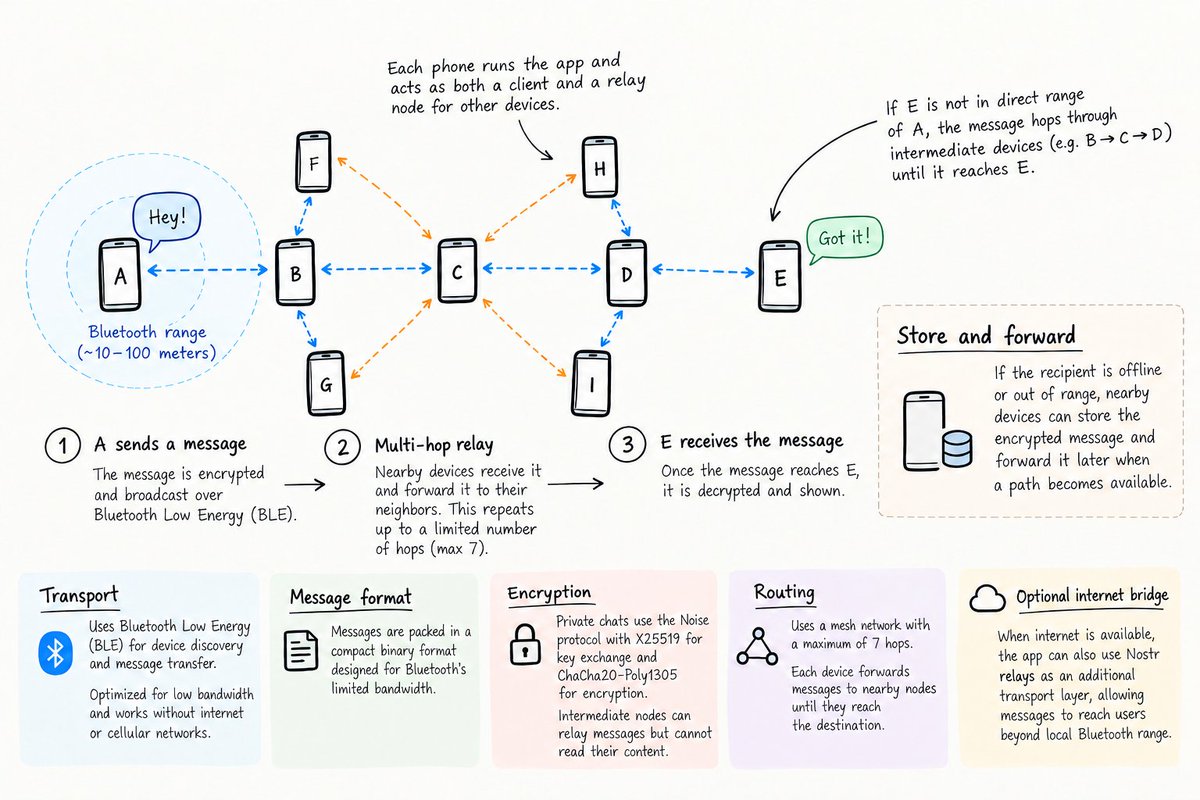
Bitchat uses Bluetooth Low Energy to create a local mesh network. Your phone isn’t just a client, it also becomes a node in the network.
If the person you’re messaging isn’t directly within Bluetooth range, other Bitchat devices can relay the encrypted message hop by hop until it reaches them.
The protocol allows up to 7 hops, uses a compact binary format built around Bluetooth’s bandwidth limits, and private chats use the Noise protocol with X25519 and ChaCha20-Poly1305 encryption.
It also has a store-and-forward system, so devices can temporarily carry encrypted messages for someone who isn’t reachable yet.
And when internet is available, Bitchat can use Nostr relays as another transport layer.
Basically, the network is partly built out of the phones running the app instead of depending entirely on a central messaging server.
That architecture is probably the most interesting thing about Bitchat.
#BitChat
@ns123abc AI companies are getting insane amounts of money even while burning cash.
I honestly can’t remember the last time a technology got this much investment before showing strong positive cash flow.
The elliptic-integral part is probably the most interesting here.
Taking the semi-numerical bootstrap, using high-precision evaluations to reconstruct exact coefficients, and then generalizing the machinery beyond logarithmic functions is a pretty serious computational result.
That feels much more interesting than just “Claude helped with physics.”
wtf is Jev AI ?
Jev is basically an AI model designed to behave more like a function than a chatbot.
You pass it some state and ask it a typed question. Instead of generating 500 tokens explaining itself, it can return a Choice, a Score, or a probability with confidence that your code can directly use.
The interesting part is the numbers.
TypeSafe prices Jev at $0.042 per million input tokens, while output tokens are free. One independent benchmark measured an average call at around $0.0000188 with a median latency of 352 ms.
It also evaluates multiple questions in parallel. In another test, asking 1 question took about 70 ms of server time, while asking 5 in the same request took about 74 ms and get structured probabilities for all of them in basically one decision call.
This is probably the easiest way to understand Jev: it is not trying to replace the LLM doing the work. It is trying to become the cheap decision layer sitting between all the expensive LLM calls.