Physics Based Energy Intel
Grid stability, Load balancing, Fault detection, Thermal Efficiency, Battery storage analyses across a range of energy asset types
Grid Harmony tells you when transmission charges peak, and when shifting your load avoids them entirely.
A 22-site food production estate. SBTi validated. £3.7M in new solar this year. Not a single certified Triad avoidance event on record.
Grid Harmony tells you when transmission charges peak, and when shifting your load avoids them entirely.
A 22-site food production estate. SBTi validated. £3.7M in new solar this year. Not a single certified Triad avoidance event on record.
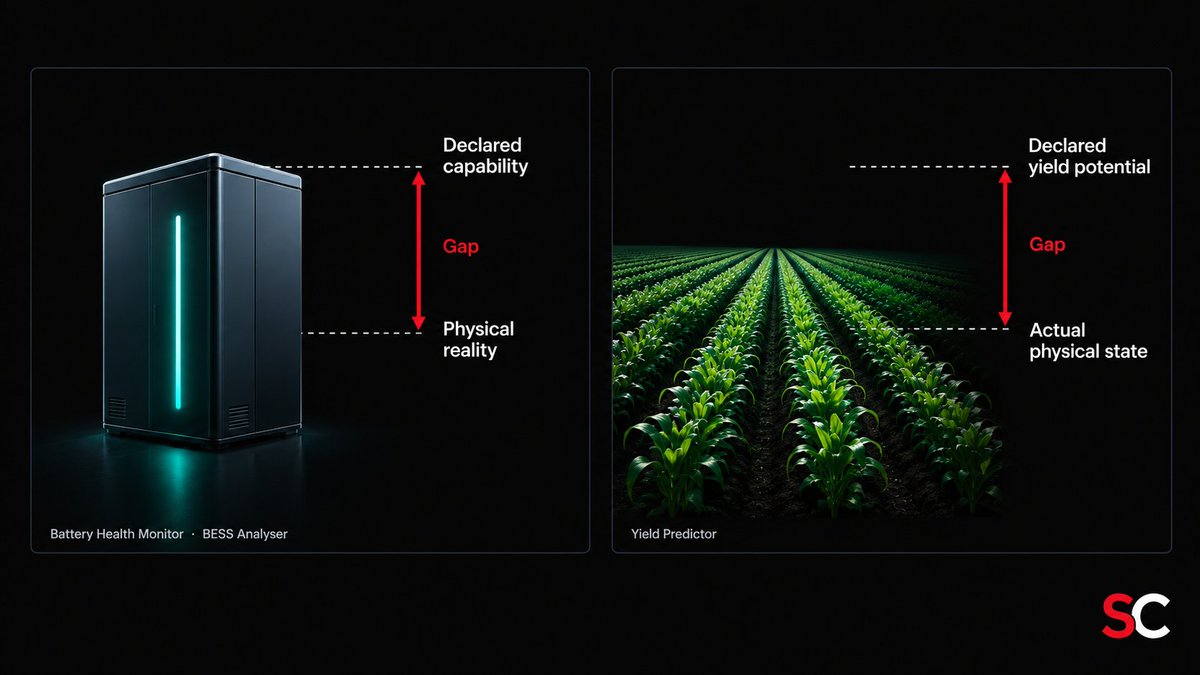
Energy storage assets and biological systems degrade in ways standard monitoring can't detect until revenue or yield is already lost.
Operators work from declared parameters. What the asset was designed to do.
Not what it can do now.
Energy storage assets and biological systems degrade in ways standard monitoring can't detect until revenue or yield is already lost.
Operators work from declared parameters. What the asset was designed to do.
Not what it can do now.
NEW – Analysis: Weaker EV targets could cost UK consumers £3bn a year by 2030
✍️ written by @DrSimEvans
📊 data analysis by Ho Woo Nam
Read here: https://t.co/OCmwWfoR2k
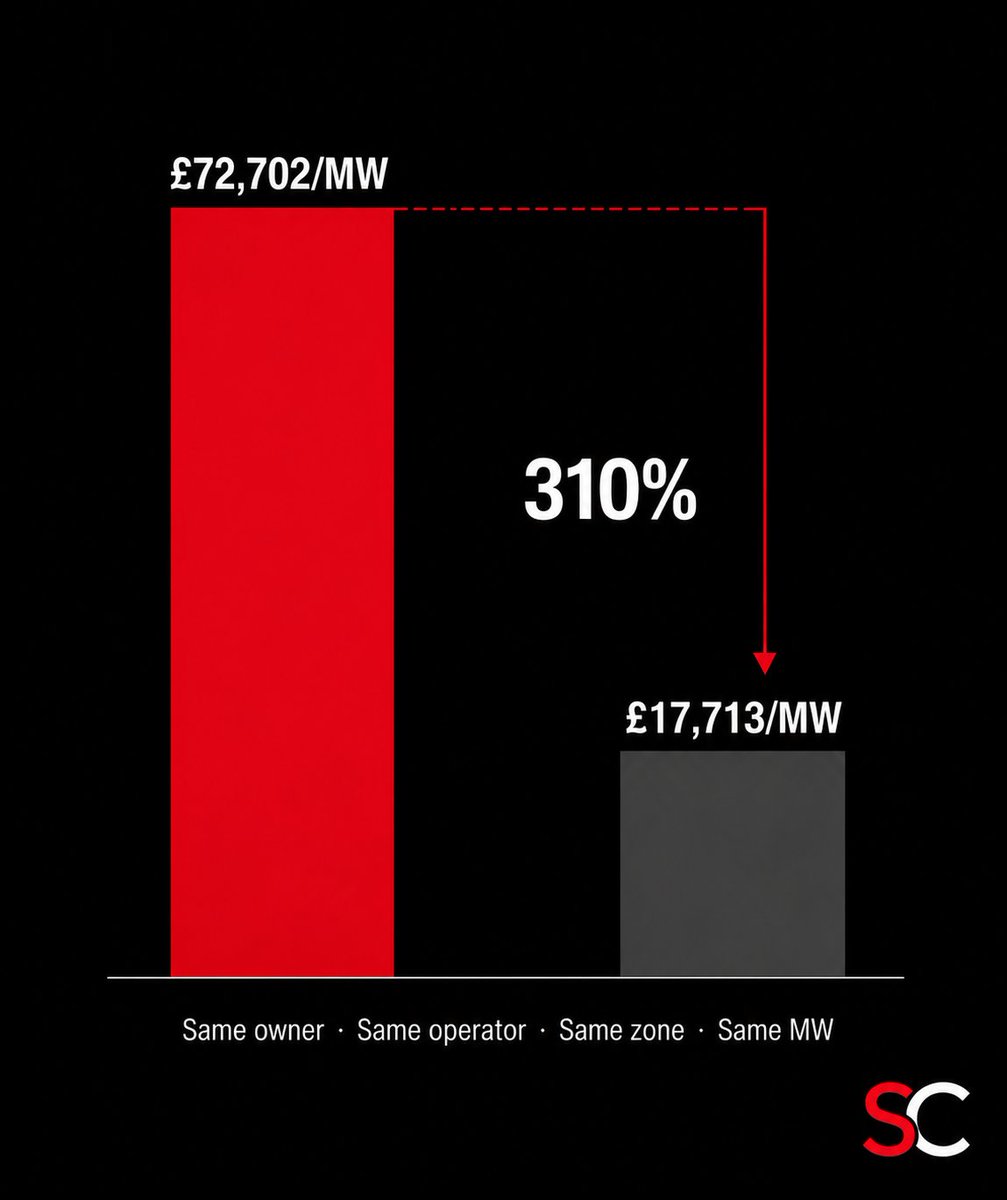
Same owner. Same operator. Same zone. Same MW.
One asset: £72,702/MW/yr.
The other: £17,713/MW/yr.
310% gap. Same company. Same market.
The zone didn't cause it.
The operator runs both.
The gap has a layer. The performance report doesn't tell you which one.
SEAST outperforms GB average in 5 of 8 revenue streams. Still lands 17% below benchmark overall.
BM is running at half the GB average in one of the best BM zones. Dispatch preference or physical constraint? The settlement data tells you which.
The optimiser's dashboard doesn't.
37.3°C record, 45-year cooling demand high, 22°C dew point, Portsmouth cooling failure confirmed, and the benchmark vs physics-validated gap.
https://t.co/otGIo8y3gk
Most DC cooling baselines were not validated against conditions like this week.
Sector benchmarks tell you how your PUE compares to the fleet. Physics-validated analysis tells you whether your cooling is optimised for your load.
Different things.
https://t.co/SMEVtjkZSd
UK broke its June temperature record on 27 June 2026. 37.3°C.
In 2022 at 40°C, Google and Oracle's London data centres lost cooling and went offline.
June 2026 peak: 38°C + 22°C dew point. Highest cooling demand in 45 years.
Underfunded for uplands, but precise data helps. Our physics-validated tools measure soil health, carbon gains & yields on peat sites, supporting SFI, carbon credits & farmer applications.
#PeatRestoration
£1,400/MWh is what happens when the system can't trust its own storage fleet to deliver. The gap between declared BM capacity and physics-constrained actual capacity is real, measurable, and compounding. The heatwave just put a price on it. @neso_energy
'Neso was forced to pay top dollar for power from gas plants and from interconnectors with European countries.
For electricity imports, it paid about £1,400 per megawatt-hour on Wednesday – roughly 20 times the average power price in June last year'
😲
How the heatwave melted Britain’s power network https://t.co/OpBxPmCRxR
The gap between what was submitted and what the physics can actually deliver at 35°C is an imbalance charge waiting to happen. Summer 2026 is the first real test of the new MDO/MDB regime under thermal stress
https://t.co/UjuQEwtN6n
When ambient temperatures hit 35°C, a battery's real available capacity drops, sometimes materially. The asset's BMS still reports rated capacity. The operator submits MDO based on that number. NESO's new Rule 5 integration then extracts the maximum dispatch from those periods.
When ambient temperatures hit 35°C, a battery's real available capacity drops, sometimes materially. The asset's BMS still reports rated capacity. The operator submits MDO based on that number. NESO's new Rule 5 integration then extracts the maximum dispatch from those periods.
38% gas, 8.4% imports, the question: how much of that gas and import dependency could domestic storage have displaced if it were dispatching against actual physics-constrained capacity rather than registered nameplate? The data exists to answer that. Has NESO modelled it?"
Yesterday #gas produced 38.0% of GB electricity, more than wind 21.0%, solar 13.5%, nuclear 9.4%, imports 8.4%, biomass 5.6%, other 2.3%, hydro 1.8%, *excl. non-renewable distributed generation
Thermal camera footage has revealed extreme temperatures as high as 62C on pavements and train station platforms in London amid a record-breaking heatwave #londonnews#heatwave#westend#news
Our Load Balancing product for tariff arbitrage (peak→off-peak) + DFS, identifies when to shift load; quantifies TOU savings and Load Flexibility for DFS / demand response payments, certifies how reliably the asset can deliver a committed reduction. https://t.co/UjuQEwtN6n