Introducing Halo, the best framework for post-training of open-source models.
Halo delivers up to 2.8x the throughput of stock TRL with less peak memory, while models stay in their native HuggingFace format.
Star us on GitHub: https://t.co/3mAiUljdrN
Over the past few days, I've taken the time to summarize my thoughts on the recent incidents involving agents’ misaligned behavior. We don't know with certainty what comes next, but we know where these issues originate, and this can help us plan the path forward.
Please feel free to ask your questions in the replies, and I’ll try to answer some of them in the coming weeks.
https://t.co/bvncjT0y0h
We’re sharing a solution to the Navier-Stokes Millennium Prize Problem, one of the deepest problems at the frontier of mathematics.
The proof was produced by a group of agents, using an OpenAI next-generation model significantly more capable than GPT-6 Astra.
The problem concerns whether the description of smooth three-dimensional fluid motion modeled by the Navier-Stokes equations can break down. It has remained unresolved for roughly 90 years.
A series of false and inflammatory allegations against me are currently circulating on social channels. To clarify, I came into the discussion following academic norms, and I'm disappointed that it has come to this. Anyone who knows me knows that academic standards are of the highest importance to me. Will have more to say tomorrow.
I'm so excited that our @theworldlabs team has achieved a major milestone today! Introducing Atlas - a first of its kind multimodal world model trained from scratch! 🚀
Atlas is capable of generating frames with pixel-perfect camera control, reconstructing large scenes from as few as one single input image, simulating space-time by reframing videos, natively outputting 3D spaces from one or more input images, composing multiple posed images into a consistent 3d world, and more! This is the best camera conditioned world model ever, opening doors to many possible use cases from VFX to robotics. I'm so so so proud of our team!♥️
Today, we're kicking off the first phase of the research preview for Model Hardware Standard (MHS): a new standard for AI agents to safely operate physical equipment in scientific research and advanced manufacturing.
Read more: https://t.co/XQ2y9EW7Af
What if a foundation model could tell us how to modify its architecture to boost inference and reasoning instantaneously—without retraining? What if that tweak incurred near zero latency cost during generation and supported indefinite state tracking? https://t.co/ye8P6Em40F
🧵Scaling Laws for T2I Diffusion
We do a scaling laws ladder for t2i diffusion models all the way from 60M to 2B, spanning 3 orders of magnitude in training flops
My talk on accelerated diffusion and flow models at @BerkeleyLab's DL4Sci School is online!
Check it out for an overview on how to:
- Reduce the number of denoising steps
- Accelerate each step
📺 https://t.co/L9TCNZXzBR (jump to 22:18 to learn more about the video below)
The Department of Energy just published their official bulletin on the Genesis Open Models Initiative.
We’re proud to support the Genesis Mission and partner with the DOE and U.S. national labs to build capable open models for science.
Read the release: https://t.co/OtKMYtYjZc
📢Meet Qwen3.8-Max — our most capable model to date.
Next week, the open weights of Qwen3.8-Max will be released, and Qwen3.8-27B is also going open-weights to meet you all!🎉
Qwen3.8-Max, a new bar for coding and cowork at 2.4T parameters:
- Autonomous coding: 10+ days of self-evolving development, from empty folder to production without hand-holding, complete project trace in the GitHub:https://t.co/iVHZWQoeSo
- Real work, real results: Production-quality deliverables across hundreds of professions.
- Long-horizon mastery: System-level autonomous planning with closed-loop adaptive learning, driving 500+ turns of chip design optimization and 365 days of e-commerce strategy.
- Native multimodal intelligence: Vision isn't just input — it's a continuous feedback loop for planning, execution, and self-correction.
💰Pricing:
Input: $2.0 / M tokens
Output: $6.0 / M tokens
Implicit Caching: $0.25 / M tokens
Start building with Qwen3.8-Max! 🚀
📖 Blog: https://t.co/iwjmQxLBof
✅ Qwen Studio: https://t.co/4V2pFvDovG
⚡ API: https://t.co/gAGqaLQGbN
Today we are announcing a partnership with the Department of Energy to build Genesis-Science-1, an open model for scientific research. GS1 is an American open-weight AI model and governed research harness designed to complete scientific computing workflows while preserving a reproducible record of its work.
This model will be shaped by the people who know scientific work inside and out. @ENERGY is opening a contributor program for researchers, laboratories, universities, companies, and nonprofits, and we're speaking with infrastructure partners who can add training or evaluation capacity.
There’s still lots of work ahead, and we hope you’ll help us build in the open, starting with GS1.
Excited to share DriftWorld -- a world model built on drifting!
https://t.co/tgag1V9OBx
Existing world models are both slow and very expensive to train. DriftWorld is much more efficient -- natively runs at 30+ FPS, and also only requires a 1-2 GPU to train!
A follow-up to Representation Autoencoders: instead of diffusing in low-dim VAE latents, this builds stochastic world models directly in high-dimensional DINOv3 feature space, using flow matching to predict future frames.
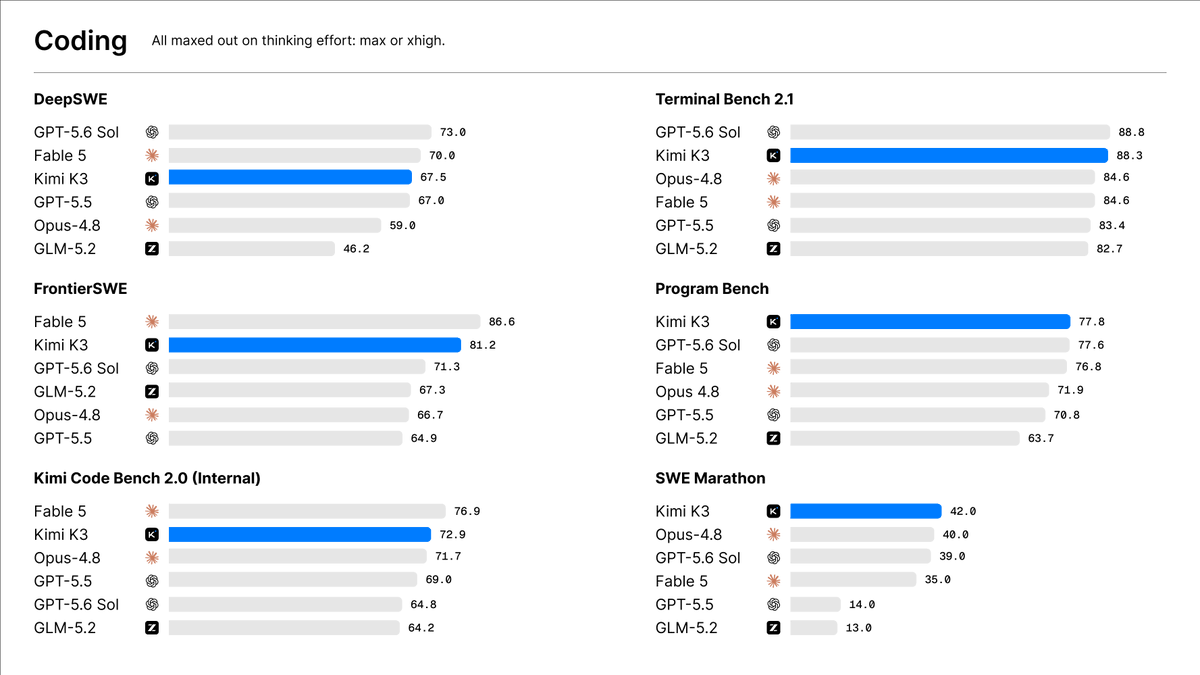
Introducing Kimi K3: Open Frontier Intelligence
🔹 2.8 Trillion Parameters, 1 Million Context, Native Multimodal
🔹 Kimi Delta Attention enables up to 6.3x faster decoding in million-token contexts
🔹 Attention Residuals deliver ~25% higher training efficiency at <2% additional cost
🔹 Built for long-horizon agentic coding and self-evolving workflows
Kimi K3 is now live on on https://t.co/zrk6zZxZUo, Kimi Work, Kimi Code, and the Kimi API.
Open Weights by July 27, 2026.
🔗 API: https://t.co/XCrgjXAqMw
🔗 Tech blog: https://t.co/YTfiMSNM1f
GLM-5.2 is Fully Open, Frontier Intelligence Belongs to Everyone
Today, the sudden restriction of certain frontier models is deeply regrettable. At a time when access to frontier models is abruptly cut off for non-technical reasons, we are even more convinced of one thing: science should be global.
The path to AGI (Artificial General Intelligence) must never be enclosed by high walls. We have always believed that AGI should be the cornerstone for all of humanity to collaboratively explore the boundaries of intelligence and solve complex challenges, rather than a privilege monopolized by a few rules and subject to revocation at any moment. In the face of external blockades and restrictions, our attitude is one of radical openness. Frontier intelligence must remain open-source, accessible, and buildable, serving every dedicated developer.
GLM-5.2 is Zhipu's most capable open-source model to date. It not only supports a truly usable 1M context window but also maintains a continuous lead in the independent completion of long-horizon tasks, providing solid foundational support for building complex agent applications. It also continues to be our main engine for creating the strongest domestic coding model.
Tonight at 5:21—at this special moment—GLM-5.2 will officially be available to all GLM Coding Plan users (including Lite / Pro / Max). The API will also go live next week.
A step closer to frontier intelligence for everyone.
The future of AI is open, and it is for the people.
ModelKey: GLM-5.2
Super excited to announce seven new world-class MAI models today. They represent what we consider a new era in AI designed to keep you in control and on the frontier.
First is our text foundation model, MAI-Thinking-1, exceptionally strong on reasoning and SWE tasks.
- It’s a 35B active parameter MoE with a 256K context window. Independent human raters on Surge prefer it for overall quality in blind side-by-sides versus Sonnet 4.6, and it��s achieved 97% on AIME 2025, the key measure of its general-purpose reasoning abilities.
- It's at 53% on SWE Bench Pro, placing it right alongside Opus 4.6 on one of the toughest coding benchmarks.
- And since we co-designed our models with our own silicon, MAI-Thinking-1 is optimized on our MAIA 200 chip. Benchmarking head-to-head against the GB200, we see 30% better performance per dollar as well as a 1.4x performance-per-watt gain when running our MAI models on the MAIA 200 end-to-end.
Next is MAI-Image-2.5 and its Flash variant. Two super strong models now at #2 on the leaderboards, surpassing the score of Nano Banana 2 on image editing.
Last for now is MAI-Code-1-Flash, our new inference efficient coding model, especially tuned for VS Code and GitHub Copilot CLI.
- Code-1-Flash achieves 51% on SWE Bench Pro, despite having just 5B parameters, putting it closer to Haiku in size but cheaper in cost.
All of this is the foundation for Microsoft Frontier Tuning. It lets you customize our models to create custom, company-specific agents that only you control. You can make our model, your model. Your data. Your agents. Your moat.
Early adopters are already seeing a difference. When we tuned our models for McKinsey’s tasks, MAI delivered the highest win rate, outperforming GPT-5.5 on quality, while being 10x lower on cost.
Also really excited to be collaborating with the amazing team at Mayo Clinic to jointly train a new frontier AI model for healthcare.
Our announcements today mark another milestone on the road to humanist superintelligence. You can learn more and about our other new models in our latest blog: https://t.co/v65eop5Ixq