One Up on Wall Street By Peter Lynch - 10 Timeless Investment Lessons
1. Invest in What You Know — Your Daily Life is Research
Lynch discovered Taco Bell while eating a burrito on a trip to California. His wife found L'eggs pantyhose at a supermarket checkout. A New England fireman watched Tambrands expand near his home and invested early — turning a modest stake into a small fortune. These aren't lucky accidents; they're the result of paying attention.
As a consumer, parent, employee, or professional, you observe new products, crowded stores, and industry trends months — sometimes years — before Wall Street analysts file their first report. That window is the amateur's edge.
2. Understand What You Own — The Two-Minute Drill
Before buying any stock, Lynch required himself to articulate a clear, simple story: what does this company do, why will it do better, and what could go wrong? He called it the "two-minute monologue." If you can't explain it to a child, you don't understand it well enough to own it.
This discipline filters out two dangerous categories: stocks bought on tips without understanding, and stories so complex that you can't track whether they're still valid. If your "story" comes down to "it's going up," that's not a story — that's a hope.
3. Know What Kind of Stock You Own — Six Categories
Lynch sorted all stocks into six types, because each demands a different strategy and holds different expectations:
Slow Growers — large, mature companies growing near GDP rate; hold for dividends. Stalwarts — solid companies (Coca-Cola, Bristol-Myers) with 10–12% growth; buy cheap, sell after 30–50% gain. Fast Growers — small, aggressive firms growing 20–25%+ annually; potential tenbaggers. Cyclicals — companies tied to economic cycles (autos, steel); timing is everything. Turnarounds — beaten-down companies with a credible recovery plan. Asset Plays — companies sitting on undervalued assets (land, cash, patents) the market hasn't noticed.
4. Earnings Drive Stock Prices — Follow the Earnings Line
Lynch was direct: in the long run, stock prices follow earnings. Overlay earnings and price on any stock chart and they move together. When price drifts far above earnings, a correction follows — as Avon Products demonstrated when its P/E reached 64 and the stock collapsed. When price falls far below earnings, opportunity appears.
The P/E ratio is the practical tool. A simple rule: a fairly valued company has a P/E roughly equal to its earnings growth rate. If the growth rate is 15% and the P/E is 7, you may have a bargain. If growth is 10% and the P/E is 30, you are paying for years of future growth up front — with no margin for error.
5. The Balance Sheet Tells the Truth — Cash and Debt Matter
Lynch bought Ford when the stock appeared expensive but saw that Ford held $16.30 per share in net cash beyond all long-term debt. That transformed a seemingly pricey $38 stock into a business you were really buying for $21.70. The auto operations alone, at that effective price, had a P/E of just 3.
Conversely, heavy debt — especially short-term "bank debt" that can be called in immediately — is the most common reason otherwise good companies go bankrupt. In a crisis, funded long-term debt gives a company time; bank debt does not. Lynch contrasted GCA Corporation (collapsed under bank debt) with Applied Materials (survived with low debt) to illustrate the point.
6. Boring Is Beautiful — Seek the Dull, Avoid the Hot
Lynch's ideal stock had a name like "Pep Boys — Manny, Moe, and Jack," did something disagreeable (like processing coupons or cleaning grease traps), operated in a no-growth industry with no glamour, and was completely ignored by Wall Street analysts. Such companies could compound in peace, with no competition from copycat investors or start-up rivals.
Hot stocks in hot industries — disk drives, solar energy, biotech buzzwords — attract swarms of competitors and excitable investors who bid prices to levels that require impossible growth to justify. The crashes are reliably brutal. When everyone at the cocktail party is talking about a stock, it is usually time to sell, not buy.
7. Institutions and Analysts Are a Hindrance, Not a Guide
Lynch observed that professional fund managers face structural barriers to good investing: approved-list systems, quarterly performance reviews, career-risk incentives, and size constraints that prevent them from buying small companies. The result is that the greatest opportunities — the pre-discovery phase of a Wal-Mart or a La Quinta Motor Inns — are available only before institutions arrive.
Service Corporation International had 22 years of rising earnings and zero Wall Street analyst coverage for a decade. The Limited had 400 stores and only six analysts. By the time thirty-seven analysts crowded onto The Limited's story, the stock had already made most of its money and was about to fall.
8. Ignore the Market — Focus on the Company
Lynch could not predict market direction, and he was honest about it. The 1987 crash caught him in Ireland on holiday. In 1982, the atmosphere was so bleak that professionals wondered if they should "take up hunting and fishing" — just before the greatest bull market of the century began. Every major advance and decline in his career arrived as a surprise.
His solution: stop trying to predict. Focus entirely on whether the individual company is doing what you expected it to do — growing earnings, paying down debt, expanding locations, or whatever the original story required. If the fundamentals are intact, a falling price is an opportunity, not a warning.
9. Avoid Common Mistakes — Diworseification, Hot Tips, and "The Next ___"
Lynch coined "diworseification" for companies that blew cash reserves on acquisitions outside their core competence — Gillette buying digital watches, conglomerates assembling random businesses. Shareholders almost always suffered. The antidote: companies that buy back their own shares instead, which grows earnings per share without adding risk.
He was equally sceptical of "whisper stocks" (exciting stories with no earnings), "the next McDonald's" claims (the original is rarely followed by a worthy successor), and stocks with excessively high P/E ratios. Stocks like Ross Perot's EDS at 500x earnings look visionary; they are simply overpriced.
10. Know When to Sell — And Stick to the Story
Lynch had a disciplined framework for selling. Sell a stalwart after a 30–50% gain if nothing has changed in the fundamentals. Hold a fast grower as long as the expansion story remains intact — new stores opening, markets untapped, debt manageable. Sell a turnaround when the recovery is complete and the stock has re-rated. Never sell just because the price has fallen if the story is still valid.
The most common investor error is the reverse: selling winners too early (because they look "expensive" after a double) and holding losers too long (hoping to get back to break-even). Lynch found that six winning stocks out of ten produced excellent long-term results. One tenbagger can offset many small losses.
📘 10 Key Book Insights from Stan Weinstein's Secrets for Profiting in Bull and Bear Markets
01 Core Framework
Every stock moves through four predictable stages
All stocks cycle through Stage 1 (basing), Stage 2 (advancing), Stage 3 (topping), and Stage 4 (declining). The entire Weinstein system is built on identifying which stage a stock is in and acting accordingly. You buy only in Stage 2, avoid or sell in Stage 3, and never hold through Stage 4. Missing this framework means playing the market blind.
02 Entry Signal
The 30-week moving average is your primary compass
The 30-week MA separates actionable situations from ones to ignore. Never buy a stock trading below a declining 30-week MA, no matter how good the fundamentals look. The ideal buy triggers when a stock breaks out above resistance and simultaneously clears a flattening or rising 30-week MA. The MA cuts through the noise of daily swings to reveal the true trend.
03 Timing
Breakouts above resistance are the only valid buy trigger
Don't try to catch a stock while it's still in a base. The correct time to buy is when price breaks above the top of its resistance zone, signalling that buyers have overwhelmed sellers. Weinstein recommends placing buy-stop orders just above resistance so the market itself confirms the breakout before you commit capital. Anticipating a breakout that never comes is an expensive habit.
04 Confirmation
Volume must confirm every breakout — no exceptions
A breakout without a significant surge in volume is a red flag, not a buy signal. Volume is the gauge of buying power behind a move. Weinstein looks for at least double the average weekly volume on the breakout week. Low-volume breakouts frequently fail and return to the trading range. If a buy-stop order fills on weak volume, exit on the first rally rather than holding for a larger gain that may never come.
05 Selection
Relative strength separates future winners from also-rans
A stock that lags the market during a rally will get crushed when the market turns. Before buying any breakout, check whether the stock's relative strength line is trending upward and ideally crossing above its zero line. A breakout with deteriorating relative strength should be passed over even if every other factor looks fine. Strong relative strength before the breakout often signals that insiders are quietly accumulating.
06 Top-Down Process
Start with the market, then the sector, then the stock
Weinstein's "forest to the trees" approach requires you to first confirm the broad market is in a Stage 2 uptrend. Then identify which sectors are showing the strongest technical action. Only then search for individual stocks breaking out from those leading sectors. Buying a great stock in a bear market or a weak sector dramatically reduces the probability of success. The tide lifts all boats — and sinks them.
07 Risk Control
Protective sell-stop orders are non-negotiable
Every position must have a sell-stop in place the moment you enter. Place it just below the prior support zone or the 30-week MA — not at an arbitrary percentage. As the stock advances, trail the stop upward beneath successive correction lows and the rising MA. This mechanical discipline removes emotion from the sell decision and prevents a small loss from becoming a catastrophic one. Professionals use stops routinely; most retail investors do not.
08 Selling Discipline
Stage 3 signals it's time to exit — don't wait for Stage 4
A Stage 3 top looks deceptively bullish: earnings are still good, news is glowing, and the stock feels expensive to short. But the MA is flattening and price is churning on heavy volume — buyers and sellers are now equal. Weinstein advises selling at least half the position when Stage 3 characteristics appear, and tightening the stop on the remainder. Waiting for "one more high" is how large profits become losses.
09 Short Selling
Bear markets offer mirror-image profits for those who short
The same stage framework applies in reverse. Short a stock when it breaks down from a Stage 3 top into Stage 4, below its support zone and declining 30-week MA. The ideal short entry occurs after an initial decline followed by a low-volume pullback rally back toward the breakdown point. Unlike a breakout which needs heavy volume, a Stage 4 breakdown can occur on relatively light volume — stocks fall of their own weight.
10 Mindset
Price and volume tell the whole story — ignore the fundamentals noise
By the time good news appears in the newspaper, the stock has already moved. The market is a discounting mechanism that prices in future expectations, not current earnings. Weinstein repeatedly shows stocks rising with deteriorating earnings and crashing with strong earnings, because the chart reflects what insiders and informed buyers know. By learning to read the tape consistently and ignoring the financial commentary, you end up trading alongside the professionals without needing their information.
Top 10 mental models — Poor Charlie's Almanack
Charlie Munger's latticework of ideas for thinking clearly, deciding well, and avoiding folly
Model 01 · Foundation
The latticework of mental models
No single discipline explains the world. You need roughly 100 big ideas from math, physics, biology, psychology, economics, and history — hung together into a latticework — to think clearly about complex problems. A mind with only one tool sees every problem as a nail.
Model 02 · Superpower
Incentives shape everything
Never underestimate how powerfully incentives drive behavior — including your own. People unconsciously rationalize bad conduct to get what incentives reward. FedEx couldn't fix late night shifts until they switched from hourly pay to per-shift pay. The simplest management rule: get the incentives right.
Model 03 · Arithmetic
Compound interest — the eighth wonder
Compounding works on money, knowledge, and habits alike. Small consistent advantages, reinvested over decades, create staggering results. The corollary: never interrupt compounding unnecessarily. Avoid taxes, transaction friction, and decisions that force you to reset the clock.
Model 04 · Algebra
Invert, always invert
Many problems are solved more easily backward than forward. Instead of asking "how do I succeed?", ask "what guarantees failure — and how do I avoid it?" Jacobi, the algebraist, made this his signature move. Munger uses it to sidestep disaster before seeking triumph.
Model 05 · Psychology
The psychology of human misjudgment
25 cognitive tendencies — from doubt-avoidance to social proof to envy — systematically warp human judgment. Recognizing them in yourself and others is the first defense. The antidote isn't willpower; it's building systems and checklists that make bad decisions structurally harder.
Model 06 · Synergy
The lollapalooza effect
When multiple forces align in the same direction, results become non-linear — explosively good or catastrophically bad. Understanding this explains both Coca-Cola's dominance (many reinforcing advantages) and spectacular failures (multiple biases compounding). Seek lollapalooza combinations; beware them in your blind spots.
Model 07 · Epistemology
Circle of competence
Every person has a bounded domain where their judgment is reliable. The edge of that circle matters more than its size. Munger and Buffett simply refuse to act outside theirs — putting everything not immediately understandable into the "too hard" basket. Knowing what you don't know is itself a superpower.
Model 08 · Decision-making
Extreme patience + extreme decisiveness
Most of the time, the right move is to wait. When truly exceptional circumstances appear, act with full conviction and bet heavily. The worst investors do the opposite: trade constantly on mediocre ideas, then hesitate when the odds are best. "Sit-on-your-ass investing" is a philosophy, not laziness.
Model 09 · Epistemics
Checklists prevent smart-person errors
Even brilliant people miss things when relying on unaided memory under pressure. Pilots use checklists not because they're dumb but because human attention is fallible by design. Systematically running through all relevant mental models — checklist-style — catches what intuition skips, especially in complex or high-stakes situations.
Model 10 · Character
Lifelong learning as a compounding asset
Wisdom is itself subject to compounding. Reading voraciously across disciplines, collecting instances of both good and bad judgment, and updating your views when evidence demands it — these habits build the raw material from which all other models improve. Going to bed a little smarter than you woke up is the only reliable edge.
Technical discipline beats emotion — regardless of market conditions.
10 timeless lessons from Stan Weinstein's Secrets For Profiting in Bull and Bear Markets 👇🏼
1. Foundation
Think in four stages, not in news headlines
Every stock cycles through Stage 1 (basing), Stage 2 (advancing), Stage 3 (topping), and Stage 4 (declining). Buy only in Stage 2; sell or short only in Stage 4. No earnings report, rumour, or media story overrides the stage the chart is currently in.
2. Timing
The 30-week moving average is your compass
A rising 30-week MA below price = Stage 2. A flat or falling MA with price breaking below it = Stage 3 or 4. This single indicator has flagged every major bull and bear market over decades. Track it on the individual stock, its sector, and the broad index simultaneously.
3. Entry
Buy breakouts with volume — never guess a bottom
The ideal entry is when a stock clears a well-defined resistance area on above-average volume after an extended Stage 1 base. Late is safer than early: a confirmed Stage 2 breakout is worth more than a "cheap" Stage 4 guess. Volume is the fuel — without it, don't trust the move.
4. Risk control
Always place a protective stop before entering a trade
Every position — long or short — must have a pre-decided stop before the order is placed, not after. Set it just below a meaningful support level (or above resistance for shorts), and place it physically with your broker on a good-till-cancelled basis. No stop = no trade.
5. Profit protection
Trail your stop to lock in gains as the trend matures
After a stock advances, raise the sell-stop progressively — first under the rising 30-week MA, then tighter under each subsequent correction low. Never let a big gain turn back into a small gain, or worse, a loss. The market will show you when the ride is over through its own price action.
6. Sell discipline
Unrealised gains are real money — protect them
A stock at 80 (bought at 40) is worth $80 today. Allowing it to fall back to 40 is a $40,000 loss, not a "paper" break-even. Reframe every position in current market value. A Stage 3 top or a break below the MA is the signal to sell — not the hope that it will come back.
7. Downside
Profit from bear markets by selling short
Stocks fall faster than they rise because fear triggers panic. Short only Stage 4 stocks (below a declining 30-week MA) in weak sectors, during a bearish overall market. Never short a rising stock or one with high short interest (a "sucker short"). Always protect with a buy-stop.
8. Context
Work from forest to trees — market → sector → stock
The best individual stock pick in a bearish sector during a bear market is still likely to fail. First confirm the overall market direction (Stage 2 or 4). Then find strong or weak sector groups. Only then select the most compelling individual chart within a favourable group. All three must align.
9. Psychology
Ego is your worst enemy — treat losses as a business cost
Investors hold losing stocks because admitting a loss feels like admitting stupidity. Professionals take the first small loss and move on. The first loss is always the best loss. Average down in a Stage 4 stock and you replace winners in your portfolio with deepening losers. Kill your ego; protect your capital.
10. Big picture
When the crowd is certain, be suspicious
Unanimous bullishness (magazine covers, "Dow 3,000: not if but when") signals tops; wall-to-wall pessimism (bear on the cover, "Death of Equities") signals bottoms. Contrary opinion is not about being contrarian every week — wait for a truly one-sided consensus, then watch your technical indicators for confirmation before acting.
The 10 Most Important Lessons from Mastering the Market Cycle by Howard Marks 👇🏼
1. You can't predict the macro future, but you can know where you stand in it — and that's enough.
Marks's foundational claim is that almost no one can reliably forecast economies, markets, or geopolitics, so trying to do so is a poor basis for outperformance. What you can do is study where various cycles currently stand — the economy, profits, psychology, risk attitudes, credit, real estate — and use that positioning to tilt the odds in your favor. As he puts it, "we may never know where we're going, but we'd better have a good idea where we are." This is the difference between forecasting (largely futile) and "tendency awareness" (achievable and valuable).
2. Cycles are driven by causation, not just sequence — and they're products of human psychology, not physics.
Most people see a cycle as a series of events that simply follow one another. Marks insists the deeper truth is that each event in a cycle causes the next: a swing toward an extreme stores energy that eventually reverses, and the reversal carries momentum that overshoots the midpoint toward the opposite extreme. Crucially, these aren't mechanical, scientific processes — they're driven by human emotion and behavior, which is why cycles are real but irregular, and why "history doesn't repeat itself, but it does rhyme."
3. Cycles almost never stop at the "fair" midpoint — they overshoot, and excess breeds excess.
The midpoint of a cycle (fair value, sober psychology) acts like a magnet, but swings back toward it rarely stop there; the same momentum that brought a market back to "normal" usually carries it on toward the opposite extreme. And the further a cycle travels from the midpoint, the more violent and damaging the eventual correction — "trees don't grow to the sky," and booms produce busts roughly in proportion to their own excess.
4. The single most important variable to track is investor attitudes toward risk.
Marks calls this "perhaps the most important topic covered in this book." When times are good, people lower their guard: less analysis, more credulousness, smaller margins of safety, lower demanded risk premiums. This is precisely backward — risk is highest exactly when investors feel it's lowest, because asset prices have been bid up with no cushion for error. As he summarizes: "the greatest source of investment risk is the belief that there is no risk."
5. Risk doesn't come from the economy or the companies — it comes from the behavior of market participants.
Securities, balance sheets, and even economic data are mostly stable; what swings wildly is how investors price and react to them. When investors are prudent and risk-averse, markets are safe even amid bad news. When they're euphoric, markets become dangerous even amid good news. This is why "taking the temperature of the market" — gauging crowd psychology — matters as much as fundamental analysis.
6. Watch the credit cycle: it's the most volatile and consequential of all the cycles.
Small fluctuations in the real economy can produce enormous swings in the availability of credit, because the "credit window" can go from wide open to "slammed shut" almost overnight. When credit is cheap and abundant, weak deals get financed and risk builds invisibly. When the window slams shut, even sound borrowers can be forced into distress through no fault of their own — a dynamic Marks sees as the engine behind most boom-bust cycles and financial crises, including 2008.
7. The best opportunities and the worst dangers both live at the extremes, not in the middle.
Marks argues you don't need to call market direction every day — you need to recognize the rare moments (he estimates four or five times in his nearly 50-year career) when psychology, valuation, and credit availability have reached genuine extremes. In the "middle ground," distinctions are unreliable and not worth obsessing over. Trying to be precise about short-term moves is "trying to be cute" — a losing game; the dependable edge comes from spotting and acting on true extremes.
8. The biggest mistake is converting a temporary paper loss into a permanent one by selling at the bottom.
Markets are cyclical, so a decline during the down-leg of a cycle isn't fatal if you hold through to the recovery. What's fatal is panic-selling at the trough — exactly when fear is highest and prices are lowest — because that locks in the loss and forfeits the rebound. Marks calls this "the cardinal sin in investing" and notes that the safest time to buy is usually when everyone is convinced there's no hope, since prices then have little room left to fall.
9. Position your portfolio along a spectrum of aggressiveness and defensiveness — and dare to be a contrarian.
Rather than picking single "best" assets in isolation, Marks frames portfolio management as a continuum: lean aggressive (more risk, more market exposure) when the cycle favors you — sober psychology, available bargains, depressed prices — and lean defensive (more cash, safer assets, less leverage) when euphoria and high prices signal danger. Quoting Buffett: "The less prudence with which others conduct their affairs, the greater the prudence with which we should conduct our own affairs." When others are euphoric, be cautious; when others are terrified, be willing to act.
10. Even with skill, you'll be wrong often — survival and emotional discipline matter more than being right every time.
Marks is candid that even his correct "great cycle calls" came only a handful of times across decades, and he never holds more than moderate confidence in any single judgment. Being early can look identical to being wrong for a painfully long stretch ("being too far ahead of your time is indistinguishable from being wrong"). The job isn't certainty — it's building the analytical discipline, unemotional temperament, and financial staying power to act on probability-weighted judgment and survive the periods when you're wrong, so you're still standing when the next extreme arrives.
10 Timeless Lessons from The Little Book That Builds Wealth by Pat Dorsey
1. Buy Moats, Not Stories
A business is worth the present value of all the cash it generates over its lifetime. Companies with a durable competitive advantage — an "economic moat" — can defend high returns on capital for decades, while moat-less companies see profits evaporate as competitors rush in.
Takeaway: Before buying any stock, ask: "What stops a smart, well-funded competitor from stealing this company's profits?" If you can't answer, you don't have a moat — you have a hope.
2. Great Products, Big Market Share, and Slick Execution Are NOT Moats
A hit product, dominant market share, or efficient operations can all vanish fast — Kodak, Krispy Kreme, and a dozen other former darlings prove that "great today" rarely means "great for a decade." These traits feel like advantages but are easily copied or eroded.
Takeaway: Don't confuse a hot trend or temporary lead with a structural edge. Ask how a position was won, not just how big it is.
3. Only Four Things Create a Real Moat
After analyzing thousands of companies, Dorsey narrows true competitive advantages to four: intangible assets (brands, patents, licenses), customer switching costs, the network effect, and cost advantages (scale, location, process, unique assets).
Takeaway: Screen every investment idea against this checklist. If none of the four apply, assume the business is exposed to competition.
4. Switching Costs Are an Underrated Profit Engine
When it's expensive, risky, or annoying for a customer to leave (think enterprise software, banks, or anything deeply integrated into daily operations), companies gain serious pricing power — even without flashy products.
Takeaway: Look for "sticky" businesses where customers stay out of inertia or cost, not loyalty — that stickiness shows up as durable margins.
5. The Network Effect Is the Most Powerful Moat — When It Exists
A product or platform that gets more valuable as more people use it (credit cards, exchanges, marketplaces) builds a self-reinforcing lead that's brutally hard to dislodge. It's rare, mostly confined to information- and connection-based businesses, but devastating when present.
Takeaway: When you find genuine network effects, you may be looking at one of the widest, longest-lasting moats available — but don't mistake "lots of users" for a real network effect.
6. Bet on the Horse, Not the Jockey
Management matters far less than people assume. A wide-moat company run by an average CEO will usually outperform a no-moat company run by a star — structural economics overpower managerial talent almost every time, as shown by superstar CEOs who failed at Ford, Gap, and Conseco.
Takeaway: Spend your diligence time on the business's structural position, not the founder's resume or charisma.
7. Industry Structure Decides Your Odds Before You Even Pick a Stock
Moats are far easier to dig in some industries (asset management, branded pharma) than others (airlines, commodity manufacturing). A mediocre company in a great industry can beat the best company in a brutal one.
Takeaway: Evaluate the industry's competitive intensity first — it sets the ceiling on how good any company within it can be.
8. Moats Erode — Watch for Technology Shifts, Customer Consolidation, and "Bad" Growth
Even strong moats can crumble: technological disruption (Kodak, newspapers, landline phone companies), customers consolidating into a few powerful buyers (Walmart vs. suppliers), or management chasing growth outside its moat. The single most common self-inflicted wound is a company expanding into businesses where it has no edge.
Takeaway: Re-underwrite your thesis periodically — a moat isn't a one-time checkbox, it's a trend you have to keep verifying.
9. Price Is What You Pay, Value Is What You Get — Even Wonderful Companies Can Be Bad Investments
A company's value equals the cash it will generate, discounted for risk and timing. The best business in the world destroys returns if you overpay; valuation discipline protects you from market mood swings and ties your results to business fundamentals, not sentiment.
Takeaway: Always estimate intrinsic value and demand a margin of safety — moat quality tells you what to buy, valuation tells you when.
10. Sell for the Right Reasons, Not Emotional Ones
Sell only if: you made an analytical mistake, the business has permanently (not temporarily) deteriorated, you've found a far better opportunity for the capital, or the position has become an outsized chunk of your portfolio. Selling well is as important to returns as buying well — and most investors are far worse at it.
Takeaway: Write your sell triggers down before you buy, so a future stock-price swing doesn't hijack a sound long-term decision.
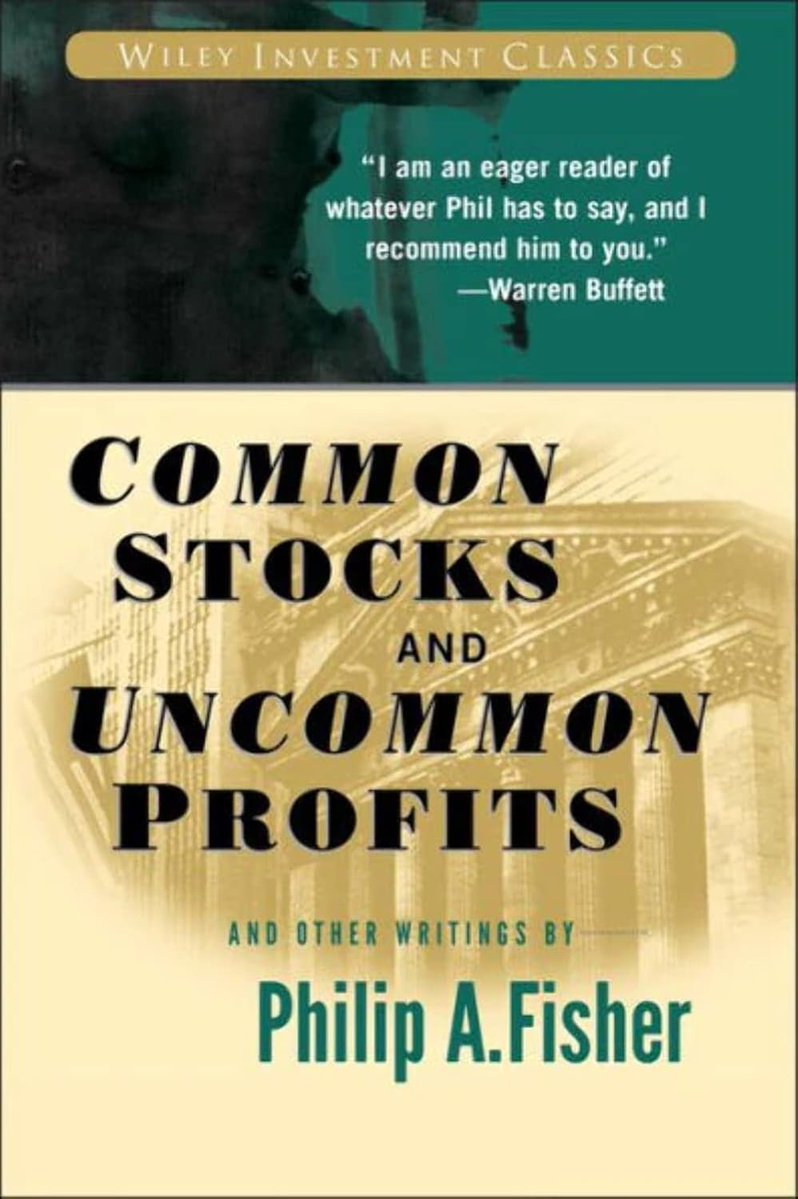
10 Timeless Lessons for the Long-Term Investor from Philip Fisher's Common Stocks and Uncommon Profits, ranked by practical impact:
#1 — Use Scuttlebutt — Go Beyond the Numbers to Know the Business
The single most radical and valuable idea in Fisher's entire body of work is what he called the scuttlebutt method: building an investment thesis primarily through the informed opinions of customers, competitors, suppliers, former employees, and industry scientists — not from balance sheets and annual reports alone. Financial statements tell you where a company has been. Scuttlebutt tells you whether it is genuinely excellent.
#2 — Management Quality and Integrity Are Non-Negotiable, Irreplaceable Inputs
Of Fisher's famous Fifteen Points for evaluating a company, the people-related factors carry the most weight. Outstanding businesses are built on managements that (a) have a burning determination to develop new products and markets long after the current ones are exploited, (b) treat employees at every level with genuine respect and fairness, (c) cultivate deep executive talent so the business doesn't depend on any single individual, and (d) communicate honestly with shareholders — especially when things go wrong.
#3 — The Right Time to Sell an Outstanding Stock Is Almost Never
Fisher articulated three — and only three — legitimate reasons to sell a stock: (1) you made a mistake in the original analysis and the facts clearly no longer support the thesis; (2) the company has genuinely deteriorated — through management decay or market saturation — and no longer qualifies on the original criteria; (3) you have discovered a significantly better opportunity and have high conviction in it.
#4 — Invest Only in Companies With Large, Expanding, Durable Sales Potential
Fisher's Point 1 is the gateway to everything else: a company must have products or services with sufficient market potential to generate sizable, multi-year sales growth. A one-time spurt or a temporarily favorable business cycle is insufficient — the opportunity must compound over time. Fisher distinguished between companies that are "fortunate and able" (blessed with a growing market they didn't create) and those that are "fortunate because they are able" (Du Pont-style companies that create their own next market through research and ingenuity). Both qualify; what does not qualify is a company whose growth story has a foreseeable ceiling.
#5 — Great Research Means Nothing Without Great Sales — and Vice Versa
Fisher was among the first investors to systematically evaluate both R&D effectiveness and sales organization strength as co-equal pillars of business quality. Most investors at the time fixated on production efficiency and accounting metrics. Fisher saw that even the best product dies without skilled salespeople who can move it, and even the best sales force is helpless without a pipeline of competitive products.
#6 — Favor Companies With High Margins That Are Actively Defending and Widening Them
Fisher treated profit margin analysis as a two-step inquiry. The first step is identifying whether current margins are above average for the industry. Marginal producers (those with thin margins) are deceptively attractive during boom times because their earnings surge faster on a percentage basis, but they are almost always the first casualties in a downturn. Fisher believed outstanding long-range profits nearly always come from high-margin businesses.
#7 — Don't Over-Diversify — Own a Few Businesses You Know Deeply
Fisher's "Don't Overstress Diversification" is one of the most radical and consistently misunderstood principles in the book. He argued that the obsession with diversification — driven by fear of "all eggs in one basket" — leads investors to spread capital so thin that they own far too many companies they don't understand well enough, and far too little of the handful they genuinely know. He considered this a greater risk than concentration.
#8 — Macro Forecasting Is Largely Useless — Buy Great Companies at Company-Specific Inflection Points
Fisher was deeply skeptical of macro economic forecasting, comparing it to medieval alchemy — some basic principles were emerging, but nothing reliable enough to bet real capital on. He did not try to predict recessions, interest rate cycles, or bear markets. What he did try to predict was whether a specific, well-understood company was approaching a moment of earnings inflection: a new plant coming online, a new product gaining traction, a temporary labor problem being resolved.
#9 — A High P/E on a Persistent Grower Is Not Expensive — It Is Often Cheap
Fisher identified a widespread and costly error: investors comparing a growth stock's P/E to the market average and concluding it is "overpriced." This reasoning is wrong because it implicitly assumes the growth stock should trade at the same multiple as average companies in the future — but it won't, if it continues to deserve its premium. The correct comparison is: how will this stock's P/E look in 5–10 years, relative to what its fundamentals will then justify?
#10 — Dividends Matter Far Less Than Most Investors Think — Reinvestment by a Great Business Beats Payouts
Fisher devoted an entire chapter to dismantling the "hullabaloo about dividends" — the pervasive belief that high dividend yield signals safety, or that companies "owe" shareholders a larger payout. His argument was elementary but devastating: if a company can earn 15–20% returns on reinvested capital, paying that capital out to shareholders who then pay taxes on it and reinvest it in something of unknown quality is a severe destruction of compounding power.
10 Enduring Insights on Trading, Speculation, and the Psychology of Markets from Reminiscences of a Stock Operator by Edwin Lefèvre 👇🏼
1. Sit tight — the big money is in the big move, not the fluctuations
Livermore learned repeatedly that being right about the market's direction was only half the battle. The other, far harder half was staying in position long enough to collect the full profit. Traders who obsess over minor fluctuations and take profits too early consistently turn potential fortunes into modest gains. The market needs time to do what it's going to do.
2. There is nothing new in Wall Street — human nature repeats endlessly
From his earliest days as a quotation-board boy, Livermore observed that stock prices move in recognizable patterns because the human emotions driving them — fear, greed, hope, impatience — never change. Every boom and bust follows the same psychological script, regardless of the era or the instrument being traded.
3. Never trade without a clear reason — and only when conditions favour you
One of Livermore's costliest mistakes was trading out of restlessness rather than conviction. He called this "the Wall Street fool" — someone who trades every day simply because the market is open. The desire for constant action, independent of underlying conditions, guarantees death by a thousand cuts.
4. Trust the tape — price action tells you more than any insider or tip
When Livermore was bullish on Union Pacific and his well-connected friend advised him to sell, he capitulated. The stock then surged 10% on a surprise dividend. The tape had been correct all along. He lost $40,000 — a cheap lesson in the hierarchy of information. Price action reflects the aggregate of all known facts; tips reflect one person's limited view.
5. Study general conditions, not individual stocks — macro context is everything
Livermore's most transformative upgrade as a trader was moving from reading individual stocks to reading the entire market and its underlying economic conditions. His greatest wins — the 1907 Panic short, the 1929 crash — came from correctly diagnosing systemic macro conditions months before the crowd. No amount of stock picking compensates for being on the wrong side of a credit cycle.
6. When you are wrong, cut losses immediately — without argument or hesitation
Livermore developed an iron discipline around loss-cutting rooted in a simple principle: if the market isn't doing what your thesis predicted, your thesis is wrong. When Anaconda failed to hold above the key breakout level he had identified, he immediately sold 8,000 shares — at the market, without limit orders, regardless of the adverse price impact. Ego has no place in a losing trade.
7. Never let gratitude, friendship, or emotion override your market judgment
In what Livermore called "the most curious experience of my entire life," the broker Dan Williamson funded his comeback — then subtly neutralised him by using emotional obligation to stop him trading. Livermore's genuine gratitude caused him to suppress his bearish convictions at exactly the moment they would have made him millions. Five lean years followed. The market rewards clarity, not loyalty.
8. Trade along the line of least resistance — don't fight the tape
Livermore's concept of the "line of least resistance" is one of the book's most powerful ideas. A market that fails to go down on bad news is telling you something. A market that keeps making new highs despite skeptics is telling you something. The tape is the ultimate truth-teller, and fighting it — because of prior opinions or stubbornness — is among the most expensive things a trader can do.
9. The unexpected will happen — always protect against the unexpectable
Livermore's coffee trade was one of his most elegantly reasoned positions — logically flawless, macro-driven, and well-timed. And yet it was wiped out by a government price-fixing edict he had no way to foresee. He called this "the unexpectable." Even a perfect trade can be destroyed by a force outside the system of analysis. Position sizing and diversification are not admissions of doubt — they are structural defences against unknowable risks.
10. Experience, memory, and mathematics — the three pillars of successful speculation
In one of the book's most reflective passages, Livermore distills everything he learned into three non-negotiable foundations: the accumulated wisdom of lived experience (which cannot be transferred, only earned), a disciplined memory for how prices have behaved in analogous situations, and rigorous mathematical thinking about probabilities. Intuition without these three pillars is just gambling with a story attached.
10 trading lessons from Mark Minervini's "Think & Trade Like a Champion"👇
1. Risk-first thinking. Before you ever buy, decide exactly where you'll get out if you're wrong. Minervini caps risk at 1.25–2.5% of total equity per trade — small enough that no single mistake can hurt you badly, but real enough to matter.
2. Cut losses small, let winners run. Average losses should stay around 5–8%. The math is brutal: a 50% loss needs a 100% gain just to break even. Protecting capital is priority number one, before profit.
3. Only buy stocks in a confirmed uptrend ("Stage 2"). His Trend Template includes things like price above the 150- and 200-day moving averages, those averages trending up, and price near its 52-week high. Roughly 95% of historical superperformance stocks were in this stage when they made their big moves — fighting downtrends is fighting the odds.
4. The Volatility Contraction Pattern (VCP). Before a big move, a stock often "tightens up" — price swings and volume shrink with each pullback, like wringing water out of a towel. That tightening point (the "pivot") is where the highest-probability entries occur.
5. Tennis balls, not eggs. After a breakout, a healthy stock bounces back quickly from any dip (tennis ball). A weak one cracks and doesn't recover (egg). Learning to tell the difference tells you when to hold and when to walk away.
6. Concentration beats over-diversification. Spreading money across 20+ positions just gets you an average return. Minervini argues for 4–8 carefully chosen positions you can actually watch closely — what he calls avoiding "di-worsification."
7. Sell into strength, not into hope. When a position is up nicely, professionals start selling while buyers are still eager. Waiting for "just a little more" is how big gains evaporate into small ones or losses.
8. Small, consistent gains compound into huge results. You don't need one miracle stock. Twelve trades each gaining just 10% compound to roughly a 214% return. Consistency beats chasing the lottery ticket.
9. Always have a plan — including a plan for when things go wrong. "Hope is not a strategy." Decide in advance how you'll handle a loss, a sudden gap down, even a broker outage. Preparation removes panic from the equation.
10. Winning is a choice — discipline beats talent. Minervini frames every trader as having a "builder" (process-driven, learns from mistakes) and a "wrecking ball" (ego-driven, blames outside forces) inside them. Which one wins depends on which one you feed, day after day.
Top 10 Key Insights from Trading in the Zone by Mark Douglas
1. The market doesn't hurt you — your reactions to it do. Most losses come from emotional responses (fear, hesitation, revenge trading), not from bad analysis. Mastering trading means mastering your own mind first.
2. Anything can happen. Markets are probabilistic, not predictable. Once you truly accept that any outcome is possible on any given trade, you stop being shocked or rattled when things go against you.
3. You don't need to know what happens next to make money. A solid edge played consistently over many trades produces results — even though each individual trade is essentially random.
4. Risk has to be defined before you click "buy." If you haven't pre-decided your risk and accepted it emotionally, you're not really trading — you're gambling and hoping.
5. Every loss is fully paid for the moment you take it. Cutting a loss early and cleanly means it's "done." Hesitating or holding on turns a small, manageable loss into a much bigger psychological and financial one.
6. Your beliefs shape what you "see" in the charts. Two traders can look at the same chart and reach opposite conclusions because their underlying beliefs filter the information differently.
7. Think in probabilities, not certainties. Top traders treat each trade as one of many in a series — like a casino treats one hand of blackjack — rather than a single make-or-break event.
8. Consistency comes from a consistent mindset, not a "better" strategy. Jumping between systems looking for the perfect one is usually a symptom of unresolved psychological issues, not a strategy problem.
9. Self-discipline beats willpower. Long-term success comes from building habits and rules that don't require constant emotional struggle — not from white-knuckling through every decision.
10. "Being right" can be the enemy of being profitable. The need to be right (ego) often causes traders to hold losers too long or exit winners too early — letting go of that need is a major unlock.
Top 10 Key Insights from 100 Baggers by Christopher W. Mayer
1. The Twin Engines drive everything. Earnings growth alone doesn't create 100-baggers — you need both rising earnings and multiple expansion working simultaneously. MTY Foods grew earnings 12x, but the stock was a 100-bagger because the P/E also expanded from 3.5x to 27x. Both engines must fire.
2. High return on capital + reinvestment is the master formula. The single most important factor is finding a business that earns a high return on invested capital and can keep reinvesting at that rate for years. A 20% ROIC compounded over 25 years mathematically delivers a 100-bagger. Moats are what make this possible.
3. Time is the non-negotiable ingredient. The average 100-bagger in Mayer's study of 365 stocks took 26 years. Patience isn't a virtue here — it's a mathematical requirement. Selling even five years early can cut your return in half due to the explosive power of late-stage compounding.
4. Owner-operators are a critical edge. The greatest 100-baggers — Amazon (Bezos), Walmart (Walton), Monster Beverage (Sacks & Schlosberg), MTY Foods (Stanley Ma) — had founders or large shareholders running the business. Skin in the game aligns incentives and drives superior capital allocation decisions.
5. Small size is a prerequisite. Apple at $4 trillion cannot become a 100-bagger; the math is impossible. Start with acorns, not oak trees. The median market cap at the start of the 365 studied 100-baggers was ~$500 million — real businesses, not penny stocks, but still small enough to have a long runway.
6. The Coffee-Can Portfolio approach. Robert Kirby's concept: buy a great business, put it in a metaphorical coffee can, and don't touch it for 10+ years. The discipline of not selling protects you from your own emotional mistakes. Tax deferral on unrealized gains also silently amplifies returns — one study showed a buy-and-hold investor ending up with 3.4x more wealth than one who churned.
7. Look forward, not backward. Most 100-baggers didn't appear cheap on past metrics alone. You must visualize what the company can become in 10–20 years. The question isn't "is this cheap today?" but "how big can this get?" — a fundamentally different frame that most investors never adopt.
8. Economic moats are mandatory for durability. A 100-bagger requires sustaining high returns for a long time, which only a real competitive advantage — brand, switching costs, network effects, cost leadership, or dominant niche scale — can provide. High gross profit margins are the most empirically reliable signal of a genuine moat.
9. Concentrate on your best ideas; reject the Noah's Ark approach. Great investors like Buffett, Klarman, and Pabrai hold 4–10 positions, not 100. The Kelly criterion formalizes this: bet in proportion to your edge. Owning 100 stocks guarantees mediocrity. When you finally find a 100-bagger candidate, you want it to actually matter to your portfolio.
10. Ignore macro noise; stay in the hunt at all times. Great 100-bagger investors don't spend time on Fed policy, GDP forecasts, or market timing — these are unknowable and irrelevant to a 25-year thesis. Bear markets are opportunities, not reasons to stop searching. As Phelps put it: "bear market smoke gets in one's eyes" — the discipline is to see through it.
Be boring. Live your life your way. Go to bed at 9. Wake up at 5. Eat simple foods. Go for 2 hour walks. Read 900 page books. Avoid drama. The world chases excitement. More noise. More excitement. But you chase real. Things that align with your soul. A calm routine. A quiet mind. A healthy body. A small circle. A private life. Shit that make you feel like you. Depth over noise. Always...
🌙 It’s 2 AM.
You’re awake… while your mind scripts a future that hasn’t happened — and likely never will.
The career fails.
The relationship breaks.
The dream turns into regret.
Your brain doesn’t just imagine pain — it accelerates it.
Years of “I knew it” in a few minutes.
But here’s what it forgets:
You’ll face it.
You’ll figure it out.
And you’ll adapt — faster than you expect.
This is immune neglect — forgetting your built-in ability to cope, reframe, and bounce back.
So you overestimate:
• How bad it will feel
• How long it will last
• How much it will define you
Reality?
Most “disasters” soften quicker than you think.
Not because life is easy —
but because you’re more resilient than your fear admits.
👉 Fear is loud.
👉 Resilience is quiet — but stronger.
You don’t break.
You adapt.
What “what if” is your mind stuck on right now? 👇
#FutureAnxiety #Overthinking #Resilience #MentalStrength #Psychology #Mindset #Growth #SelfAwareness
You open Instagram “for 5 minutes.”
30 minutes later:
you feel drained, restless, unfocused.
That’s psychic entropy — a term by Mihály Csíkszentmihályi.
Your attention, instead of being directed, gets scattered across random inputs.
No goal → no order → mental chaos.
It’s not the scrolling itself.
It’s the lack of purpose behind it.
The antidote? Flow.
Clear goal. Full focus. Energy aligned.
Next time you catch yourself drifting, ask:
“What is my attention serving right now?”
That question alone can reset your mind.
#PsychicEntropy #FlowState #AttentionEconomy #DeepWork #MentalClarity
“I can’t see you tonight, I’ve got plans”
The plans:
Legs up the wall!! One of the most underrated things you can do for your body (all the hot girls are doing it btw): zero equipment, cost or effort, and it works on nearly every level that actually matters.
“Uh but why would I do that?” I’ll tell you why:
When your legs are elevated above your heart, gravity does the work your sluggish lymphatic system is struggling with.
Venous blood and lymph move back toward the torso, reducing swelling in the feet and ankles, relieving tired legs after hours of sitting or standing, and improving lymphatic drainage.
Stagnant circulation promotes stress signals in your tissues. Fluid that isn’t moving freely = poor tissue oxygenation and waste buildup. Elevating the legs is one of the simplest ways to reverse that.
This position naturally shifts your body into parasympathetic mode: the state responsible for recovery, digestion and cellular regeneration.
You’ll notice slower breathing, lower heart rate, reduced stress hormones, a calmer mind.
Stress physiology is catabolic. It drains energy and accelerates ageing. Relaxation supports mitochondrial function and repair. A posture that quiets the stress response (without supplements, protocols or spending a penny) is brilliant.
This posture also unloads the spine, releases pressure in the lower back, and relaxes the hip flexors and hamstrings.
Your body feels supported and safe, adrenaline and cortisol drop. Muscles and connective tissue release.
A lot of people notice their body temperature warming slightly afterward; that’s improved circulation and reduced stress. Your metabolism is literally switching back on :)
Improved venous return = more efficient blood flow. And it will reduce fatigue, help with mild headaches and promotes mental clarity.
Good circulation and oxygen delivery support oxidative metabolism: the process that keeps your cells producing energy efficiently. When that process is impaired, everything suffers. When it’s supported, everything improves. It’s that straightforward.
How to do it? Sure, I’ll tell you:
Sit sideways next to a wall. Swing your legs up. Rest for 5–15 minutes. That’s it.
Optional additions: a small pillow under the hips, red or warm light, slow nasal breathing.
Works especially well before bed, after work, or after long periods of sitting.
All the hot girls are doing legs up the wall and it combines circulation support, nervous system relaxation and gentle spinal decompression: a proper reset for the body with zero cost and zero risk.
One of those rare things where the simplest answer is the best one :)
Two minds shape our life every day.
Conscious mind
• makes plans
• sets goals
• analyzes
Subconscious mind
• stores beliefs
• runs habits
• drives behavior
We think with the conscious mind.
But we live through the subconscious one.
#SubconsciousMind
Ever feel exhausted… even when you’re productive?
Or stuck… even when you’re resting? ☯️
That’s the dance of Yin and Yang energy within you.
🌙 Yin Energy
Yin is soft, quiet, intuitive, nurturing.
It’s rest, reflection, listening, patience.
It’s the energy you feel during meditation, deep conversations, or peaceful evenings.
☀️ Yang Energy
Yang is active, bold, expressive, decisive.
It’s action, leadership, movement, ambition.
It’s the energy that pushes you to build, compete, create, and achieve.
Neither is “better.”
Balance is power.
When Yin dominates too much → you may feel stuck, low-energy, overthinking.
When Yang dominates too much → you may feel burnt out, reactive, restless.
✨ How to strengthen Yin:
• Spend time in silence
• Journal your thoughts
• Prioritize sleep
• Connect deeply with loved ones
• Practice slow breathing or meditation
🔥 How to strengthen Yang:
• Exercise regularly
• Set bold goals
• Take decisive action
• Speak up for yourself
• Try something that challenges you
Life isn’t about choosing one.
It’s about knowing when to be still… and when to move.
Balance your Yin. Activate your Yang.
That’s harmony. 💫
#YinYang #EnergyBalance #SelfGrowth #Mindset #InnerWork #PersonalDevelopment