We are glad to share our publication about transient low shear stress that influences endothelial traction and alignment in the long term under high-shear flow. https://t.co/I4UwaJ9x8p
I tried to use VideoByte for our recent publication in Communications Materials. Why does myosin-independent stiffness sensing matter? It is because it suggests the differential tension can run across nascent adhesions! https://t.co/8f7eWmcMtb
The Health Research Institute @michigantech is seeking talented, ambitious undergrads for our Summer Undergraduate Research Fellowship program. This includes travel, room and board, and a $4000 summer stipend. Please DM me if you want to learn more! @HRI_MTU#AcademicTwitter
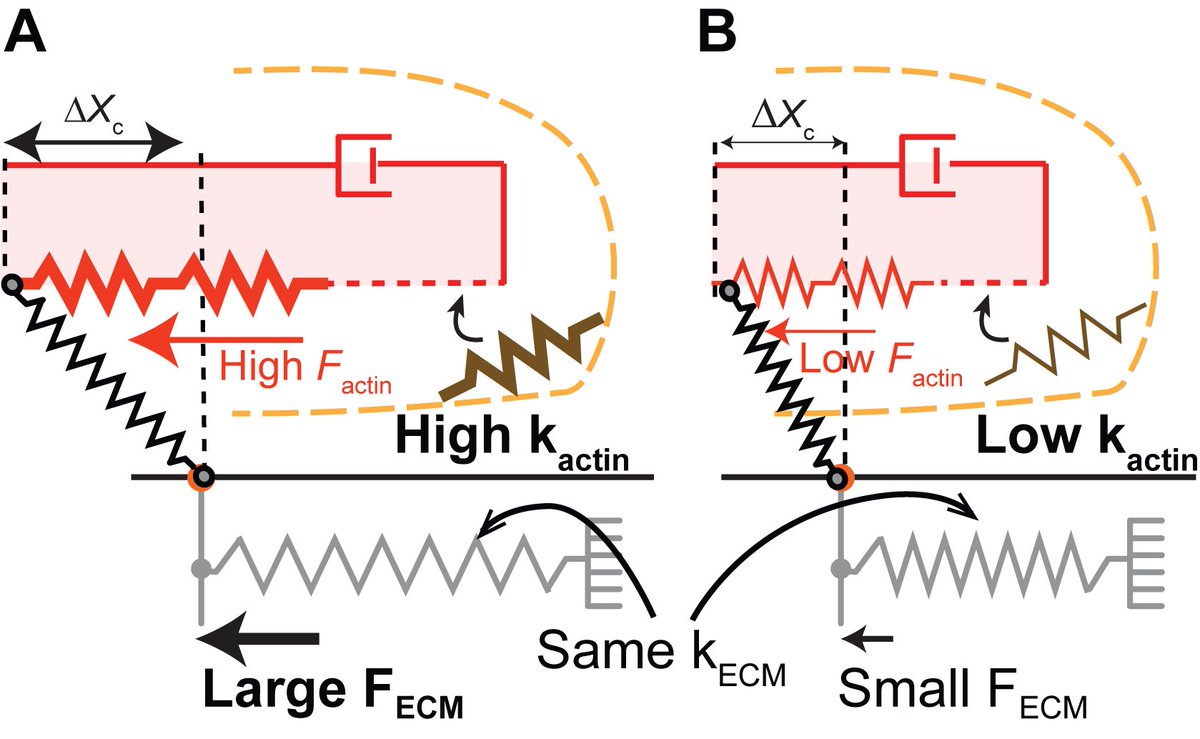
To explain this, we developed an actin elasticity-based molecular clutch model. Basically, the stiffer the actin is, the easier it is to transmit larger traction with the same actin retrograde flow speed.
Finally, the finding regarding myosin-independent stiffness sensing has been published! Many thanks to my Ph.D. student Nik, collaborators Alex Cartagena-Rivera (NIH) and Bryan Smith (MSU), and senior mentors/colleagues, Schwartz, Ginsberg, and Tristan!
https://t.co/jX3ayUyBz7
Then we show that the stiffness-dependent differential traction is significantly further reduced when we inhibit actin polymerization in addition to myosin inhibition. @BiomedMtu@HRI_MTU
Read this #preprint on @researchsquare: Polymerizing actin regulates myosin-independent mechanosensing by modulating actin elasticity and flow fluctuation https://t.co/tJ1VrwmSps
It is finally out! We present a better bead tracking method adapted to traction microscopy. It's my first paper with two undergraduate students as co-first authors. Good job guys! #PLOSONE: https://t.co/rWsxbvbjyL
Owing to my student Shaina, we had a chance to learn about a rare disease called EDS and it was actually highly relevant to altered ECM structure and mechanical properties. We reviewed relevant mechnobiological players potentially involved in the disease. More to come from Shaina
Nikhil Mittal, Ph.D. student in my lab, was awarded Travel Award in CMBE 2022 conference where he presented his project about myosin-independent force transmission. Congrats, Nik!
Cells can control their ability to move through the body by using a protein called fascin to control the stiffness of neighbouring cells https://t.co/yqz8fC7SQK
Our paper on the spatial arrangement of actin and myosin at the cell cortex just got published! Special thanks to Binh An Truong Quang and @Ruby_Peters_@PDN_Cambridge@LMCB_UCL (1/3)
https://t.co/MTMyC2fb0P