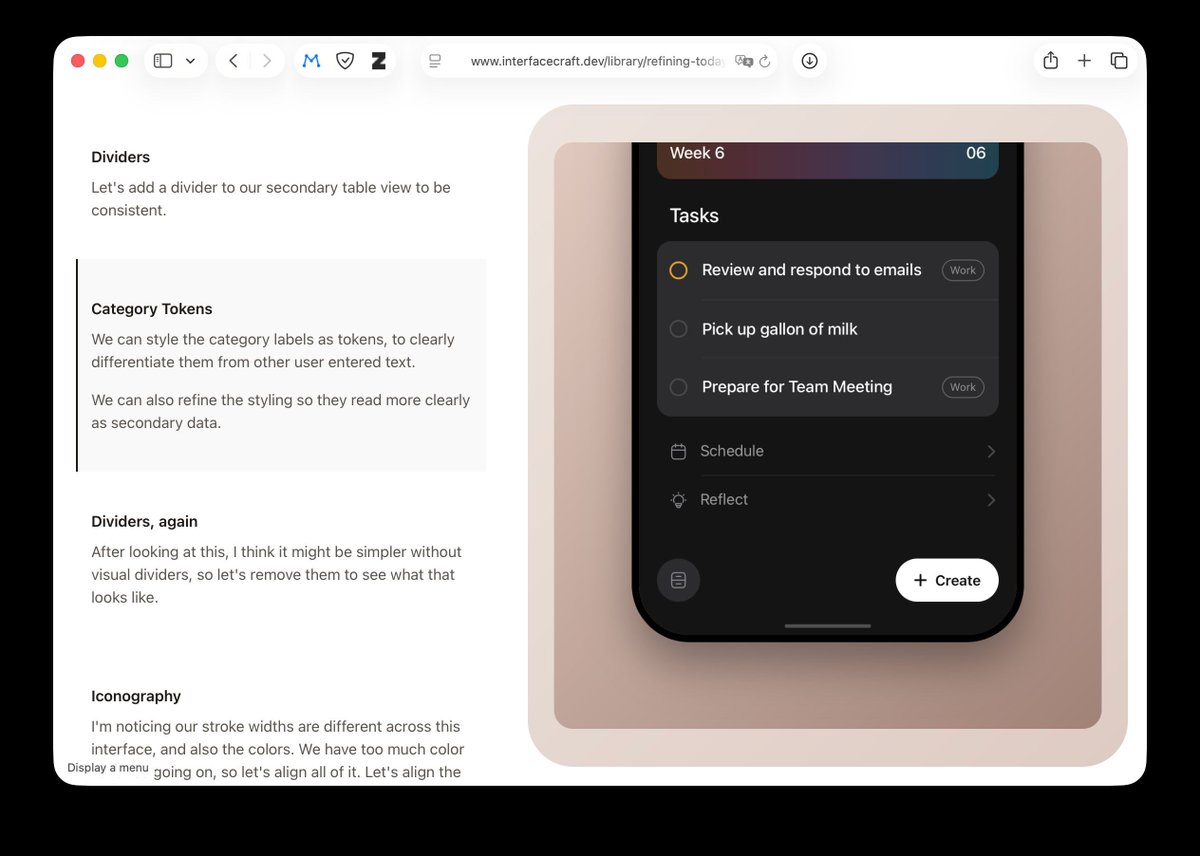
I've often complained that interface design lacks great textbooks—still mostly taught through apprenticeship and trial/error. @joshpuckett's new https://t.co/RJpUTvfFRk is shaping up to be a great resource, particularly for polish and craft.
The step-by-step UI crit/redesigns are a really nice format. Interesting to imagine structuring material like that as Figma artboard sequences, so the student could try each step themselves before revealing the author's take (in the style of https://t.co/1wdrLrxIby)
I’m very happy to present my toy research project: Sotaku!
It's a neural net that automatically discovered the rules of sudoku and learned to solve them, achieving a new state-of-the-art score of 98.9% on one of the hardest sudoku datasets, while being agnostic to the game, and beating all other sudoku-optimized neural net architectures*
Read more for fun motivations, plus some extremely unconventional discoveries, e.g. reverse curriculum consistently beating curriculum (!), emergent reasoning-like capabilities, and the future of traditional programming
@poetengineer__ You might like this old paper about “read and edit wear” in software, like a scroll bar showing where you’ve read the most
https://t.co/qvlshWHMdg
Meet Gizmo: a new way to make playful, personal software—right from your phone.
No code. No desktop. Just your camera, your fingers, and a good idea.
[1/7]
@steipete Agreed - it’s been shocking to me how few devs I follow are working with AI. It uncovers mind-blowing opportunities that haven’t been possible before!! Too excited for the products I’m building!
We have two identical groups of 8 gauges with anomalous gauge at position (3,1). The degree of anomaly is identical in both groups ~ 8 deg.
Humans have extreme hyperacuity with respect to detecting angular orientation of line segments—needle gauge is so much faster to read. The arc gauges all look the same even though the amount of deviation is the same, about 8 degrees. Even if you concentrate, it's hard to tell which one is off.
My mind changed re: programming with AI as soon as I realized how much of the stuff I do when "programming" is just tedious grunt work.
Programming with AI actually frees me up to do more programming, not less.
What if a spreadsheet cell could hold multiple values at the same time?
That's the idea behind Ambsheets, a project I've been working on w/ @geoffreylitt at @inkandswitch. It's a new spreadsheet that makes it easier for you to explore many possibilities simultaneously.
1/2
The story behind this is insane - idea -> proving the fundamental breakthrough + working microscope in <6 mo. Could be a massive deal for ie single cell resolution across a whole mouse cortex - really, really excited to watch the applications for this new microscope. Congrats!!!