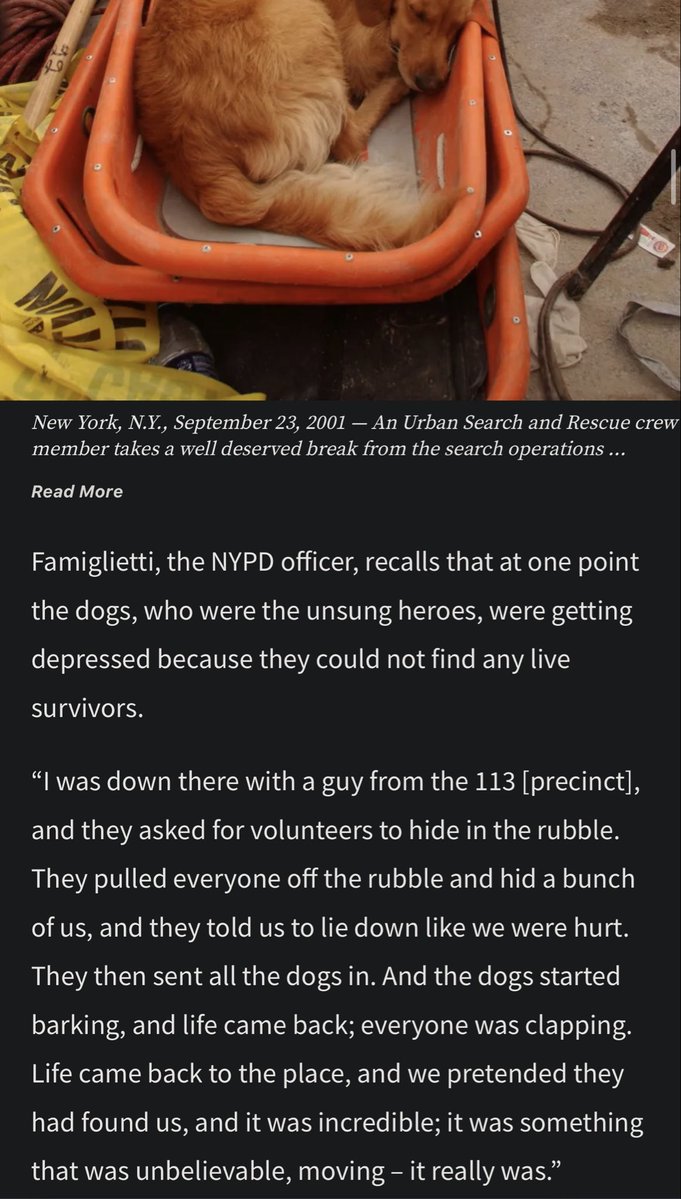
Only thing I'll mention about 9/11 today since I don't see it mentioned as much:
The search dogs got visibly stressed and actually lost morale from finding so many deceased people that workers would have to stage "successful rescues" (live people) for them.
Man, my heart..
@jjen_abel Yes, Tier 1 logos may squeeze the hardest on price, partly because the know their value as reference customers, but they are often the first to 'buy' - the smaller firms are much more circumspect, and they wait for industry leaders to move first.
Some research says(!):
Make daylight part of the working day: a walk before work or a lunch break outside. In the three hours before bed, lower room lighting and screen brightness. Keep the bedroom dark during sleep.
Those are practical ways to move towards the brighter days and dimmer evenings recommended by circadian researchers.
Blue-light glasses deserve a closer look; regarding the evidence for reducing eye strain and how they affect sleep.
The lighting you work in during day affects your sleep.
Eight (or more!) hours inside an office, then an evening (till past midnight!) under room lights and screens - keep receiving light long after sunset.
Now because light helps synchronise the body clock that regulates sleep and wakefulness, evening exposure can suppress melatonin and delay circadian timing.
New kids (agents) meet old systems.
Google Cloud’s report says 43% of IT leaders cite difficulty integrating legacy APIs and data sources as a major infrastructure gap.
While an agent may reason in seconds, but doing useful enterprise work means retrieving context from one system, calling tools in another, writing back to a third, and respecting permissions throughout.
Every brittle connector, stale schema and slow response becomes hurts the agent’s performance.
The cleverest agent may still spend its day waiting on software written before it was born.
https://t.co/xHvNkjVgSN
Seats measure access. Messages measure activity. Neither reveals much work was actually transferred to AI agents or importantly, whether the result was good enough to use.
All enterprise employees know that the longer answer is not necessarily a better one; and you could replace answer with meetings equally!
The useful metric may become completed, accepted workflows per employee. And can enterprises and development teams measure that?
OpenAI’s Enterprise Signals compares the top 10% of companies by monthly AI usage with companies around the middle.
The top group uses 3.5× as many generated tokens per worker and message volume explains only 36% of that gap. So the difference is not simply that leading companies send more prompts. They provide more context, assign more complex tasks and ask for more substantial outputs.
That points to the next enterprise measurement problem.
https://t.co/TvUB1MCtsZ
@alexandr_wang How about first making it available across the world instead of geo-restricting?
Was really hoping to try it yesterday but was greeted with my first ever region restriction message in an AI agent launch.
🚨 Reddit users say Astra xHigh lasts much longer than Medium
One Pro 20x user ran xHigh for an hour and used only 2% of their weekly usage, while Medium drained it much faster, and others said they saw the same thing. After checking the logs, they found Medium made 122 responses vs 65 on xHigh and burned usage about twice as fast.
https://t.co/Wr1aS78fIe
Intelligence requires energy.
Google Cloud’s report says 91% of leaders now factor power into AI hardware selection. Grid capacity and regulation shape deployment.
The path to agentic AI still runs along power lines.
https://t.co/Wotna8MWL2
3/ SaaS players have an obvious place here. They sit inside the workflow, with data, permissions and distribution. Model companies bring intelligence; services firms bring implementation.
Who is best placed to assemble the models, skills, connectors and controls for the job?
1/ Google Cloud has launched Gemini Enterprise for Legal: specialised legal skills, connectors to iManage and RelativityOne, partner agents and a governed platform. Google says it is the first in a series of packaged industry solutions.
https://t.co/FEurFEPfnJ
2/ TCS launched AgentHub for drug development: role-based AI workers for clinical development and pharmacovigilance, with oversight and auditability.
So cloud giants and enterprise SIs are both betting that agents will be sold industry by industry.
https://t.co/aSBnQsek2j
Dig a new well each time; or build the water system.
The first delivers one bespoke fix. The second turns each deployment into reusable IP: connectors, workflows, evaluations and product improvements.
Vinoo Ganesh, who ran Palantir’s Project Frontline, describes FDEs as an extension of the product team.
Software engineers rotated into the field, solved problems close to customers, then returned to product development with what they had learned.
https://t.co/wQ1LoF8ji2
@AndrewCurran_ Yup, the frontier labs can’t be out-machined! Can they be out-human-ed though? Better judgement, better taste and a more precise sense of the actual problem/opportunity? What will sell?
Just not able let go! How do you trust an AI with complete access to your email - its not just an email but complete control over all other creds that you have