The AI is not the architect. We are. These anti-patterns emerge when we forget that AI is a tool, not a replacement for understanding. https://t.co/4MgHYnUW4Z
4 AI Anti-Patterns That Waste 40% of ML Engineering Time (And How to Fix Them)
The AI is not the architect. We are. These anti-patterns emerge when we forget that AI is a tool, not a replacement for understanding.
https://t.co/m9msF9KNyt
Agent tutorials are easy to find. A structured path from patterns to evaluation is harder.
AI Agents - The Definitive Guide is the corresponding code repository for a book on agent systems, for builders studying how agents are designed, deployed, and evaluated.
It helps you work through the material in order by grouping Jupyter notebooks into 12 chapters and linking each listed notebook to Google Colab.
Key features:
• Chapter-based path – moves from LLM foundations and agent patterns through deployment, evaluation, memory, cost, and threat modeling
• Pattern notebooks – includes examples for Chain-of-Thought, Tree-of-Thought, ReAct, human-in-the-loop workflows, hierarchical teams, and swarms
• Colab access – every listed notebook has an Open in Colab link for running it in the browser
• Reliability coverage – dedicated material covers contracts, tools, reliable execution, secure tool governance, and deployment
• Evaluation and operations – includes notebooks for evaluation harnesses, external evaluation pipelines, memory comparisons, and cost estimation
Free public GitHub repo.
Link in the reply 👇
What an incredible month of response! 61K impressions and 3.7K reads. Immensely grateful to this growing community for tuning in.
https://t.co/083ZMse1Xm
Guys,
If you want to learn A to Z of AI/ML in 2026 not like 2019 then I have a big update for you.
This the repo where I am working with @sanshinde2012 on creating a open-source runbook to cover:
- Pre-requists of ML
- Data foundation
- Core mL
- Feature Enigneering
- Deep Learning
- AI Engineering
- MLOps
- Inference Engineering
- Making projects and portfolio
With resources in one place, I will be actively contributing to this repo and if you have any doubts and topics to add/request then raise issues or PR. We will merge it.
This is not a static one-way runbook. We want the engineers with experience should contribute and make the best possible way to learn AI/ML/LLMs/MLOps according current's market.
Check comment for GitHub link.
If you are looking to gain experience, start by learning from others' mistakes. But where can you actually find them?
My approach is to explore GitHub repositories and check their Issues sections. For a deeper understanding, I analyze the codebase as if I built it myself.
https://t.co/v4noyGB4HU
Medallion architecture assumed the reader never writes.
Agents write — corrections, decisions, whole new records — and nothing in Bronze, Silver or Gold says where those writes land.
Treat the agent as a source system. The ladder becomes a loop.
https://t.co/hbEGcUNB6U
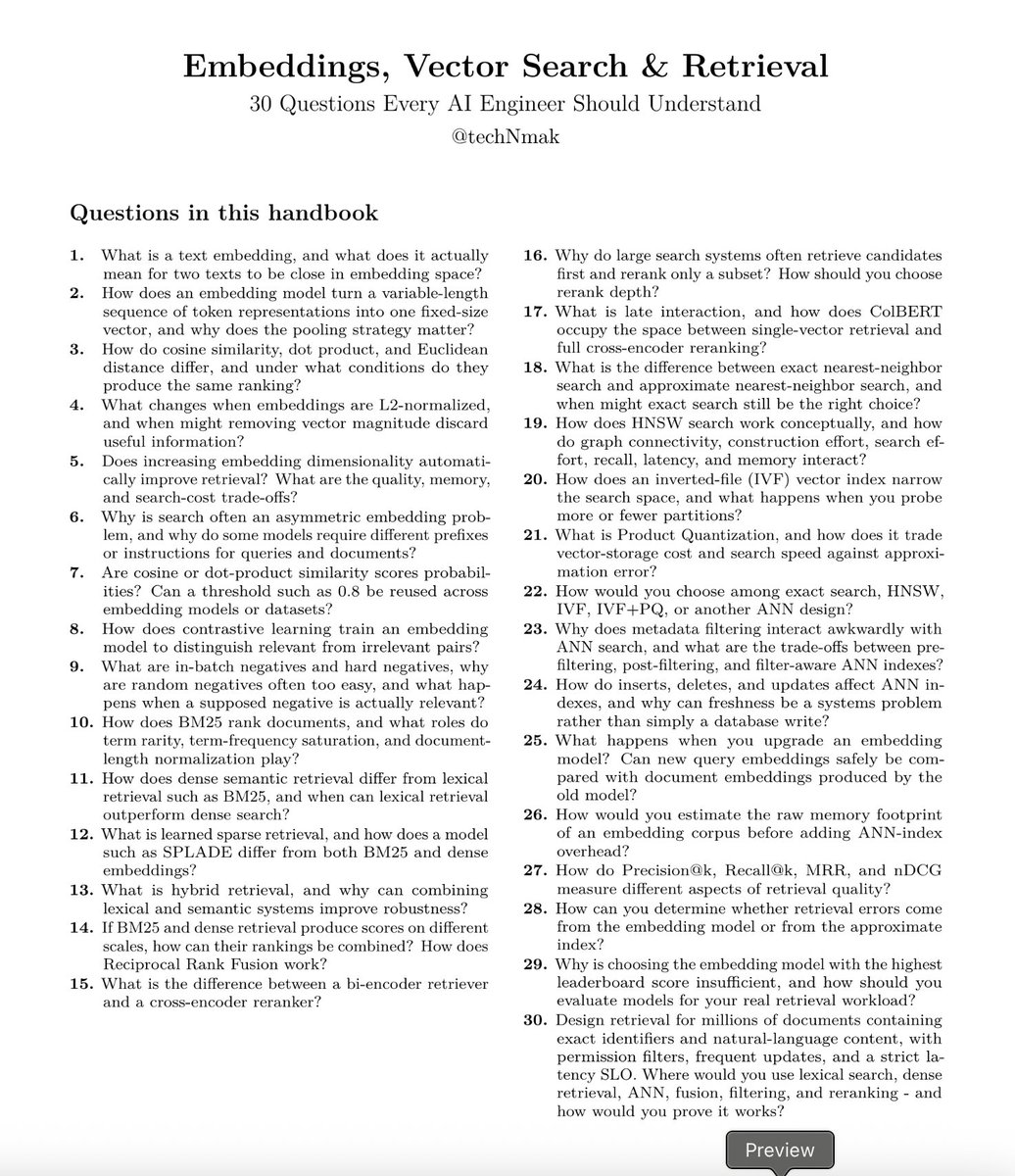
A 30-question breakdown of how embeddings, vector search, and retrieval actually work - similarity metrics, contrastive training, BM25, hybrid search, ANN indexes (HNSW/IVF/PQ), reranking, and evaluation.
➡️ Embeddings fundamentals
→ What it actually means for two texts to be "close" in embedding space
→ Pooling strategies, and why you can't change them at serving time
→ Cosine similarity vs. dot product vs. Euclidean distance, and when they rank the same
→ Why similarity scores aren't calibrated probabilities
→ Does more dimensions always mean better retrieval? (No)
→ Why search is often an asymmetric embedding problem
➡️ Training embedding models
→ How contrastive learning teaches relevance
→ In-batch negatives, hard negatives, and the false-negative trap
➡️ Lexical, dense, sparse & hybrid retrieval
→ How BM25 actually ranks documents
→ When lexical search still beats dense retrieval
→ Learned sparse retrieval and SPLADE
→ Hybrid retrieval, and why it's not automatically better
→ Reciprocal Rank Fusion, combining rankings on different scales
➡️ Reranking
→ Bi-encoders vs. cross-encoders
→ Retrieve-then-rerank, and how to choose rerank depth
→ Late interaction and ColBERT
➡️ Vector indexes & ANN search
→ Exact vs. approximate nearest-neighbor search
→ How HNSW actually works, and why it's not O(log N) in production
→ IVF and the speed/recall trade-off of probing
→ Product Quantization
→ Choosing between exact search, HNSW, IVF, and IVF+PQ
➡️ Production systems
→ Why metadata filtering breaks ANN search in non-obvious ways
→ Inserts, deletes, and freshness in ANN indexes
→ What happens when you upgrade your embedding model
→ Estimating raw memory footprint before index overhead
➡️ Evaluation
→ Precision@k, Recall@k, MRR, nDCG, what each one actually measures
→ Debugging: is the error in your embeddings or your index?
→ Why the top leaderboard model can be the wrong production model
You can follow for more learning!
Please share with your network!
Nowadays, writing code isn't the problem—understanding, owning, and securing that code is.
A strong foundation always matters because that’s how we truly help businesses define their value proposition.
Knowledge Graph Over Gold Product
Your joins live in keys and habit. An agent needs them drawn.
Dashboards never had this problem — a human picked the join path once and froze it in a view. An agent picks it again on every question, and at four hops the best models are under 40% accurate while still returning a confident number.
https://t.co/DExhwYb69g
Deciding system design for your Agents completely affects business and cost.
Agent Harness, LLMOps, Loop Engineering, and Evals matter more than the model you choose.
In this article, I covered all major concepts to design any agentic system.
Meanwhile, I designed an end-to-end Agent Harness PoC covering these major topics (GitHub link in comment)
From prompts and tools to context engineering, memory, and caching.
All concepts we already knew, but aligning them based on business requirements and agent expectations.
The attached video explains system design for agents excellently do watch it.
This is just part 1; I will upload 2 more parts.
The next part covers backend for agentic projects, explaining the importance of low latency, low cost, and better throughput for user experience.
Part 3 is a template for deploying any agentic application on AWS with minimal setup for dev and prod environments.
If you like the content, follow @kmeanskaran.
I'll post both articles by this Sunday.
Keep learning ;)
How I stopped waiting for a smarter AI and started building the system around it
- Asking (Prompting)
- Grounding (Context)
- Controlling (Harnessing)
- Delegating (Loop & Graph) https://t.co/qDn0Q7m7SS