DEEPLY DISTURBING!
BJP-RSS goons beating a young girl in the presence of Delhi Police, with an officer seemingly guiding them to stop the recording.
Why is Delhi Police helping goons attack peaceful protestors instead of protecting them? Who gave them this free hand?
BREAKING NEWS
The Norwegian Nobel Committee has decided to award the 2026 #NobelPeacePrize to Navanethem “Navi” Pillay for her efforts to promote peace and international law.
#NobelPrize
Apple has misunderstood the Indian premium consumer.
The product is not enough. He must also be visibly spared the inconvenience suffered by everyone else.
Launch a ₹50,000 VIP Darshan Style Pass for the first 100 iPhone buyers.
Skip the 12-hour queue. Walk in. Collect phone. Flex. Leave.
Ten thousand registrations on Day One. My guarantee.
India mein koi 5 minutes number Google kar le to doodh ka doodh paani ka paani ho jaye.
RBI surplus to Govt : ₹2.87 Lakh Crores (US$30 Bn)
Total listed bank profits : ₹4.11 Lakh Crores (US$42 Bn)
NPCI - which runs UPI pre tax ‘surplus’ : ₹ 1,888 crores (US$200 Mn)
To nuksaan kis ka ho raha hai UPI se aur kaunsi subsidy de rahi hai Govt UPI pe jo chubh rahi hai?
Cost of running ATMs and cash logistics in India is ₹30,500 crores (US$ 3.0 Bn). If you want to optimise shut ATMs and promote UPI instead.
Any levy on UPI is just tax collection. UPI is the one scientific achievement of India everyone acknowledges par ab tax ki bali chadhegi.
For the coming week:
0. You’ll see hoardings and banners everywhere assuring everyone that UPI is still FREE for every citizen
1. You’ll see influencers explaining how impossible it is to run such a complex UPI infra with no charges
2. You’ll see TV channels calling experts to talk about how complex the tech is behind running UPI at such a low cost
3. You’ll see ads and marketing campaigns of small vendors happily accepting digital UPI payments
Bhai Chandra sahab ke ₹22,000 crores maaf nahi karte to India mein UPI agle 20 saal tak free chal jaata by government’s number of ₹8,000 crores subsidy.
Also NPCI - which runs UPI has ₹6,119 hard cash on its balance sheet and pre tax operating profit of ₹1,900 crores. NPCI apne cash pe and profits par zindagi bhar UPI free chala sakti hai. Government ka kuchh lena dena hi nahi hai. Government earned ₹1,000 crores tax from NPCI last year.
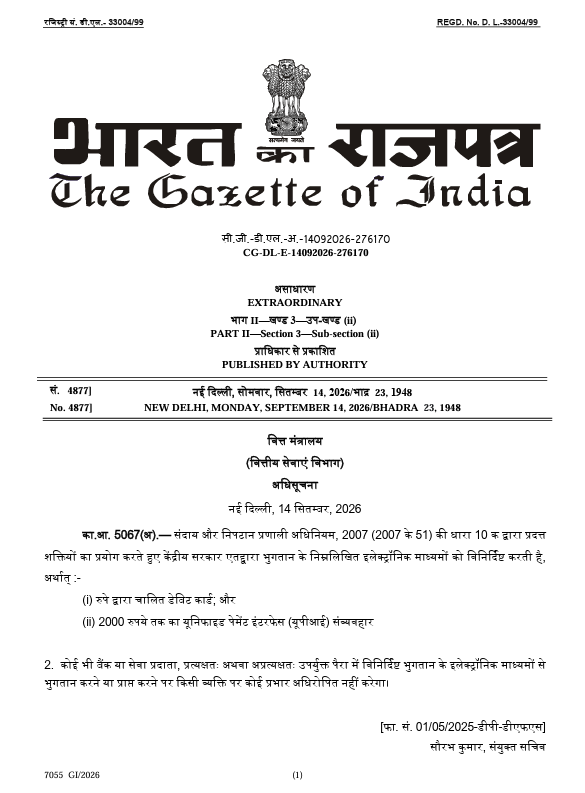
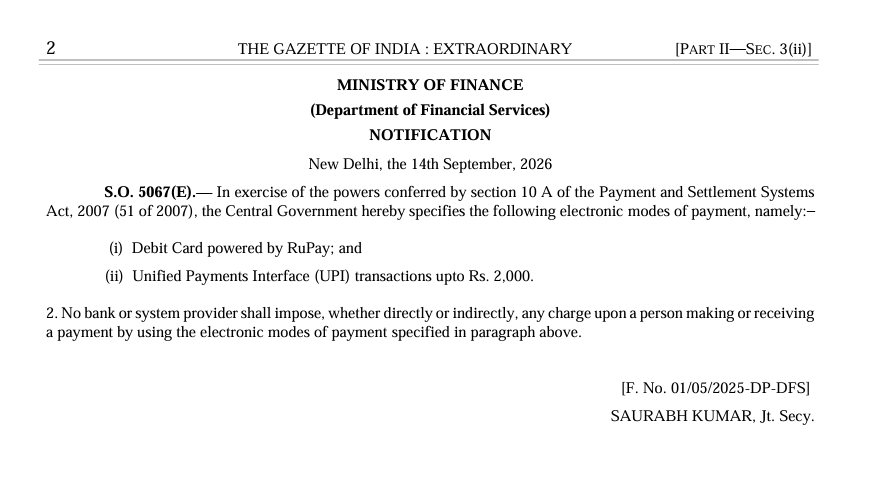
As per section 10A of the Payment and Settlement Systems Act, 2007 (51 of 2007), the Central Government prohibits banks and system providers from imposing, directly or indirectly, any charges on a person making or receiving payments using debit cards powered by RuPay and UPI transactions up to Rs 2,000: Ministry of Finance
Running UPI costs the industry an estimated ₹20,700 crore a year. The government puts in ₹2,000 crore.
Here is the math, in plain terms.
A UPI payment feels like nothing happens. You scan, you type a PIN, a green tick appears.
But behind that at least five parties work.
Your bank checked your balance and debited you. The shop's bank credited them. NPCI ran the switch that connected the two.
The app you used, whether that is PhonePe or GPay or Paytm, built and maintained the interface. And somebody ran fraud monitoring on that transaction in real time, plus a call centre for when it fails and your money is stuck.
All of that costs money. Servers, engineers, compliance, customer support.
A parliamentary committee report cited an industry estimate that processing one merchant transaction with an average value of around ₹800 costs about ₹2.
Now multiply.
August 2026 saw 24.51 billion UPI transactions. That is 791 million payments every single day. The committee noted that the current government incentive covers roughly 11 percent of what the industry says it costs.
So who is paying the other 89 percent today? Banks and payment apps, out of their own pocket.
PhonePe has said publicly that even the ₹3,900 crore it received in FY24 did not cover its operating costs. RBI Governor Sanjay Malhotra put it plainly earlier this year. He never said UPI can stay free forever.
He said there are costs and somebody has to pay them.
Look at how the government has handled this. Merchant fees on UPI were set to zero in January 2020. Before that, the cap was 0.30 percent.
Since 2021 the government has run an incentive scheme that reimburses banks at about 0.15 percent for small merchant payments under ₹2,000.
The amounts have swung wildly. ₹2,000 crore in FY24. Slashed to ₹437 crore in FY25. Budgeted at ₹437 crore for FY26 and then revised up to ₹2,196 crore mid-year as volumes exploded. Back to ₹2,000 crore for FY27.
The government trying very hard to keep something free while the bill grows faster than the budget line.
Now, one thing we need to understand is that nobody is proposing to charge us for our ₹40 chai.
The industry proposal on the table is 0.3 percent on merchant payments above ₹2,000, and only for merchants with annual turnover above ₹20 lakh.
Person to person transfers stay free. Small merchants stay free. Small transactions stay free.
For scale, on a ₹5,000 payment, 0.3 percent is ₹15. Paid by the shop, not by you.
Compare that with what merchants already pay on everything else.
Credit cards cost them around 2 percent. Debit cards can go up to 0.90 percent under RBI rules. A shop that happily pays 2 percent on a credit card swipe is being asked to consider 0.3 percent on a large UPI payment.
Brazil already does this. Its instant payment system, Pix, is free for individuals and charges larger merchants.
But why has the government resisted so hard on this so far?
See, the moment a merchant starts paying a fee, some of them will say cash only. But cash is not free either, it just hides its costs.
Notes have to be printed, transported in armoured vans, guarded, counted, and replaced when they wear out. Banks run vaults and ATMs. Shops lose money to fake notes and handling.
And there is a second, bigger reason, which Ashok Lahiri Ji himself made at the same event.
Every UPI transaction leaves a record. A kirana store with two years of UPI history is suddenly a business a bank can actually assess and lend to.
That shop owner has never had a balance sheet in his life, but he now has proof of daily revenue.
That is the single biggest prize in Indian finance right now. Bringing crores of small businesses into formal credit. It only works if the payments stay digital.
Yes, there is also a serious argument on the other side.
Some economists point out that keeping UPI free costs roughly ₹2,000 to ₹2,500 crore a year to serve about 49 crore users and 6.5 crore merchants, and that this is extraordinarily cheap for what it delivers in tax compliance, transparency and inclusion.
By that reading, the government should simply fund it properly instead of introducing fees.
My read is that the shape is already fairly clear.
Free for people. Free for small shops. A small fee on large merchants for large payments, which they already pay on every other payment method.
If the govt can hand out freebies worth thousands of crores, surely it can allocate a budget to keep something as transformative as UPI free.
We’re a country where people argue with sabziwala over 5rs dhaniya. Even tiny UPI charges could push people back toward cash.
So someone wants to make "Digital India" but want people to pay for it?
All this, over Direct and Indirect Taxes already.
The day such payments start, I am switching back to Cash.
Ganv mein daal do UPI.
> This government spent years flexing UPI saying UPI is India’s greatest digital success. We made even chaiwalas go cashless.
> Got everyone from street vendors to grandparents dependent on it.
> After everyone starts using UPI for literally everything, now government be like, you can’t use it for free anymore🤡
Then why tf did you spend years pushing everyone towards UPI? Just to get the whole country hooked on the convenience and then start charging for it? Everyone in this country is just hell bent on looting money from taxpayers for more useless laura lassan freebie schemes.