CT missed the most important earnings call of the week. It wasn't a crypto company. It was @Cloudflare
Everyone caught the wallet announcement. The real alpha was in the call itself.
Today Cloudflare monetizes the internet through subscriptions: security services, AI platform spend, pools of funds. A mix of SaaS and IaaS economics. The CEO was explicit that AI agents are about to break that model.
Cloudflare sits in front of roughly 20% of internet traffic. Here's what that traffic looks like from the call:
- AI agent requests up 1,700% YoY
- Agents crossed 50% of total network traffic this quarter. First time in history non-human traffic is the majority. Management admitted it happened faster than their own models
- Their projection: if trends hold, non-human traffic outnumbers human traffic 1000x within 5 years
The monetization shift is the key part. The ad-supported internet doesn't work when the visitor is an agent. Cloudflare's CEO answer: block malicious bots for free, charge good agents a tiny fee per request. Fractions of a penny. They want to be the ones defining that layer.
Now the throughput math here:
- Cloudflare handles ~500M requests per second
- They estimate 1 to 10% is monetizable via micro/nanotransactions
- That means 10M TPS on day one, scaling to 100M TPS
Visa peaks at ~20k TPS
The CEO's framing: "we're building this while others compete with Visa." Three to four orders of magnitude beyond card rails. No existing payment network can settle this. It has to be something new.
Two conclusions I keep coming back to:
- Being short L1 throughput is being short agentic workflows. If agent traffic gets monetized per request, the settlement layer needs to scale orders of magnitude beyond anything live today.
- The fee math for L1s flips. Base fees have collapsed across ETH, SOL, everywhere. MEV is getting internalized by apps. Hard to build a base fee revenue case at human scale. But at 10M TPS and $0.001 per transaction, you're looking at ~$315B a year in base fees alone. At 100M TPS the number gets silly.
Stablecoins and crypto are the end-game here for Agentic finance @jerallaire@circle
Our mission at Atlendis has always been to make it easy for everyone to access the finest curated off-chain Asset-Backed deals directly on-chain🫡
To advance this mission, Atlendis will be expanding to @modenetwork🟡 on the 29th of April
A thread about what it means and what is to come 🧵:
We’ve gotten RWAs all wrong.
The future of RWAs aren’t copy-paste of tradfi assets, inheriting the inefficiencies of the old system.
The RWA mega-protocols of 2030 will leapfrog tired off-chain infrastructure and:
A) Solve an actual, non-fugazi non-legerdemain problem for real world issuers and investors
B) Give rise to new new, blockchain-native asset classes (birth assets)
The reality is that most RWAs that end up on-chain otherwise wouldn’t be financed traditionally. The “problem” being solved, if any, is that risk is being underpriced. Adverse selection.
During my time at Maker, we (RWA units) helped usher in the current, flourishing era of on-chain RWAs. Serving as a sovereign mega balance sheet willing to take risk on commercial real estate, US gov debt, and structured credit.
We were the buyer in the market, we provided almost all the demand. This was key because every on-chain RWA marketplace easily finds asset issuers to SUPPLY assets (will look for anywhere that gives them the cheapest capital), but it has always been and will always be the DEMAND side that is elusive.
The next, binary unlock for RWAs is getting traditional, institutional investors to allocate. What will drive this? Again - 1) Solving a problem for them - i.e. lowering risk 2) Providing net new asset classes, otherwise inaccessible via traditional deal flow
1) Lowering Risk
Risk takes a number of forms, from credit to market to liquidity and many more. To me, fundamentally, blockchains are risk-reduction machines: counter-party risk, settlement risk, data fidelity risk, and eventually, as a function of successfully mitigating these risks, liquidity risk.
2) Net New Assets
Not the same old shit. Parametric insurance contracts, hash-power derivatives, deterministic debt (on-chain borrower's revenue contracts are escrowed), and vast securitizations of assets that would've otherwise never been securitized. This is what we are doing at @EntheosNetwork with smart battery securitizations.
This last point is important. Securitization is one of the most fundamentally important financial innovations in our lifetimes. Diversification drives a lower risk profile, which invites more investment, driving down the cost of capital to end borrowers, driving demand for more assets, which then get sluiced back into securitization and so on...
But most assets never make into securitization execution. Why? Because the service providers necessary to make it happen in a tradfi are prohibitively expensive.
Placement agents, investment banks, trustees, special servicers, master servicers, lawyers, auditors. These parties are paid massive amounts to pass paper and cash back and forth. Reporting on asset performance and remitting distributions.
Blockchains are built to remit high fidelity data, distribute value without settlement, custody, and counter-party risk, be audited easily and deterministically, enforce cash waterfalls via smart contracts, and permit seamless capital formation, combination, and composability.
Of course the devil lies off-chain: the oracles. I believe blockchains will combine with a new generation of higher-fidelity, tamper-proof oracles (i.e. not a servicer who collects a rent roll from landlords once a month).
Asset performance will be machine-reported, real-time, and highly reliable. We'll see composability between sensors, drones, and wearables reporting on assets and DePIN networks like @helium and @Hivemapper.
Ultimately what's being built is a completely fresh supply chain for infrastructure, physical (renewables, telecoms, etc.), financial (new securitization structures, reporting (IoT), and legal (smart contract logic).
Incrementalism isn't going to cut it. Blockchains are an exponential technology and will seep into every aspect of the real world.
1)
While broader crypto is in shambles, Maker continues to grow its position as the biggest in DeFi
Everyone else shitcoin'd and ponzi'd. Maker built stuff that works & in the last month Dai grew by 400m
Next up is SubDAOs and they will be a gamechanger for growth in crypto
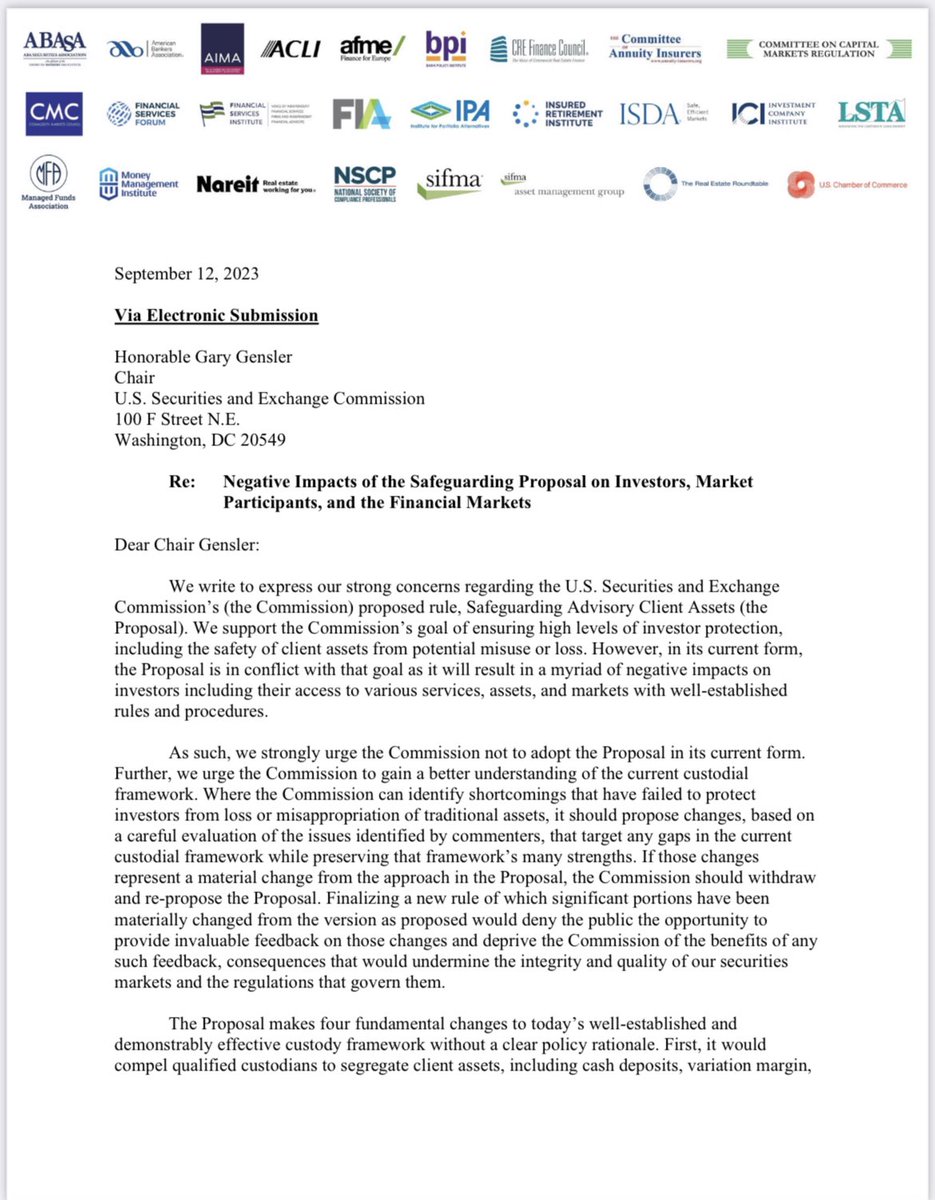
Noteworthy this morning: @SIFMA, @ABABankers, and basically every other major tradfi DC trade group has submitted a comment letter to the @SECGov saying the safeguarding (custody) rulemaking should be withdrawn entirely.
The Federal Reserve is currently paying banks 5.4% on reserves. Some of those bank reserves come from customer deposits. The average rate banks are paying depositors is 0.43%
In any other industry, this would be a scandal.
Imagine: The US government sold oil from the SPR to oil firms for $1/BBL while they sold it to the public for $4. There would be protests and congressional hearings. But not in banking.
Why am I bringing this up? Because the simplest explanation of the U.S. government's hostility towards crypto (and even FinTechs) is a near obsession at the highest levels with protecting financial intermediaries and their profits.
We saw this play out in both 2008 and 2020 when far more resources were spent on saving intermediaries than the general public. There are almost as many examples as there were interventions.
This is the point at which 90% of economic experts start yelling at me that I am oversimplifying a complex issue unfairly.
"The intermediaries were saved because they serve the public interest" these experts would say. "It wasn't corruption, it was complex econoomic management."
Yes and no.
While such programs MAY benefit the downstream public, they MUST benefit the intermediaries, because that is how they are designed. Oddly, this is the part of the interventions that is never debated.
So the talking heads will argue endlessly about whether the Fed should lower rates by buying Treasury bonds or MBS from Wall Street, but they won't debate whether the Fed should buy those bonds directly from the agencies that issue them. The notion that they should only be bought from a handful of primary dealers is sacrosanct.
And yet while you, Joe Shmo public, may or may not benefit from JPM's latest interactions with the Fed, JPM obviously will, otherwise they wouldn't participate.
It's not corruption per se, but a form of groupthink and consensus about how the world should be.
Crypto represents a different paradigm.
Many of the people doing the pushing don't even realize they are trapped within this paradigm. So they'll go on about how blockchain--a technology invented to replace intermediaries--is best utilized to make those companies marginally more efficient. Then they'll tell you that stablecoins are dangerous, while checking accounts at levered banks like SVB (or Lehman, or WaMu) are not.
The existing Washington-Wall Street complex is like an organism. And like any other organism, it fights back when it feels threatened. Crypto is the biggest threat it has faced in generations, so it is fighting back fiercely.
How do I feel about the re-branded crypto market structure bill?
Happy, Sad, Frustrated, Angry
Happy: A bill got out of committee with *bipartisan* support!
Sad: It won’t get passed by the Senate. (Maybe the stablecoin portion)
Frustrated: The bill centers on CFTC vs SEC jurisdiction dispute resolution
The bill misses the unlock: SRO and ‘the Big Prize’
*The Prize is unlocking cultural relevance*
The Prize is enlisting a broad constituency that cares and derives value from Digital Assets.
There are 1,000 artists with the same talent and drive as Taylor Swift when she was unknown 13 years ago.
Example: NFT crowdfunding
An NFT framework that enables creators to disintermediate publishing houses.
How? By crowdfunding tours from their fans - the best underwriters who know the subject matter better than anyone.
The concept of a Direct Listing, how Coinbase and Google went public without an investment bank, also applies.
These are variations on the theme of Tokenization.
Make no mistake, Tokenization *is* securitization…
…in all of the interesting use-cases:
- NFT creator scenarios
- Democratized (fractionalized) access to asset classes (MBS/CRE debt/Marvel Comics royalty streams, etc)
- Banking on-chain
- Crowdfunding, Issuance on-chain
That requires updating SEC regulation directly.
Where to start?
The ‘lead domino’ is Creator economy…
Pushing the CFTC at all costs w/o advancing a crypto securities framework solves for the Present not the Future.
The creators on Youtube, TikTok and Spotify - have a much greater constituency than the entire Digital Assets sector.
But they don’t care b/c the sector is not relevant to their daily life.
Crypto crowdfunding frameworks are inapplicable (although the tech is ready)
Now imagine if the creatives derived value from Kickstarter-style NFT crowdfunding model. Users participate in the upside.
Imagine small banks participating out interests in senior performing debt to their local communities?
These are examples of Investing in the American Dream.
How would the public and artists, restaurant owners, small banks choking on CRE debt - perceive Digital Assets then?
Who would the losers be?
Gatekeepers. Publishing houses and investment banks, big artists who benefit from the status quo, and too-big-too-fail banks.
Isn’t Investing in the American Dream a prize worth fighting for?
Crypto’s biggest constituency - IP creators, builders, and investors - are in the Future.
@jchervinsky@katie_haun@kristinsmith@coincenter@jerrybrito@brucefenton@twobitidiot@DigitalChamber@PatrickMcHenry@austincampbell@RebeccaRettig1@sheila_warren
Watching the stablecoin hearing blow up over behind the scenes machinations to try to assert Federal only control over the space is mind-blowing.
This sort of issue is precisely why the US is positioned to completely lose control of the financial rails used for global transactions.
To make clear why this is so absurd, let's start with a fundamental definition: a stablecoin is the representation of a unit of fiat on a blockchain. That's it. If you think that's an existential threat to the system, then you believe changing the ledger technology of a money market fund or a bank deposit can destroy your financial system. If that's true, you have way bigger problems than just the blockchain part.
Given that, and given the lessons we learned in 2008, there are obviously some good ways to do stable financial products (gov't mmfs, unlevered bank entities, stable value funds) and some bad ways to do stable financial products (prime mmfs, securitizations, levered banks).
There's also a question of what size these things become relevant at. As of today, fiat-backed stablecoins in the United States range from ~$2mm (GMO) to $26.5B (USDC). Quite the range! Also, very, very small compared to money market funds, which are a $5T industry, approximately.
Thus, the overwhelming panic about having the Feds vs. States regulate a $2.5mm stablecoin (completely serious that this is what the hearing just fell apart over) can only be explained in one of two ways:
Either you don't understand what you are regulating and haven't done your homework, or you are desperately trying to protect incumbent banks from any competition. There's no other reason to require Fed and OCC approval of something so small it wouldn't even register as relevant to most state regulators, much less an entity that doesn't regulate a single bank under $100B in size.
If the United States can't do better than this, some combination of China, the EU, and the UK will, which will have dire consequences for the value of the dollar and the US economy.
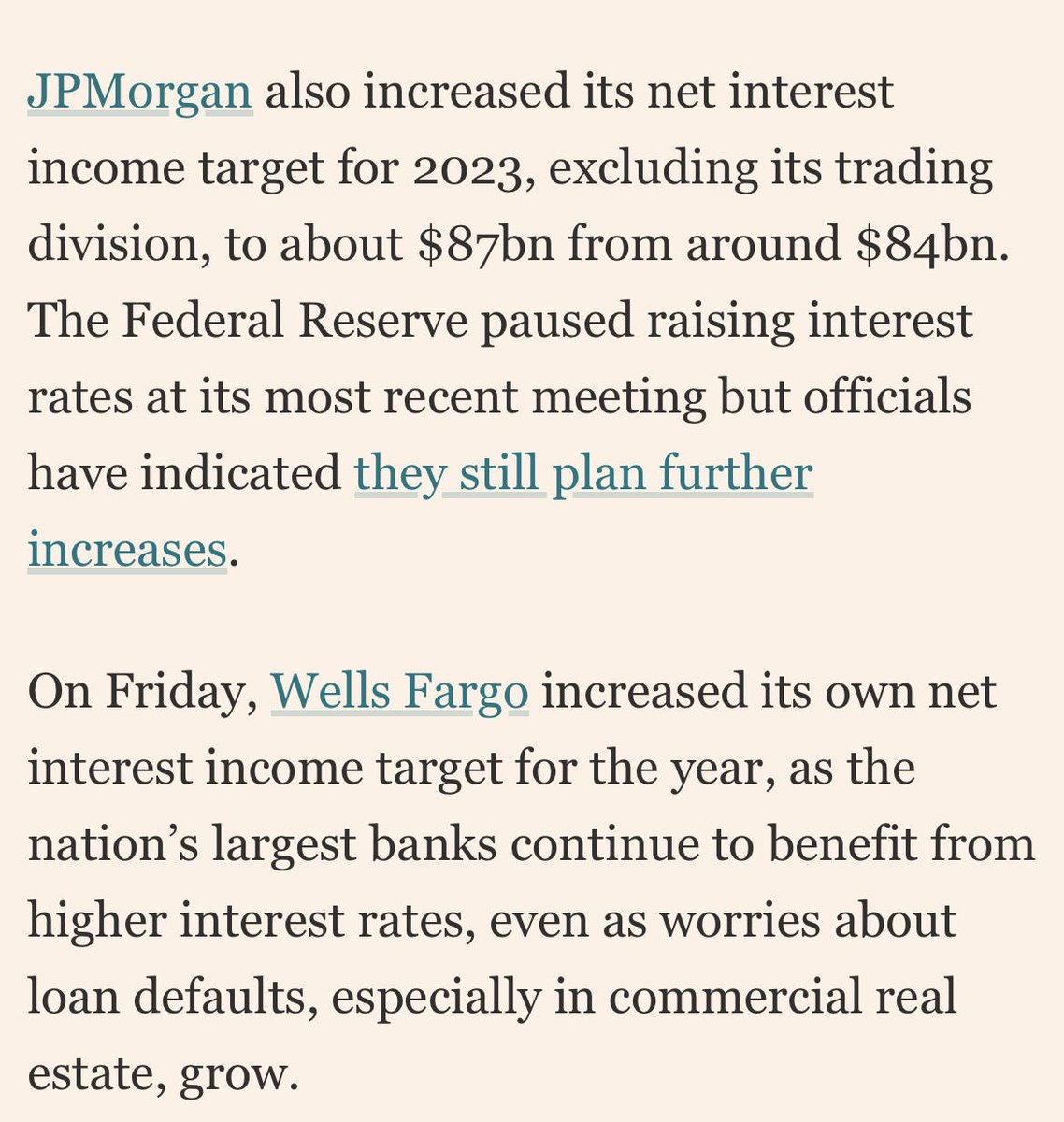
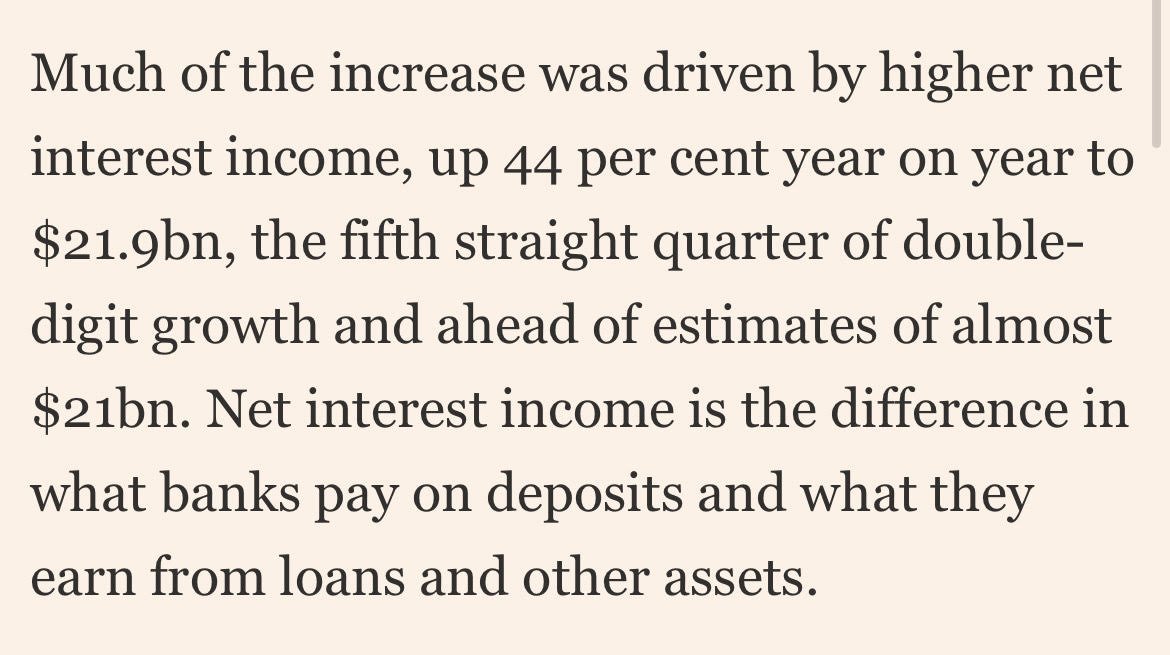
Big banks like JPM and WFC reported monster earnings today thanks to high net interest margins (NIM)
While many attribute this to Fed hikes, the real reason are laws that force all of us to subsidize banks.
Crypto fixes this, but not without a fight. Here's how 🧵👇
The fact that we have a BTC futures ETF, an inverse BTC futures ETF, and a 2x leveraged BTC futures ETF, but still no BTC spot ETF is insane
Not only are futures riskier and more expensive to hold than spot, but futures contracts are inherently based on the spot market
@nic_carter Jan 2018, Marc Lipsitch: "like myself, worry that human error could lead to the accidental release of a virus that has been enhanced in the lab so that it is more deadly or more contagious than it already is... potential to jeopardize millions of people."
https://t.co/t018dDyYkQ
Long thread, no TLDR:
Throughout Uniswap's history, there have been many moments that upset people
Raising VC funding, adding fee switch to v2, not having a token, having a token, criticizing Nomi days before he rugged, blocking certain tokens in the UI, geoblocking OFAC countries, concentrated liquidity, BUSL, etc
Some people wish instead of raising money to build at scale, I begged for grants until I ran out of money and gave up
Some people wish I moved abroad and launched a token anon, and had to look over my shoulder the rest of my life
Some people want me to practice civil disobedience, intentionally flaunting laws they (and often I) believe are unjust and live with the legal consequences
Some people disagree with structural, economic, or technical decisions that were made
I work in crypto because of the immense positive impact I believe it can have on the world by removing gatekeepers, and increasing access to value and ownership, the same way the internet has for information
I work on Uniswap because I think it has massive potential to contribute to that outcome
I'm incredibly proud of Uniswap v1, v2, v3, v4, the thousands of projects building on top of it, the web app with millions of users, the wallet with hundreds of thousands of downloads, and the airdrop that changes thousands of lives around the world
I've made many mistakes, but stand behind the decisions I've made. I'm a bit introverted, so constant public communication can be tough. But I'm going to continue pushing myself to engage publicly, transparently, and clearly as often as I'm able.
We're still in the early days - this technology and revolution will play out over decades. I'm in it for the long haul - that's why I'm still grinding away 5 years in
Hope that we can come together more as an industry, and see past minor disagreements
The more uni-fied we are, the stronger we are, the harder we are to kill. So lets be frens
🦄💜
Recently:
1) Brazilian President Lula asked why should every country be tied to the US Dollar rather than just trade in its own currency?
2) BRICS countries finalized agreements to trade with each other in their own currencies
So, has the de-dollarization started?
Thread
1/
and the expression of ideas, but not the world leader – or even a major player – when it comes to the adoption of decentralized, digital money."
https://t.co/VU87vHB2hy
"Speaking and transacting combined represent the overwhelming majority of human activity. It occurs to me that America is making the gravest of strategic mistakes by choosing to be the world’s leader when it comes to decentralized, digital publication of words...