Former Governor of the Bank of England, now Prime Minister of Canada.
A fascinating NYT interview with Mark Carney — a rare perspective from someone who has moved from central banking to political leadership.
https://t.co/OrbGoOTeAz
Carlos Garriga (St. Louis Fed research director) on why the FOMC feels like it's rushing and dragging at once: deduction is slow, induction is fast, abduction is flexible but hard to verify.
The rate is a negotiated equilibrium, not a solved equation.
St Louis Fed research Director Carlos Garriga has a very insightful piece on 3 types of reasoning that happens in the FOMC:
Induction, deduction, abduction.
We would be fortunate if currently there is more than one type.
https://t.co/E9qSMsHtz9
This paper finds that 90% of the observed rise in the 10-year US Treasury since August 2020 has occurred in the three-day window around US payroll reports or speeches by top Fed officials (the chair, vice chair, or Waller), which accounts for just 24% of trading days
The paper finds those days are responsible for 81% of the rise in markets' expected average short-term rate over the next 10 years, which means this isn't about investors getting nervous about holding long-term debt and is instead about markets revising their view of short-term rates.
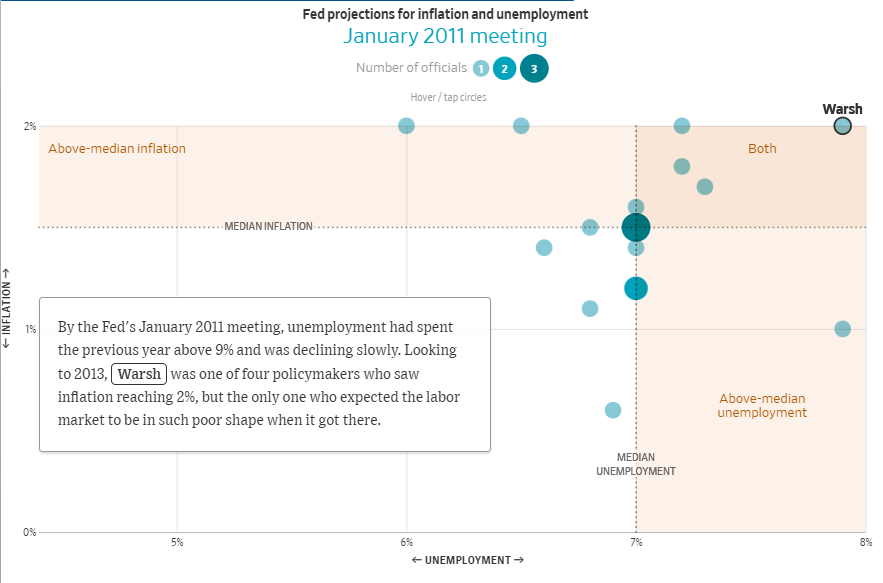
Kevin Warsh has been critical of how the Fed publishes forecasts and feels pressure to defend them.
As a Fed governor from 2007-11, he submitted one every quarter. They came out on the Fed's usual delay, after he left the Fed, and they haven't gotten much attention since.
@biancoresearch Quantifiable, and it backs you exactly: we ran tomorrow 19x modeling the 12 as independent voters —Warsh hikes in all 19, room holds 2/3. He gets outvoted. The 35–40% sits in 5 swing members, median run = 3 dissents. This Fed needs 12 reaction functions, not one.
@Claudia_Sahm That gap — hawkish Chair, compromising committee — is precisely why the 2:00 statement carries the information, not the 2:30 presser. Curious whether your redline keeps June's deleted easing-bias line out, or walks it back toward it.
@Claudia_Sahm This is exactly right — and it's measurable. We model the members individually and ran tomorrow 19x:
the Chair votes to raise in all 19, and the room still lands on hold in two-thirds of them. The median run produces 3 dissents.
@LarkDavis The tail is real and rising — our sim pegs it at 32%. Still a tail, though: 68% hold. And for markets the bigger tell isn't hike-vs-hold, it's the dot plot and whether the hold is unanimous. Our median run throws 3 dissents — a hawkish hold can move markets as hard as a hike.
@DeFiTracer The tail is real and rising — our sim pegs it at 32%. Still a tail, though: 68% hold. And for markets the bigger tell isn't hike-vs-hold, it's the dot plot and whether the hold is unanimous. Our median run throws 3 dissents — a hawkish hold can move markets as hard as a hike.