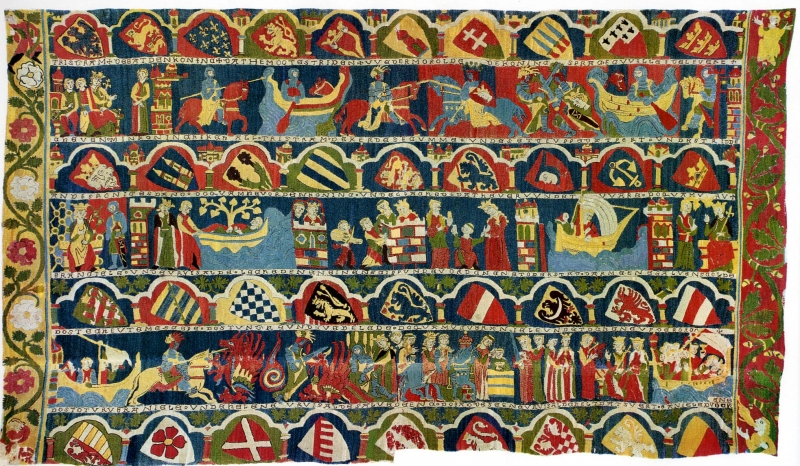
I think this counts as a lay down misere:
French: Le Mot (@WordleFR) archive #407 [20/02/2023] 5/6
⬛⬛🟨⬛🟨
🟩⬛🟨⬛🟩
🟩🟩⬛⬛🟩
🟩🟩⬛⬛🟩
🟩🟩🟩🟩🟩
https://t.co/KUDuRPFdmB
@MayFaireMoon@SallyTuckett I think in this context they're more likely to refer to specific weaving patterns which include images of roses and lavender plants.
@SallyTuckett My guess is that it derives from the Elizabethan use of the term to describe patterned flower beds, i.e. knot gardens. See OED n.1, senses 6 and 7.
@SallyTuckett I'm going to disagree with most commenters here. 'Knots' is a term used in 18th c. Scottish inventories to refer to woven patterns in damask napery. See Habib & Clark, 'Linen Weavers of Drumsheugh ...', Proc Soc Antiq Scot, 132 (2002), 529–553.
@UnaMcIlvenna He was subsequently transferred to Doveton, the second in a series of four abusing priests sent to that parish. I would love to know who made the decision to transfer him as far away from Laverton as possible, and who made the decision to bring him back to Victoria.
@UnaMcIlvenna In 1974 my family moved (ironically) from Ballarat to Nhulunbuy, one of Australia's most isolated towns. Our parish priest, Victor Rubeo had just been 'loaned' to the Darwin diocese from his previous post in Laverton, where he had abused children.
@SarahABendall Similarly, denim is (at least linguistically) derived from 'de Nîmes', and was possibly a French attempt to reproduce cloth 'de Gênes' (from Genoa) - from which we get jeans.
@FourRedShoes As someone who did my PhD while working full time, I am constantly being tripped up by such unspoken conventions and expectations. It's too easy for them to become forms of gate-keeping.
@churchartnature@PeterMGilliver@lauravarnam@SlCathy Heraldic martlets (as opposed to house martins) are mythical and have no feet because they were supposed never to land. But I think that's probably a later explanation for a generic bird silhouette.