I don't want to get into this GDP growth debate. I lost interest in this data point a while back.
Instead I go with " Real Feel" GDP growth.
India,$4 trln , growing ~7%: Crashing quality of life. Janata looks stressed. Traffic looks chaotic.
Cities & villages look GDP of a $ 100 billion country not 4 trln.
"Real Feel" : GDP growth of 2-3%
Europe: GDP growth: ~ 2-3%. Janata looks happy. Khushhali - happiness everywhere. Everything looks super chic, organised. Clean. Cafes, restaurants buzzing, music on the streets. Lovely villages.
"Real Feel": GDP growth of 7.8%
MASSIVE EXPOSE 🤯
Economist & Former Finance Secy Subhash Chandra Garg revealed that actual GDP growth rate is 2.6%, NOT 7.8%
He exposed Modi Govt based on its own data, not speculations.
Watch how shamelessly NDTV anchor tried to shut him down, but he didn’t stop.
@pvsubramanyam@yadavakhilesh As a old man, you should have sense in your talking and maturity. Since papu govt was not right, that is why selected this sanghi govt. Againg doing the same means then what is the use ? Think wisely
@Sowmiyanbumani@singersrinivas Mam, you are doing fantastic job in Assembly putting all the data points. Please ensure all the issues raised are been addressed by the present govt. Kudos to you👍👍
@mrjethwani1 Since roads are neat and clean there, these upper castes are rolling there. Ask them to roll in chennai roads nobody ready to do that idiots. That is the reason all foreigners kicking these Indians out
Rearing four wild tiger cubs reflects peak ecosystem health. A litter this size requires high prey density and a secure core territory to support the metabolic demands of lactation, which increases a mother’s daily caloric requirement by roughly 50%.
To nurse all four cubs simultaneously, the tigress relies on a functional postural shift. Lying on her side, Elevating her leg opens direct access to the higher-yielding rear inguinal teats, allowing every cub a dedicated spot to feed without overcrowding while the mother conserves critical energy.
VC: Durgesh Sonawane
( @ durgesh_sonwane_pench )
#Tigers #BigCats #Wildlife #Conservation #Nature
KAYNES: 2 years ago, everyone said India couldn’t do semiconductors. Now Kaynes wants to build the entire chain.
Sanand, Gujarat, 2023. Kaynes buys land for an OSAT plant. Skeptics said India would forever be an assembly-and-test shop — importing chips, packaging them, nothing more.
Fast forward to today. Kaynes Semicon isn’t just running the OSAT plant. CEO Raghu Panicker has told ET the company is in advanced talks to go upstream — wafer fab, compound semiconductors, chip materials, equipment manufacturing.
Here’s what’s actually on the table:
1/ Wafer fab JV — potential sites in Sanand and Dholera, Gujarat. Spread across multiple locations, not concentrated risk.
2/ Chip materials — talks with a Japanese company on manufacturing equipment and spares domestically.
3/ Semiconductor materials segment — a separate JV in discussion.
Why now? ISM 2.0. The Union Cabinet cleared it on July 15 with a ₹1.27 lakh crore outlay. Buried in it: a 30% capital subsidy for domestic semiconductor materials and equipment manufacturing. That subsidy is the trigger — it makes the economics of backward integration actually work.
The pattern to notice: Kaynes isn’t trying to build every layer alone. It’s doing this through JVs and tech partnerships — same playbook as its SEALSQ tie-up for post-quantum chip personalization, announced earlier this year. Capital-light, technology-heavy, de-risked.
Why this matters for the business:
→ OSAT alone is a services margin business — assembly and testing fees. Moving into materials and equipment shifts Kaynes toward higher-value, stickier revenue pools.
→ A wafer fab JV would make Kaynes one of the few Indian players with exposure across the full value chain — design-adjacent, packaging, and now front-end fabrication.
→ The 30% capex subsidy under ISM 2.0 materially changes unit economics for anyone building materials/equipment capacity domestically — first movers capture that advantage.
→ Diversifying beyond a single OSAT customer concentration (Alpha & Omega Semiconductor takes a large share of current capacity) into multiple verticals reduces single-client risk.
The bigger picture: India’s semiconductor mission was always going to be judged on whether OSAT players could climb the value chain, or stay stuck at the bottom of it. Kaynes is now the test case for whether that climb is actually happening.
— At Zenflow Finance, we track what actually moves the value chain, not just the headline.
Though the ruling party’s ecosystem praises Nirmala Sitharaman as the best finance minister, I have explained many times, with details, why she is the worst finance minister in post liberalised India.
I was not surprised when she said that the NEET re-exam gave students an opportunity to prepare further.
She has always been insensitive, arrogant, and completely detached from the reality of day to day India.
🚨 Ex-HPCL Chairman MK Surana Says On Record:
Ethanol cost: ₹56.71-71/litre
Ex-refinery petrol price: ~₹53/litre
Ethanol blending will not lower the fuel prices because ethanol is costlier than petrol. It's not a discount.
If you've always been confused about CFO/EBITDA, this tea stall example will make it click in under 5 minutes.
Most people think profit means cash.
It doesn't. One of the simplest ways to understand a business is by looking at CFO/EBITDA.
Let's use a tea stall example for understanding this.
Imagine you sell 1,000 cups of tea in a month.
Selling price per cup: 20
Revenue = 20,000
Now let's calculate EBITDA.
Milk, tea leaves, sugar, cups, gas, helper wages and other operating expenses together cost 14,000.
Revenue = 20,000
Operating expenses = 14,000
EBITDA = Revenue - Operwtingexpenses
= 20,000 - 14,000 = 6,000
Your EBITDA margin is 30%. ( 6,000/20,000) * 100
So far, so good.
Now remember that EBITDA is NOT the final profit.
Your tea cart also has depreciation.
Maybe you bought equipment that slowly wears out over time.
Let's assume depreciation is 500.
EBIT becomes 5,500.
Suppose you borrowed money to buy the cart.
Interest cost is 300.
Profit before tax becomes 5,200.
Assume taxes are 1,200.
Profit After Tax (PAT) is now 4,000.
Many investors stop here.
They think the business earned 4,000.
But here's the real question.
Did the business actually receive the cash?
Let's see.
Out of the 20,000 sales,
Customers paid only 16,000.
The remaining 4,000 was sold on credit (Udhaari we say in day to day life )to nearby offices.
On paper, revenue is still 20,000.
PAT is still 4,000.
But your bank account has received only 16,000.
Now let's look at working capital.
You also had to buy extra milk and tea leaves worth 2,000 before month-end to prepare for next week's demand.
That inventory is sitting in your store.
You have paid for it.
But you haven't sold it yet.
Cash has already gone out.
Now calculate Cash Flow from Operations.
Start with EBITDA = 6,000.
Subtract increase in receivables because customers haven't paid yet.
Receivables increased by 4,000.
Subtract increase in inventory because cash is stuck in stock.
Inventory increased by 2,000.
CFO becomes: 6,000 - 4,000 - 2,000 = 0
Think about that.
The business reported EBITDA of 6,000.
It even showed PAT of 4,000.
But operating cash flow is zero.
The business generated accounting profits.
It generated almost no operating cash.
This is exactly why working capital matters.
When receivables increase, cash gets stuck with customers.
When inventory increases, cash gets stuck on shelves.
When both rise faster than profits, a company can report beautiful earnings while struggling for cash.
Now let's calculate CFO/EBITDA.
CFO = 0
EBITDA = 6,000
CFO/EBITDA = 0%
That tells you almost none of the operating profit became cash.
Now imagine another tea stall.
Same revenue.
Same EBITDA.
Same PAT.
But customers pay immediately.
Inventory stays under control.
Operating cash flow is 5,700.
Now,
CFO = 5,700
EBITDA = 6,000
CFO/EBITDA = 95%
That's a fantastic business.
Almost every unit of operating profit turns into real cash.
This is why experienced investors love cash flow.
Accounting profit is based on accounting rules.
Cash flow is based on money actually entering and leaving the business.
Profits can be improved with assumptions, estimates, depreciation policies, revenue recognition and many accounting judgments.
Cash is much harder to manipulate over long periods.
Whenever you study a company, don't stop at Revenue, EBITDA or PAT.
Always ask one more question:
"How much of this profit actually became cash?"
That single question can save you from many bad investments.
#CFOEBITDA #KPIs #Financecontent
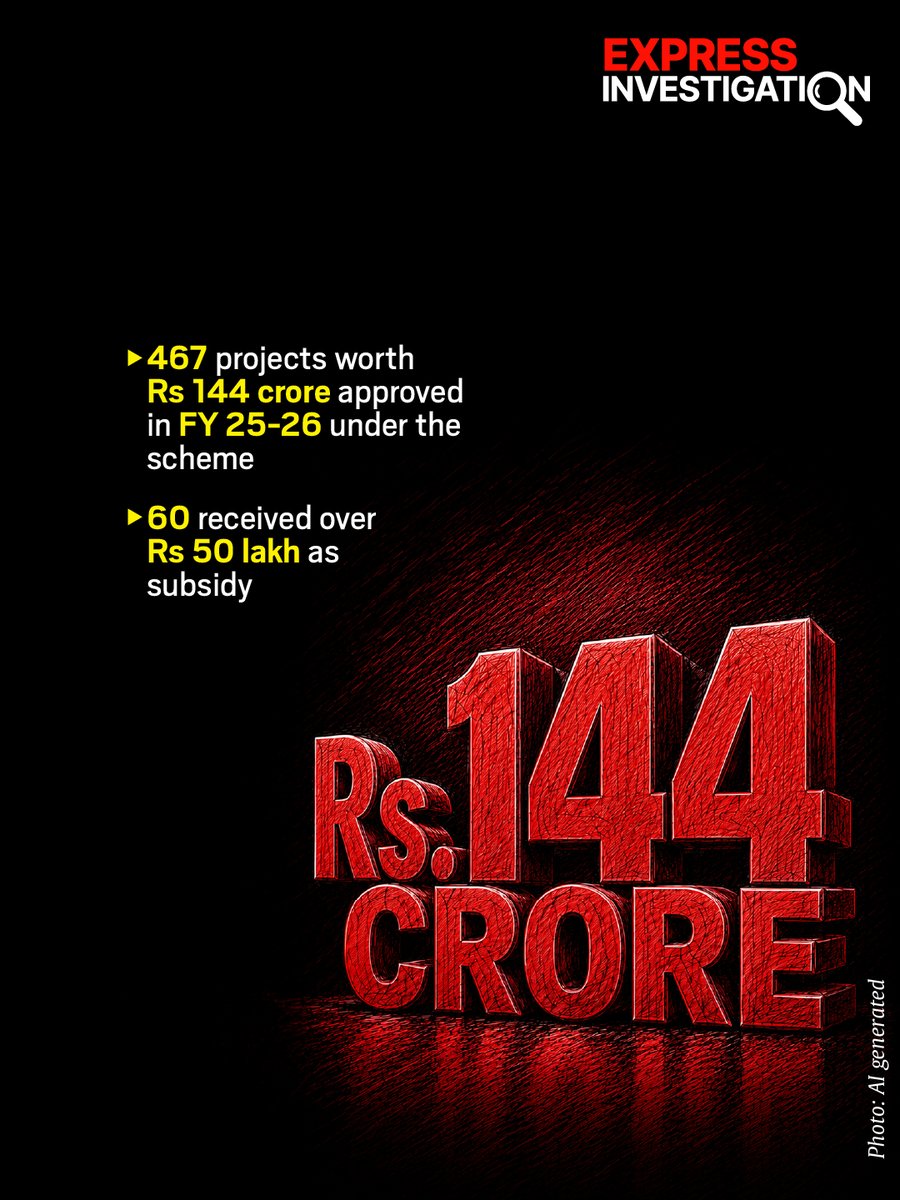
🚨 #ExpressInvestigation | The Union Minister of State for Agriculture Bhagirath Choudhary received a ₹99.03 lakh subsidy for a commercial cucumber farming project under a scheme run by the ministry he serves in.
While the final approval was granted by an NHB project approval committee that does not include the minister, Choudhary is the ex-officio Vice-President of the NHB board that oversees its functioning.
The project, worth ₹1.99 crore, was among 467 approved under the scheme in 2025.
Express Investigation by: Harikishan Sharma
@svembu We are also fed up with this DMK corruptions in TN all along. You are very critical against only DMK corruption. Why not talk about anything against BJP corruption which is quite very monumental. One should be against all corruptions irrespective of any political party.
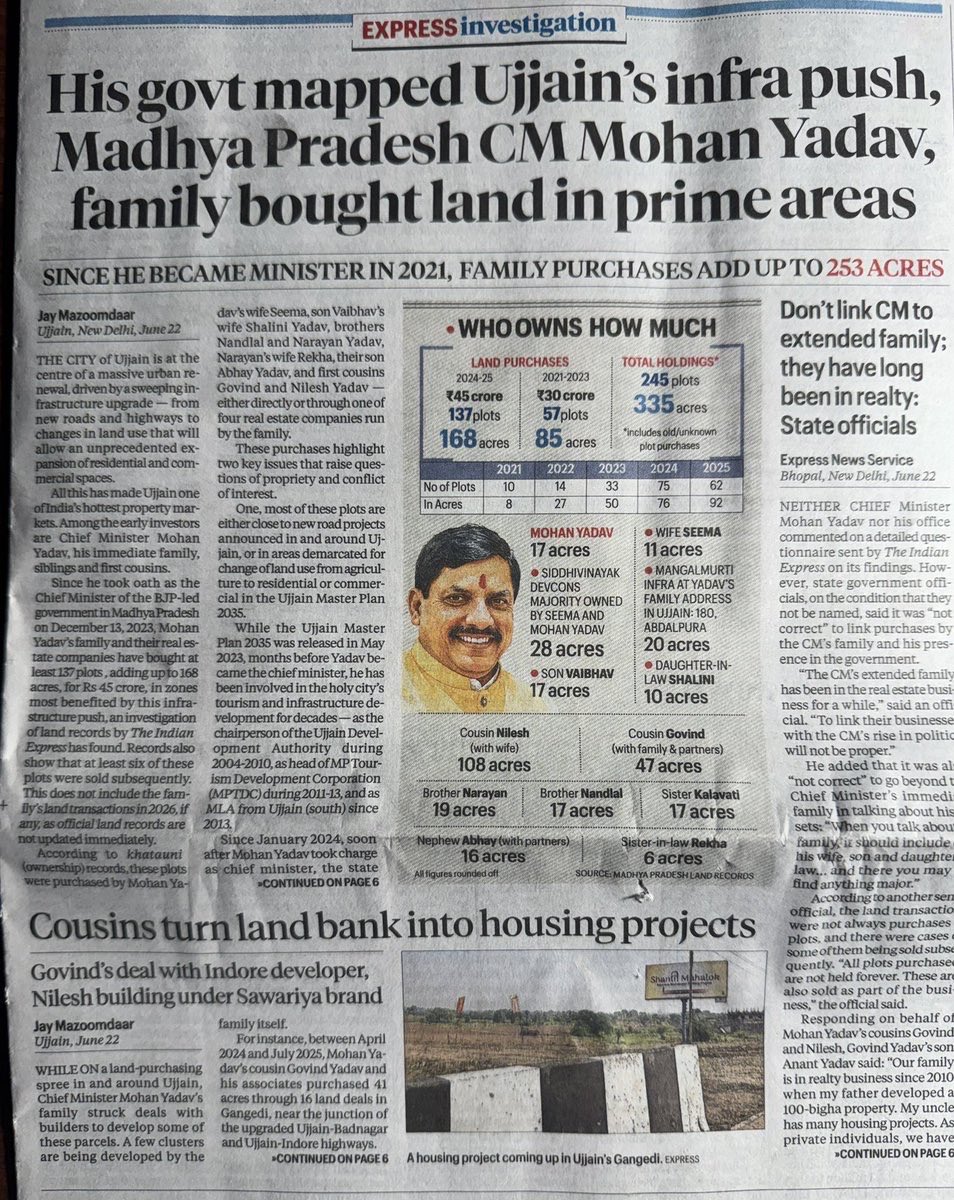
Super story by @mazoomdaar at @IndianExpress that only confirms another of the worst kept secrets of Indian politics. Across India, those in power are making windfall profits in private real estate deals by simply getting a change effected in land use. Only difference: no punitive action if it’s a ‘DOUBLE ENGINE’ state! 🙏