Living at the intersection of policy, research, & practice in wildfire mitigation. Former mayor of Mill Valley. Opinions my own & not reflective of my employer.
I was mayor of Mill Valley in 2020, and that experience led me to sign the resolution. At the time, I also signed onto the Great Barrington Declaration. The powers of the public health officer enshrined in the California Health and Safety Code are shockingly broad, as I noted in a paper I wrote in 2022 excerpted below.
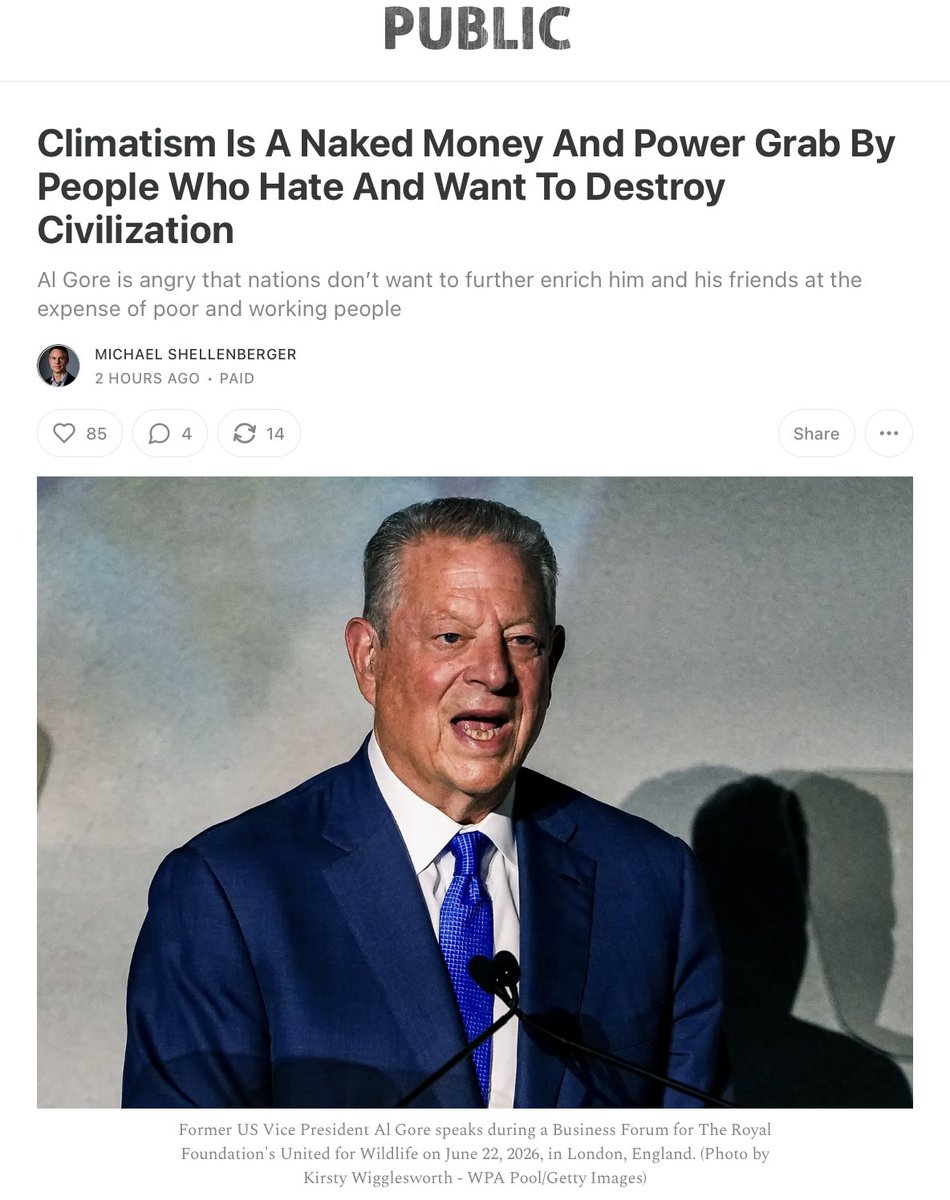
Al Gore is mad that world leaders didn't repeat their promise to rapidly phase out fossil fuels. But trying to rapidly abolish 86% of our energy supply has wrecked economies and increased poverty. It's time to call climatism what it is: the controlled demolition of civilization.
“The good news,” said @glukianoff , “is that freedom of speech has always depended on a surprisingly small number of people willing to stand up for it.”
“The bad news,” he added, “is that, apparently, we’re those people.”
https://t.co/VyMp18x9aD
Is free speech a conservative or progressive idea? The answer depends on whom you ask.
But increasingly, people on both sides seem to believe in free speech only when it protects people they agree with. That makes free speech a political convenience, rather than a principle.
Censoring your enemies. Dismantling the police. Making energy expensive. Rioting and looting. These things appear disconnected, but they're not. They're all part of a single systematic attack on the pillars of civilization. People are right to call this a controlled demolition.
Today was a good day. Got respect and acknowledgement from some upper belts today for my hours on the mats and willingness to go out of my bracket for competitions, leading to significant progress this year. Love my team and love this sport! #graciebarra#jiujitsuforeveryone
the basics have been so obscured in our relentless identity conflicts we mostly now lose sight of what’s at risk as socialism normalizes throughout the DNC, which is our freedom. well said here by @kmele.
There's a stuckness to a lot of these debates. The surge pricing is to get more drivers on the road. I'm not defending the specific way Uber does it but as with the expensive-groceries-in-NYC debate there's an assumption that greed and only greed explains the pricing.
The Nuclear Policy Playbook for Derailing the AI Revolution
As this new lawsuit mentioned in this AP story below makes clear, the third component of the 'How to Derail the AI Revolution Using the Nuclear Policy Playbook' is now underway in America. To recap the 3 steps of that anti-innovation playbook and where things stand currently as applied to AI:
Step 1: Whip up extreme fears about an important new technology until a full-blown techno-panic grips the minds of the public, the press, and policymakers. Step 1 is complete and has been remarkably successful thanks to an ever-growing coalition of fear entrepreneurs funded in large part by the Effective Altruism (EA) movement. Never in American history has there been as much fear surrounding a new technology as we see today around AI, robotics, and advanced computational systems. That mass hysteria is what fuels Steps 2 and 3.
Step 2: Unleash waves of new legislative and regulatory measures and just keep layering on the paperwork, permitting processes, confusing and contradictory new compliance requirements and threats of punishing liability at every step. Step 2 continues to unfold at all levels of government--federal, state, municipal--and will ramp up significantly in 2027-8. Next year we will likely see far more than the 2,000 bills we saw this past session. Many more will pass as AI techno-feudalism takes over America. Every state, city, and county will have its own repressive regulatory regime for these technologies. It’ll be like an ‘AI Articles of Confederation’ or ‘AI Holy Roman Empire’ model of governance as mass NIMBYism and “vetocracy” take over.
Step 3: Flood the courts with frivolous lawsuits based on junk science and enlist greedy trial lawyers to do the bidding of the anti-development forces. Step 3 is now gaining steam and this new lawsuit will be the first of many like this to weaponize our broken tort system. This will be the ultimate stake in the heart of the AI revolution. There is just no stopping the trial lawyers once they set their sights on a sector or technology. They will extract every last penny out of it (and then funnel lots of that money to the Democratic Party to make sure that no limits on liability, frivolous claims, and junk science are put on the books.) The only reason this liability hell did not decimate the Internet was because of the existence of Section 230 and the First Amendment. But now every politician in America wants to dispense with Sec 230 and skirt the protections of the First Amendment to let trial lawyers sue every tech company in America into bankruptcy using amorphous “safety” claims at every juncture. With Step 1 complete and Step 2 well underway, junk science claims will overwhelm judges and juries and the endless search for deep pockets will end with historic settlement and payouts.
Again, we have been here before. This 3-part model is a time-tested script for ending a technological revolution. It decimated the nuclear energy industry and now it will do the same to AI, robotics, and computational innovation.
It is the death of technological dynamism and an unmitigated disaster for our country, our geopolitical standing, and the public good.
https://t.co/xReJ20AhWH
Some predictions:
- Expect more "lab leaks" in the near term future engineered by cybersecurity firms
- The EA / safetyist crowd will amplify this to the moon along with the entire Democratic Left
- "Be afraid citizen! Only the government can protect you!" -> Massive crack down on open source models, regulated compute. SB 1047 will look like a hall pass by comparison
Publicly traded AI cos will not have the freedom of movement to withstand public pressure and fear mongering. Govt regulations will shut out any non-compliant actors from the market. Governance boards will instantly cave. Remaining major players are already in consensus.
AI is too powerful for citizens so only those already in power should have access to it. The government and state agencies will have frontier models. You will have whatever they think you can be trusted with.
This is the most powerful technology in history.
Nothing is too much to justify seizing complete control, and people will do so thinking they are being altruistic. The ends justify the means.
I would not be surprised if there are engineered AI false flag attacks on domestic soil blamed on "rogue actors" using "unlicensed open models"
Public will be unanimous. Everyone is getting hacked or knows someone who was hacked.
Digital agent provocateurs.
Hate to say it but this is the world we live in.
We invade countries on false pretenses, "suicide" Boeing whistleblowers, disappear trillions in unaccountable expenses.
All the crimes of western governments against their own citizens will absolutely pale in comparison to what will feel "justified" to control Superintelligence.
This is literally what they are pushing for now.
Total 1984 Dystopia where a select few control all AI production and get to impose what thoughts are legal.
Freedom of speech should be extended to freedom of thought.
We need to fight this tooth and nail.
I don't know how many of you realize that history is repeating itself.
But what's happening to Jensen Huang looks a lot like what happened to Steve Jobs. A founder who built the most important company of his era. A board meeting to decide whether he should go. And an entire system that thinks this is a great idea.
What's pretty funny is that today, in my opinion, if Steve Jobs were still alive, he'd be fighting everything Bill Gates stands for.
Let me explain.
To understand, you have to go back to the late 70s and early 80s. Back then, computing belonged to IBM. Big Blue. The gray giant, the dark suits, the processes, the hierarchy. In corporate America, everyone repeated the same line: nobody ever got fired for buying IBM.
And on the other side, there was a kid from Cupertino who had started his company in a garage.
In late 1983, Jobs went on stage and asked his people the question: will Big Blue dominate the entire computer industry? The entire information age? Was George Orwell right?
A few weeks later, during the Super Bowl, Apple aired "1984," directed by Ridley Scott.
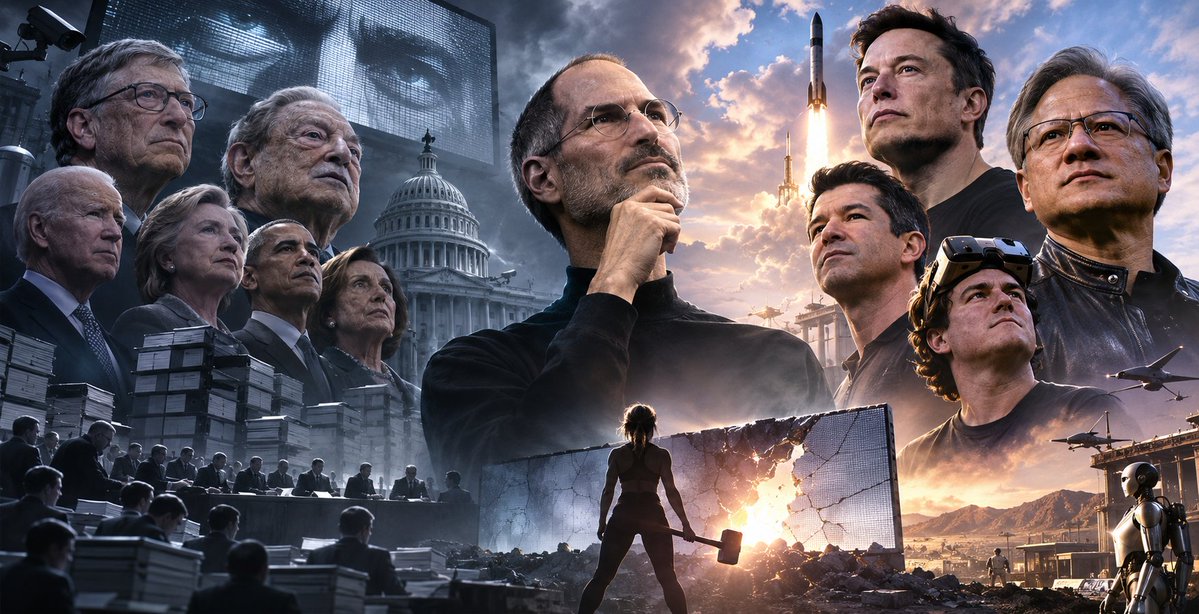
A gray hall. Rows of shaven-headed men in uniforms, marching in lockstep. On a giant screen, Big Brother recites a speech about uniformity. Suddenly, an athlete bursts in, chased by the thought police. She spins a hammer. She throws it. The screen explodes.
Then a line on a black screen: Macintosh is coming, and you'll see why 1984 won't be like "1984."
It wasn't an ad for a computer. It was a manifesto. The individual against the system. The creator against the bureaucratic machine.
And Jobs fought that fight his whole life. Against a lifelong rival: Bill Gates.
Jobs didn't just accuse Microsoft of copying. He accused it of a worldview. One line summed it up: the problem with Microsoft is they just have no taste. No taste, no vision, no soul. Products designed by committees, for committees.
Because that's what Jobs hated more than anything: bureaucracy.
In 2010, on stage with Walt Mossberg, he asked the audience a question. Do you know how many committees we have at Apple? Zero. Apple is organized like a startup. The biggest startup on the planet.
Zero committees. One person accountable per product. Ideas, not hierarchy.
Now look at what Bill Gates has become.
A foundation shaping health, agriculture and energy policy in dozens of countries. One of the largest funders of the WHO. Global conferences, task forces, expert committees, public-private partnerships. A world where nobody builds anymore, they coordinate. Where nobody launches products anymore, only programs. Where nobody voted for the people making the decisions.
Bill Gates has become the perfect embodiment of everything Steve Jobs hated.
That's why I'm convinced Jobs would be on the other side today. Not in the committees. Not in the agencies. On stage, throwing the hammer.
Because the battle of 1984 never ended. It just changed cast.
On one side, the bureaucrats. A Democratic Party that wants licenses, pauses and federal agencies to decide who gets to build. Bill Gates and his global committees. Soros and his billion a year poured into NGOs, campaigns and institutions.
On the other, the builders.
Elon Musk. Jensen Huang. Palmer Luckey. Travis Kalanick.
And they all have one thing in common with Jobs: the system tried to throw them out.
Jobs was fired from his own company by a board, in favor of a manager brought in from Pepsi. Kalanick was pushed out of Uber by his investors. Luckey was fired from Facebook over a political donation. Musk has been fighting regulators for twenty years. And Jensen is living through the exact same thing, in real time, right in front of us.
None of them stopped. Jobs founded NeXT and Pixar, then came back to save Apple. Luckey founded Anduril. Musk built rockets the entire establishment said were impossible.
And the day Apple fired Jobs, nobody imagined he'd come back twelve years later and turn it into the most valuable company in the world.
Keep that in mind as you watch what's happening to Jensen.
Today, the giant screen isn't called IBM anymore. It's called licenses, committees, federal agencies, moratoriums. And the question Jobs asked on stage is back, more urgent than ever.
Was Orwell right?
The answer depends on one thing.
Whether anyone will still be allowed to throw the hammer.
This Jensen Huang/Nvidia scandal is quite bizarre. The most dominant CEOs of the world's most powerful corporations rarely fall, let alone as easily and rapidly as this seems to be happeing. He's on the brink of being ousted with remarkable velocity and vanishingly little evidence.
Over what? If "mere" extramarital affairs were sufficient for ouster, how many top CEOs would be left? Not many. Hence the need for the sinister CCP/spying angle. But is there any tangible evidence at all that Alice Huang is an asset or spy for the Chinese government? Anything beyond anonymous vague US intelligence suspicions being mindlessly, dutifully recited (as always) by US corporate media?
The always smart and insightful @RnaudBertrand is required reading here, at least for the questions he raises:👇
Prediction. Screenshot this post, we'll talk again in five years.
They're going to pull it off. Jensen Huang is going to be pushed out of Nvidia.
And here's what happens next.
Elon hires Jensen and puts him in charge of Terafab.
He's already said it publicly: hiring him would be an honor. And Terafab is the project made for him. A chip factory Musk wants to be the largest ever built, one terawatt of compute per year, from design to packaging under one roof. Terafab's challenge is to do in a few years what the industry took decades to build. There's only one man on Earth who knows every layer of that stack.
They execute like absolute maniacs.
Musk brings speed, capital and appetite for risk. Jensen brings thirty years of mastery of the stack: architecture, software, customers, supply chain. Musk builds factories faster than anyone alive. Jensen knows exactly what to put inside them. It's the only duo in the world capable of compressing a decade into three years.
SpaceXAI merges with Tesla.
This isn't even science fiction anymore: independent committees are already studying the merger. Rockets, satellites, AI, robots, self-driving cars, energy, and now chips. One single entity, integrated from silicon to orbit.
The group climbs to $50 trillion.
Today, SpaceX and Tesla are worth around $3.4 trillion combined. $50 trillion sounds insane. But remember: ten years ago, Nvidia was worth a few tens of billions. When you own superintelligence, the robots that do the work and the rockets that go to space, you don't capture a market. You capture the economy.
Elon buys Nvidia.
Meanwhile, Nvidia without Jensen does what every company does after losing its founder: it manages. It protects its margins. It loses ground to its own customers' in-house chips. And one day, it becomes a target. For a $50 trillion group, buying Nvidia is just one acquisition among others.
Jensen becomes the chip boss again.
He takes over the semiconductor division of the new entity. Pushed out of his own company, he gets it back from above, inside the largest industrial group in history.
Sounds crazy? Steve Jobs did exactly that. Pushed out of Apple, he came back when Apple bought NeXT. You know the rest.
Nvidia's board thinks it's getting rid of a problem.
It's creating the biggest competitor in its history.
See you in five years.
I don't know who wanted Jensen Huang out but I know that whoever it was wields extreme levels of power.
Nobody actually believes that, in the age of Donald J. Trump, very powerful people rapidly fall due to extramarital affairs, right? Even if accompanied by anonymous evidence-free CIA claims that one of the women has vague ties to the Chinese government, claims that the US media instantly and uncritically ratified as only they can?