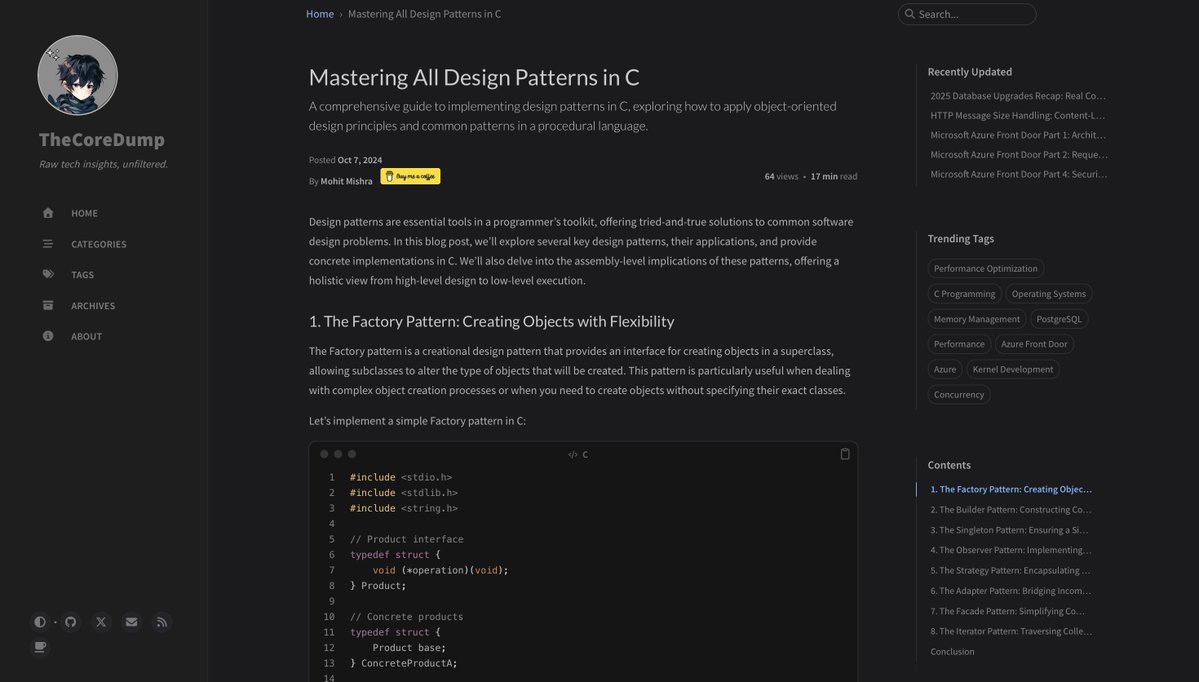
Mastering All Design Patterns in C
A detailed guide to implementing design patterns in C, exploring how to apply object-oriented design principles and common patterns in a procedural language.
Linux Finally Killed strncpy. It Took Six Years, 362 Patches, and 70 Contributors.
The story of a 40-year-old C function that looked safe but wasn't, and the codebase-wide work that removed it from the kernel entirely.
Article Link: https://t.co/EKq81ZS24z
#nerdystuff in pausa pranzo
Quando un articolo interessante finisce dietro un paywall, qui parte la caccia alla versione accessibile 😎
🔐 https://t.co/RMx6oHwgGf
🤖 Ready to get started with Agentic Development in @code?
We've put together 3 free courses covering everything from building your first AI agent to customizing and extending agent workflows.
A quick breakdown 🧵👇
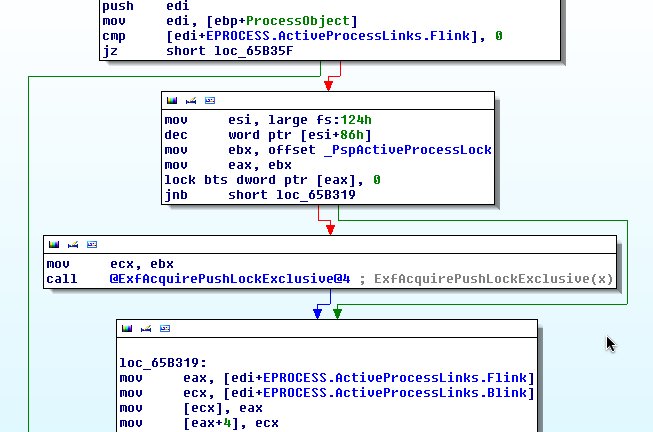
One of the most interesting Windows kernel internals is "PsActiveProcessHead", the global doubly-linked list that connects every live "EPROCESS" through "ActiveProcessLinks". Process creation inserts into this list, process exit removes from it, and kernel debuggers can walk it to enumerate active processes.
Security researchers love it because many classic rootkits used DKOM (Direct Kernel Object Manipulation) to unlink their "EPROCESS" from "PsActiveProcessHead", effectively hiding a running process from tools that trusted the list. Understanding "PsActiveProcessHead" is often the first step into Windows rootkits, process hiding, forensic detection, and kernel debugging.
Anthropic shows this video to every new employee. Someone re-uploaded it.
I hope Anthropic doesn't see this.
14 minutes of how the Claude team actually uses Claude in real work.
I watched the recording last night and kept pausing it. Each time realizing I've been using Claude like a toy.
claude.md + loops is what makes Claude stop fighting you and start working for you.
Most people will keep using Claude the hard way.
I built an MCP server for .NET performance reviews.
You give it access to a codebase, and it helps find the kind of issues that usually hide until production:
Blocking async code
Thread pool starvation
Slow request paths
Expensive database calls
Performance problems that are hard to spot in a quick PR review
This is why MCP is interesting for developers.
It’s not just “chat with AI”.
It’s AI connected to real tools that can inspect, reason, and help you improve your application.
Built in C# with Microsoft Foundry.
Learn more about Foundry here 👉 https://t.co/K91le4b3rt #dotnet
Sponsored by @Microsoft
a hash map in 25 lines of C
FNV-1a handles the hashing, start with a fixed value and XOR each byte multiply by a prime and repeat
the interesting part is the last line
instead of using hash % cap it uses hash & (cap - 1)
same result when the capacity is a power of two
and a bitwise AND is generally cheaper than a modulo operation
another neat detail is the use of void pointers for values
the hash map does not care what type you store
integers strings structs anything works
the caller handles the casting when storing and retrieving data
David, co-creator of MCP at Anthropic:
"There's more to the protocol than what most people use it for."
In a 26-minute talk, he shows how shallow most people's use of these tools really is.
Most people are scratching the surface. The new high-paid role lives in the depth they never reach.
That gap is exactly where the money is moving.
Watch the talk, then see the role it's creating in the article below.
Save this before it scrolls away.
Blogged: Exploring the .NET 11 preview - Avoiding ToString() allocations with StringBuilder.MoveChunks
https://t.co/so8IPlfZxW
In this post I take a look at the new MoveChunks() API, explore how it works, what it's for, and how the new API provides opportunities for public APIs
Peter Steinberger took the stage at Microsoft Build with the most loop-pilled title in tech:
"Build the thing that builds the thing."
The same guy whose two sentences on this hit 6.5M views except now he's got 43 minutes to actually show the machine.
Inside: the tool ecosystem he wired around OpenClaw the loops that let agents build, check their own work, and keep grinding while he's nowhere near the keyboard.
One free session beats every $500 "AI coding" course sitting in your bookmarks.
Watch it, then read the full 4-loop breakdown below.
Introducing Claude Tag, a new way for teams to work with Claude.
In Slack, Claude joins as a team member with access to the channels and tools you choose. Tag Claude in and delegate tasks to it while you focus on other work.
L’euro digitale avanza nell’iter europeo, ma l’arrivo è previsto non prima del 2029 anche per le resistenze delle banche. Nel frattempo, il mercato sviluppa dei sistemi alternativi. L'approfondimento di @AngeloBaglioni
https://t.co/1UqOI66XSb