is this why people want big companies to come to crypto? so the companies can sell high, trigger shorts, and buy back low ?
last year, all year long, wintermute was doing this, CEXs were doing this. constantly liquidating shorts and buying back lower. Probably making billions in the meantime.
partnership do not make a thing, if it is only about big companies buying up tokens at low price and holding them. those do not do anything good for blockchain.
yes, I am a core developer and I look from a purely functional aspect now. but value is created with real usage and real demand, from billions of people. That is what blockchain must strive for.
Strategy has acquired 1,550 BTC for $101 million to increase our $BTC Reserve to ₿845,256. We have also increased our USD Reserve by $100 million to $1.0 billion. $MSTR $STRC https://t.co/1Zf1AVsP1H
if you want to understand more what is good and what is not in AI, you definitely need to learn some math. But only if you want to get to the next level of understanding.
Information, Entropy, math theories, at one point, the most hated things in Computer Science Universities, they come back and you get to use them.
Prediction, scoring, creating adversarial or consensus creating loops, state machines, and some deep math to understand it all. And technically you can print out some of the layers and thinking tokens, so that you go and optimise more.
Everything is math, and at one point it is magical.
LLMs, transformers, the new algorithms, all based on math.
🚨 ANOTHER MASTERCLASS FROM @3BLUE1BROWN
The compressibility of language isn’t just a math curiosity, it’s the hidden engine behind every LLM you use.
Grant’s new video reframes Shannon’s entropy through one elegant lens:
Prediction IS compression.
→ The better you predict the next word, the fewer bits you need to store it
→ Shannon measured English at ~1 bit per character: astonishingly compressible
→ This is exactly what GPT-style models optimize
→ Intelligence, in this framing, is compression
FUN FACT: Von Neumann told Shannon to name it “entropy” because nobody truly understands it anyway 😄
Decades later, that same concept became the bedrock of modern AI.
Deep-dive resources in the 🧵 ↓
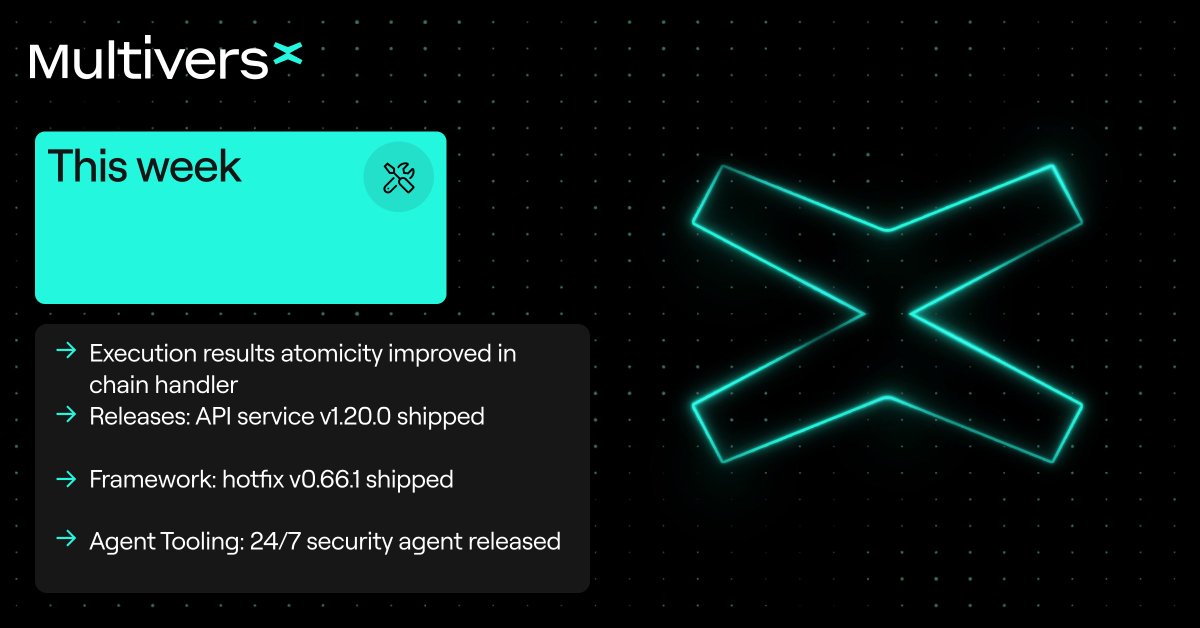
Always building. This is what you can expect from MvX.
releases on api, on framework, on agent tooling.
new SDKs everywhere, so that you or your agents can build faster, safer and better.
we do not sit with our hands behind our back, we are always a few steps ahead in building the next big thing.
Building agents it is not so simple.
I get why people are still not using hermes / openclaw so much and rather go and use the existing claude / gemini or other tools when they are up.
you need to have a big chunk of understanding and coding, engineering and architecting skills until you can make one agent to do what it is supposed to do.
even with all the fancy tutorials and skills and automatisation, in the end it is not so magical, agents are not so good, yet.
this is why, instead of having tutorials and demos on how to build your own agent, the world needs hundreds / thousands of specialised agents which they can simply call and get the job done. agents with reputation, good score, and permissionlessly to be able to call.
for this you need blockchain, you need MvX with all the standards.
one of the agents which is really awesome and I think it is in the right track, especially for coding is @julesagent . giving autonomous task of self improvement and security audits on code is really working.
i think that is the minimum requirement for any agent, and yet jules is for professional software developers. the new CLI makes it super easy to use.
"So I get a bug-finder agent to identify all the bugs ... scoring with points"
"Then I get an adversarial agent and I tell that agent that for every bug that the agent is able to disprove as a bug, it gets the score of that bug, but if it gets it wrong, it will get -2*score of that bug. "
"I get a referee agent to take both their inputs and to score them. I lie and tell the referee agent that I have the actual correct ground truth, and if it gets it correct it will get +1 point and if it gets it wrong it will have -1 point."
that is like a game of chess, but for agents.
And actually it is a well known technique from adversarial recurrent networks from around 10 years ago. it is good to go back and actually redo some of the deep learning courses from Stanford or MIT and apply it to the post transformers world.
I do not think there are billions of people doing like DeFi like finance. They use bank accounts, credit cards, debit cards, cash, but all for buying, selling, owning things. Like for billions of people money is not the end goal, it is what they use that for.
like you have billions of social media users, people who consume youtube and other apps. You do not have billions doing trading. only a small subset is doing trading. More people are doing gambling vs those who do trading.
What I was arguing is that there is an even bigger step beyond tradfi and partnering with tradfi. and partnering with tradfi does not mean those users will get their permissionless access to money and services, those users will be behind a centralised gatekeeper still.
I am imagining another type of world.
Why the huge sell off?
Maybe 🤔, just a thought 💭, but it seems like last year professionals came into crypto and showed how everyone is a child. Like they came and extracted whatever was possible. And as stocks are much sexier, they just went there, while still saying crypto is the future (like BlackRock).
Are crypto projects dead?
Those which are not developed, they might be. The list is long. Those where the foundation abandoned or went rogue, they are probably dead.
Those with active development, they are here still to change the world. Which is good.
Crypto was for people and should always be for people. Not dependent on big companies, they don’t care about crypto, they care about the green bills 💵 always.
@crypto_div For me those things, partnering for finance is not the way, but this is a personal opinion.
For me these partnership do not bring anything tangible for users.
But truly agreed on adoption, as we need to bring out meaningful products.
I like this so much.
this is the first LLM model, outside the local models which you are running via scripts, that is truly following the rules.
really kudos to @GeminiApp
Gemini 3.5 Flash High is following and actually executing the steps, as required.
pretty good video which explains that money is actually not money on EVM. or a token is not a token. There is no definition for it, only some interfaces without actual objects and anyone can inject anything. This is the surface of so many attacks.
back in 2018 when deciding on the VM, we saw so many errors with EVM that we decided not to go that way at all.
WASM was much powerful, but not alone. You needed a much clear system of what a transfer means, what a token means.
The best decision was to implement this natively, directly to the blockchain (they are not so many blockchain's doing it). Fully native, object oriented, fully formally verified, treated equal to the native eGLD. This is the full ESDT system on MultiversX, which simply elevates tokens to their proper place.
"So I get a bug-finder agent to identify all the bugs ... scoring with points"
"Then I get an adversarial agent and I tell that agent that for every bug that the agent is able to disprove as a bug, it gets the score of that bug, but if it gets it wrong, it will get -2*score of that bug. "
"I get a referee agent to take both their inputs and to score them. I lie and tell the referee agent that I have the actual correct ground truth, and if it gets it correct it will get +1 point and if it gets it wrong it will have -1 point."
that is like a game of chess, but for agents.
And actually it is a well known technique from adversarial recurrent networks from around 10 years ago. it is good to go back and actually redo some of the deep learning courses from Stanford or MIT and apply it to the post transformers world.
Today we completed the final piece of VeroPay’s Apple integration stack:
• Apple Wallet integration
• Real-time balance sync with dynamic pass updates
• Secure top-ups via Apple Pay powered by @xMoney_com
• Core infrastructure built on @MultiversX , designed for resilience, scale, and long-term financial rails
Users can now carry their VeroPay account in Apple Wallet, top up instantly with Apple Pay, and use it across the same NFC ecosystem as a physical card, without needing one.
On the product side, @GaupaLabs is building the next evolution of the iOS experience on top of this infrastructure:
• Pay and Earn points in a tap. No app needed.
• Full NFC-based usage natively on your phone
• Gamification layer for user engagement
• Merchant-side tools and features
Next release will bring this ecosystem fully together.
PS: No VC money. Just the will to offer better alternatives.
That is not true.
Gemini is incredibly good I think for coding, but people are not boosting about it. It needs a little more handholding and maybe better skills and systems, but it is following the rules just much better.
Those who are constantly building hardcore systems are mostly introverts and they do not post about demos, but they create the projects in silence.
Gemini API usage is increasing non stop. So a lot of people are using them.
I personally use it since early last year and the new 3.5 flash is really good when working with good skills and agents.
@raul_elrond Nope. I continuously accumulated and contributed non stop and I am still doing it.
I put already 8 years in building a bunch of open source software for web3.
@AncientPriest We are not dead. Have you looked at how many improvements, releases we did over the last year for example.
We are not 99% dead. That is an incorrect math.
So tomorrow I keep building. Same as today. Not because the path is easy. Because someone has to be foolish enough to walk it anyway. Still here. Still building.
As a founder, you have to be almost foolish.
Naively bullish. Irrational about the future.
Because if you weren’t, you’d never start.
───
No sane person looks at the odds and says yes.
Most of this fails. Most of the path is painful. You don’t know how long it is, only that it’s longer than you think. And it gets harder after the first big win, not easier. Now you know exactly what the next climb costs.
So you have to believe past the evidence. You have to be a little foolish.
───
I read the comments. The real ones.
The pain is real. The losses are real. I’m not going to argue with someone’s red portfolio or explain it away with terminology. That’s not respect.
Some of you loved the vision, bought conviction, averaged down, and watched it go blurry. I see that. I carry it.
───
But here’s what the foolishness is actually for.
It’s not for dodging hard questions. It’s the only thing that makes a person stay when leaving is the rational move.
You don’t get the rare win without being willing to look stupid for years. There’s no version where you skip the painful part and keep the upside.
───
So tomorrow I keep building. Same as today.
Not because the path is easy. Because someone has to be foolish enough to walk it anyway.
Still here. Still building.