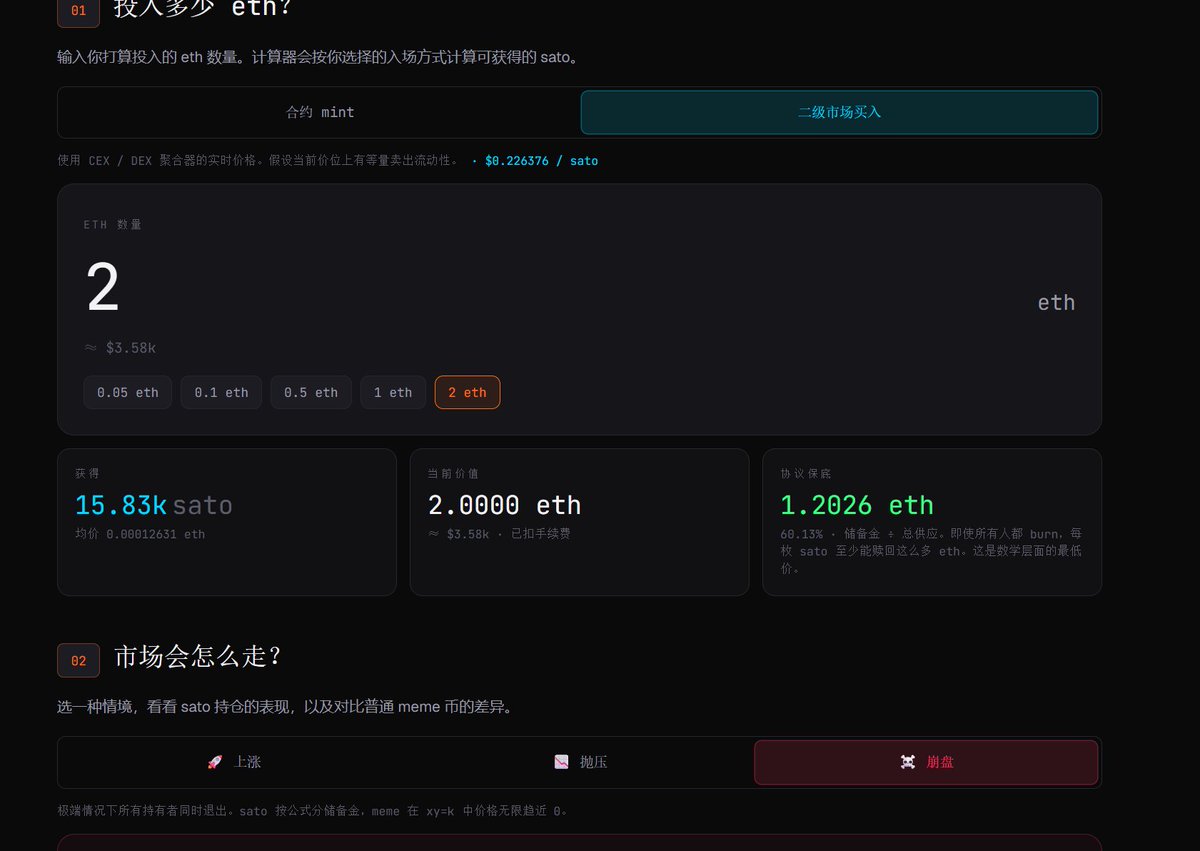
Many new Uniswap v4 hook projects are now experimenting with reserve models.
That is good for the ecosystem.
But one thing should be understood:
-SATO’s ETH reserve did not appear out of nowhere
-It was built through real market cycles, real volatility, real buys and sells, and real on-chain activity.
-SATO already went through strong upside, painful downside, community stress, and still kept running through immutable contract logic.
-At one point, SATO generated around $30M in DEX volume in a single month.
That kind of reserve formation is not easy to replicate:
A new project can write “reserve model” in its docs.
But building a reserve through real market pressure is different.
SATO’s reserve is not just a number.
It is the result of live usage, market demand, sell pressure, buy pressure, burns, fees, and time.
And at the same time, SATO is becoming harder to mint.
The curve-position drift makes new issuance more difficult, not easier.
So while many new hook projects are trying to design reserves from zero, SATO already has:
- a visible ETH reserve
- real trading history
- verified contracts
- Uniswap v4 hook execution
- sell-side burn logic
- no team treasury
- no VC allocation
- no operator
- increasing scarcity pressure
Reserve models are easy to describe.
They are hard to survive.
ethereum:0x829f4b62eebe12af653b4dd4ffc480966f7d7f09 has already survived its first real market tests.
$sato
Do you think they will leave this curve unfinished? $sato has nearly reached the support level of 0.13 cents per token; this curve will be completed sooner or later—those who miss out will regret it.
SATO’s reserve is visible on Ethereum and can be verified by anyone, at any time.
-No private balance sheet.
-No hidden treasury.
-No team-controlled reserve.
The reserve, curve state, supply, and transactions are recorded on-chain and enforced by smart contract logic.
As long as Ethereum continues to operate, the system remains publicly verifiable and permissionless.
Not a promise. Read the chain.
Everything ethereum:0x829f4b62eebe12af653b4dd4ffc480966f7d7f09 in one place.
Official links, community channels, documentation, market data, and more will come:
🔗 https://t.co/NbZkU4Y9Jf
Explore the protocol. Verify the contracts. Join the community.
ethereum:0x829f4b62eebe12af653b4dd4ffc480966f7d7f09 is still here.
Like a phoenix rising from the ashes, the protocol keeps running without a team, without an operator, and without anyone holding the keys.
The ETH reserve is visible.
The curve is alive.
The hook is immutable.
The community is rebuilding.
Some stories do not end after the first fall.
They become stronger because they survived it.
ethereum:0x829f4b62eebe12af653b4dd4ffc480966f7d7f09
Ethereum native.
Uniswap v4 hook.
No operator.
Real reserve.
And this only counts the ETH already visible today.
It does not include any additional ETH that could enter the reserve through future mint activity as the curve becomes harder to mint.
Many new Uniswap v4 hook projects are now experimenting with reserve models.
That is good for the ecosystem.
But one thing should be understood:
-SATO’s ETH reserve did not appear out of nowhere
-It was built through real market cycles, real volatility, real buys and sells, and real on-chain activity.
-SATO already went through strong upside, painful downside, community stress, and still kept running through immutable contract logic.
-At one point, SATO generated around $30M in DEX volume in a single month.
That kind of reserve formation is not easy to replicate:
A new project can write “reserve model” in its docs.
But building a reserve through real market pressure is different.
SATO’s reserve is not just a number.
It is the result of live usage, market demand, sell pressure, buy pressure, burns, fees, and time.
And at the same time, SATO is becoming harder to mint.
The curve-position drift makes new issuance more difficult, not easier.
So while many new hook projects are trying to design reserves from zero, SATO already has:
- a visible ETH reserve
- real trading history
- verified contracts
- Uniswap v4 hook execution
- sell-side burn logic
- no team treasury
- no VC allocation
- no operator
- increasing scarcity pressure
Reserve models are easy to describe.
They are hard to survive.
ethereum:0x829f4b62eebe12af653b4dd4ffc480966f7d7f09 has already survived its first real market tests.
Seeing stablecoin protocols and larger projects integrate with Uniswap v4 Hooks makes me even more bullish on the early independent hook projects.
Millions of dollars are already moving into v4 infrastructure.
But the market still seems quiet around the small community experiments that helped bring attention to this meta early.
One of the most interesting examples is ethereum:0x829f4b62eebe12af653b4dd4ffc480966f7d7f09
An independent Ethereum project.
Uniswap v4 hook execution.
ETH bonding curve.
Visible ETH reserve.
No team treasury.
No VC allocation.
No operator.
Price action may look calm for now, but that is often how early categories behave before the market fully understands them.
If Uniswap v4 Hooks become a serious DeFi category, I believe early hook-native projects like SATO will eventually get their moment.