🚨 ANOTHER BIG ACHIEVEMENT 🇮🇳
Bengaluru-based Sarla Aviation has SUCCESSFULLY flight-tested Sylla 1.0, its half-scale eVTOL technology demonstrator.
What's even more impressive? It was designed, built and flown in just 12 months. 🔥
PV SINDHU BECOMES THE FIRST EVER INDIAN TO WIN THE JAPAN OPEN! 🇯🇵🤩
- Sindhu defeats Home Favourite and Three-time World Champion Akane Yamaguchi
QUEEN SINDHU FINALLY WINS S750
TITLE!
Skyroot's Vikram-1 Showcases India's Private Space Leap
Skyroot Aerospace's Vikram-1 has demonstrated India's rapidly expanding private-sector launch capability, successfully reaching orbit and proving India's growing role in the global commercial space industry.
Vikram-1 strengthens the nation's ability to provide indigenous orbital launch services for domestic and international satellite customers.
He's Tukaram Mundhe, a 2005-batch IAS from Maharashtra.
Over the last few weeks, you might have heard his name. That is because he was recently appointed Commissioner of State’s Food and Drug Administration (FDA). Since taking charge, the FDA has been on an absolute warpath, raiding illegal, fake, synthetic, and adulterated products. From synthetic milk networks and adulterated paneer to illegal gutkha and unhygienic eateries, nothing has escaped his radar.
Mundhe has made it clear that even the most famous names will not get a free pass. His department shocked Mumbai by suspending the food licenses of iconic establishments, such as the 73-year-old Marine Drive ice cream parlor K. Rustom & Co., alongside famous eateries like Shalimar Hospitality, Noor Mohammadi Hotel, and Rahmaniya Restaurant, after surprise inspections uncovered severe hygiene violations, including live pests and expired ingredients.
Such is the fear of his crackdowns that, just two days ago, dairy farmers were caught on video spilling hundreds of liters of synthetic milk after rumors of an impending FDA raid spread.
This is his 25th transfer in a 21-year career, a testament to his refusal to bend to political pressure. It makes you wonder: if just one IAS officer can bring about so much change, where would our country be if every bureaucrat were as uncompromising and proactive as him?
14/14
Major Sonam Wangchuk, MVC - Ladakh Scouts
In late May 1999, as the scale of the infiltration in the Kargil sector was just becoming apparent, the Indian Army scrambled to assess the extent of the enemy's incursions. The Chorbat La sector, situated at an extreme altitude of over 18,000 feet, was a highly sensitive glaciated axis. If the enemy secured the ridge lines here, they could effectively sever the supply lines to the Siachen Glacier and open a new front for deep infiltration.
Major Sonam Wangchuk, an officer of the Assam Regiment on deputation to the Indus Wing of the Ladakh Scouts, was perfectly suited for the terrain. The Ladakh Scouts, composed of local soldiers acclimated to the severe high-altitude environment, were deployed to patrol the Line of Control, establish forward observation posts, and neutralize any enemy presence in the sector.
On May 26, 1999, Major Wangchuk led a patrol column consisting of a Junior Commissioned Officer (JCO) and 30 other ranks. Their mission was to secure an 18,000-foot-high ridge line on the Line of Control. The conditions were brutal, deep snow, sub-zero temperatures, and thin air that made every step a massive physical exertion.
As the column navigated a narrow, glaciated approach toward the ridge, they were suddenly ambushed.
Enemy forces, who had already established a dominant vantage point on the heights above, unleashed heavy automatic machine-gun and mortar fire on the patrol. The initial barrage resulted in the death of a Non-Commissioned Officer (NCO) and pinned the rest of the column down on the exposed glacier.
Retreating under the sustained fire was not a viable tactical option, nor was staying stationary, which would have meant the eventual annihilation of the patrol. Demonstrating sharp combat clarity, Major Wangchuk realized that a direct frontal assault would be suicidal. Instead, he opted for a highly dangerous flanking maneuver.
The Flanking Maneuver: Leaving a small element to lay down suppressive fire and hold the enemy's attention, Major Wangchuk took a handful of his men and began scaling a near-vertical, sheer ice wall under heavy enemy fire to outflank the entrenched positions.
Close-Quarter Combat: Operating at the absolute limits of human endurance, Major Wangchuk and his team successfully breached the enemy's flank. He led a direct charge into the enemy sangars.
Clearing the Ridge: In the ensuing brutal hand-to-hand combat, Major Wangchuk personally neutralized several enemy combatants. His men, galvanized by their commander's actions, cleared the remaining positions, forcing the surviving enemy troops to abandon their heavy weapons and flee back across the Line of Control.
Major Wangchuk's immediate and aggressive counter-ambush was the first successful military response of Operation Vijay. By securing the ridge line in Chorbat La, he completely sealed off that axis to further enemy infiltration. His patrol's success stabilized the sector and prevented a potential strategic disaster that could have threatened the Siachen logistics route.
He held the newly captured position for several days in extreme weather, coordinating artillery fire and repelling subsequent enemy counter-attacks until reinforcements could arrive.
For his exceptional tactical leadership, presence of mind, and conspicuous gallantry in one of the highest and most unforgiving battlefields in the world, Major Sonam Wangchuk was awarded the Maha Vir Chakra (MVC). He survived the war and later retired as a Colonel, continuing to be a highly respected figure in the Indian Army and the Ladakh region.
13/14
Naik Digendra Kumar, MVC - 2 Rajputana Rifles
By mid-June 1999, the Battle of Tololing had reached a critical operational juncture. Three previous attempts to capture the feature had failed due to the entrenched positions of Pakistan's Northern Light Infantry, who held a commanding view of the Srinagar-Leh highway. The 2nd Battalion, Rajputana Rifles (2 Raj Rif) was assigned the mission to break the stalemate.
During the operational briefing, Naik Digendra Kumar, a seasoned commando who had earned the moniker "Cobra" during his deployment with the Indian Peace Keeping Force (IPKF) in Sri Lanka, proposed a highly aggressive tactical approach. Instead of the standard routes, Kumar advocated for a direct assault up a near-vertical, 15,000-foot cliff face that the enemy considered impassable.
Under the command of Major Vivek Gupta, an elite 10-man Ghatak assault team was formed, with Kumar designated as the Light Machine Gun (LMG) detachment commander. Their specific assignment was to spearhead the attack and neutralize the enemy's heavily fortified bunker network on the ridge line.
On the night of June 12, 1999, the team initiated the climb. To scale the sheer rock face, they drove pitons into the stone and secured heavy-duty ropes, advancing over a 14-hour period in sub-zero temperatures.
As the assault group neared the summit in the early hours of June 13, the element of surprise was lost. The enemy detected the advance and opened fire with medium machine guns, rocket-propelled grenades, and heavy artillery from a network of 11 interconnected bunkers.
The initial barrage hit the assault group immediately, causing severe casualties. Major Vivek Gupta and several other members of the team were killed in action. Naik Digendra Kumar was struck by a bullet in his left arm, and his LMG was damaged. Despite the intense pain and severe bleeding, Kumar refused medical evacuation. He improvised a tourniquet using his turban to staunch the blood loss, salvaged a weapon and grenades from his fallen comrades, and pressed forward alone.
Operating on pure adrenaline and leveraging his commando training, Kumar launched a solo assault against the fortification network.
Silencing the Machine Gun: Crawling through the heavy crossfire, Kumar reached the first enemy machine-gun nest. He manually grabbed the hot barrel of the weapon to redirect its line of fire and lobbed a hand grenade through the firing slit, neutralizing the occupants.
Systematic Clearance: With the primary machine gun silenced, the remaining Indian reinforcements gained the momentum needed to breach the crest. Kumar continued his advance across the ridge, systematically targeting the remaining enemy positions. In total, he deployed 18 grenades to clear and dismantle multiple bunkers across the objective area.
Hand-to-Hand Engagement: In the final stages of the clearance, Kumar engaged the enemy command element in close-quarter combat, single-handedly neutralizing the remaining defenders, including the enemy commander, Major Anwar Khan.
Despite sustaining five bullet wounds to his body and arm, Naik Digendra Kumar successfully hoisted the Indian Tricolour atop Point 4590 at approximately 04:00 AM on June 13, 1999. When reinforcement units reached the summit later that morning, they secured the peak and evacuated Kumar, who was found unconscious but alive next to the captured fortifications.
The recapture of the Tololing heights was the first major strategic victory for the Indian Army during Operation Vijay, effectively shifting the momentum of the Kargil War.
For his conspicuous gallantry, exceptional initiative under fire, and absolute disregard for personal safety, Naik Digendra Kumar was awarded the Maha Vir Chakra (MVC) on August 15, 1999. He survived his extensive injuries and subsequently retired from military service in 2005.
12/14
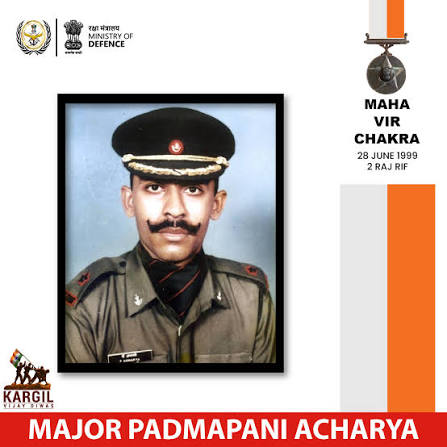
Major Padmapani Acharya, MVC (Posthumous) - 2 Rajputana Rifles
In late June 1999, following the successful recapture of Tololing Top, the 2nd Battalion, Rajputana Rifles (2 Raj Rif) was assigned its next critical objective in the Drass sector: the Black Rock Complex. Within this complex lay a heavily fortified feature known as Knoll. This elevated position allowed enemy forces to maintain a dominating line of sight and direct highly accurate artillery fire onto Indian supply routes and advancing troops.
Major Padmapani Acharya was tasked with commanding 'A' Company for this pivotal assault on the night of June 28, 1999.
The approach to Knoll was treacherous, requiring a steep vertical climb along a narrow, razor-sharp ridge completely devoid of any natural cover. The enemy had fortified the position extensively, utilizing minefields and establishing mutually supporting machine-gun posts to create an impenetrable wall of suppressive fire.
As the assault commenced under the cover of darkness, the leading platoon of 'A' Company encountered intense artillery shelling and heavy automatic fire. The sheer volume of incoming fire stalled the initial advance, resulting in heavy casualties and threatening to derail the battalion's operational timeline on the exposed slope.
Recognizing that a stalled offensive would lead to further attrition on the mountainside, Major Acharya took immediate tactical control of the situation to break the deadlock.
Leading the Reserve: With absolute disregard for his personal safety, he mobilized his reserve platoon and led them directly through the raining artillery shells and enemy fire to reinforce the stalled advance.
Sustaining Injuries: As he encouraged his men and pressed the charge up the steep rock face, Major Acharya sustained grievous injuries from the heavy barrage.
The Final Push: Despite being severely wounded and heavily bleeding, he categorically refused to be evacuated or to stall the momentum of the attack. Realizing he was physically unable to advance further, he ordered his men to leave him behind and continue the final charge toward the fortifications.
While his men surged forward, Major Acharya provided critical covering fire from his exposed position. Crawling toward the enemy perimeter despite his extensive wounds, he lobbed grenades into the immediate enemy bunkers, neutralizing the forward line of defense.
Spurred by the tactical aggression, clear directives, and sacrifice of their company commander, the remaining troops of 'A' Company overran the positions and successfully captured the Knoll feature. Major Padmapani Acharya succumbed to his injuries on the battlefield shortly after the objective was secured.
His decisive leadership broke the enemy's hold on the Black Rock Complex, paving the way for the complete recapture of the Tololing ridge line. For his exceptional courage, inspirational leadership, and supreme sacrifice in the face of overwhelming odds, Major Padmapani Acharya was posthumously awarded the Maha Vir Chakra (MVC), India's second-highest wartime military decoration.
11/14
Captain Anuj Nayyar, MVC (Posthumous) - 17 Jat Regiment
By early July 1999, the focus of the 17 Jat Regiment shifted toward the strategic heights of the Drass sector. Their objective was the capture of the Pt. 4875 complex, a dominating feature that allowed the enemy to disrupt movement on the critical Srinagar-Leh highway. Within this mountain complex lay "Pimple 2," a heavily fortified peak with steep, rocky inclines and interconnected enemy bunkers.
On the night of July 6, 1999, Charlie Company was tasked with securing the feature. When the company commander was injured early in the assault, Captain Anuj Nayyar stepped forward to take operational command of the leading assault platoon.
The approach to Pimple 2 offered no natural cover, forcing the platoon to advance up a narrow, exposed ridge under intense, direct sightlines from the enemy. As they closed in, the platoon was pinned down by heavy machine-gun fire originating from a series of mutually supporting enemy sangars (stone bunkers).
Recognizing that staying stationary on the exposed slope would lead to the annihilation of his unit, Captain Nayyar chose immediate, aggressive counter-offensive action.
The First Bunker: Leading his leading section from the front, Nayyar charged the first enemy fortification under a hail of automatic fire. He engaged the occupants in close-quarter combat, neutralizing the position and silencing the machine gun.
The Second and Third Bunkers: Without pausing to regroup, Nayyar pressed the advance toward the next two fortifications. He personally led the charge into each bunker, engaging the enemy in brutal hand-to-hand combat and clearing both positions single-handedly.
During the assault on the fourth and final bunker, the enemy resisted fiercely. As Captain Nayyar moved forward to clear the position, an enemy Rocket-Propelled Grenade (RPG) detonated directly near him, causing severe shrapnel injuries.
Despite sustaining mortal wounds and bleeding profusely, Nayyar refused to fall back or seek medical attention. He maintained operational focus, directing his remaining men to press the assault and secure the final objective. He continued to fight until he collapsed on the battlefield, having successfully dismantled the entire enemy defensive network on the peak.
Driven by the decisive actions and relentless advance of their commander, the remaining men of the 17 Jat overran the final position, completely securing Pimple 2. The capture of this feature broke the enemy's defensive line in the Pt. 4875 complex, allowing the Indian Army to consolidate its hold over the entire sector and secure the transit route below.
For his tactical acumen, exceptional leadership under fire, and supreme sacrifice, Captain Anuj Nayyar was posthumously awarded the Maha Vir Chakra (MVC), India's second-highest military decoration for gallantry.
10/14
Lieutenant Keishing Clifford Nongrum, MVC (Posthumous) - 12 J&K Light Infantry
By late June 1999, operations in the Batalik sector required the Indian Army to clear heavily fortified enemy positions situated on steep, rugged ridgelines. Point 4812 was a critical strategic feature in this sector. The Pakistani forces had established a robust defensive perimeter, utilizing the natural terrain to construct interconnected bunkers carved directly out of massive boulders, making them highly resistant to artillery fire.
The 12th Battalion, Jammu and Kashmir Light Infantry (12 JAK LI) was tasked with capturing Point 4812. Lieutenant Keishing Clifford Nongrum was assigned to lead the assault team for this critical objective.
On the night of June 30, 1999, Lieutenant Nongrum led his column up the near-vertical slopes toward the objective. The approach was completely exposed, offering no natural cover for the advancing troops.
As the assault team closed in on the summit, they were intercepted by a wall of intense automatic fire. The enemy had established a formidable crossfire network using mutually supporting machine-gun posts. Pinned down on the sheer rock face, the column’s advance stalled. Remaining stationary on the exposed cliff meant inevitable and severe casualties.
Recognizing the immediate tactical necessity to break the enemy's line of fire, Lieutenant Nongrum initiated a direct offensive action.
Without waiting for covering fire, Lieutenant Nongrum broke from the stalled formation and charged directly into the enemy's field of fire.
The First Bunker: He closed the distance to the primary enemy fortification under sustained machine-gun fire. Reaching the bunker, he lobbed grenades through the firing slits, neutralizing the position and eliminating its occupants.
Close-Quarter Combat: Continuing the momentum, he advanced on the second bunker. During this charge, the enemy concentrated their fire on his position, and he sustained multiple severe machine-gun bullet wounds.
Sustaining the Advance: Despite immense blood loss and critical injuries, Lieutenant Nongrum refused to retreat or await medical evacuation. He closed in on the second position, engaging the enemy defenders in brutal hand-to-hand combat.
His direct assault and close-quarter engagement effectively dismantled the enemy's forward command position and neutralized the immediate suppressive fire that had pinned down his column. Lieutenant Nongrum fought until he collapsed from his injuries on the battlefield.
Lieutenant Nongrum's calculated aggression and refusal to halt the advance directly broke the enemy's defensive perimeter. His actions provided the critical window for the remaining troops of the 12 JAK LI to surge forward, overrun the remaining positions, and successfully capture Point 4812 by the following morning.
For his exceptional tactical leadership, complete disregard for personal safety, and supreme sacrifice in securing a vital objective, Lieutenant Keishing Clifford Nongrum was posthumously awarded the Maha Vir Chakra (MVC), India's second-highest wartime military decoration.
9/14
Captain Neikezhakuo Kenguruse, MVC (Posthumous) - ASC attached to 2 Rajputana Rifles
In late June 1999, the 2nd Battalion, Rajputana Rifles (2 Raj Rif) was tasked with capturing a strategically critical enemy stronghold known as "Black Rock" in the Drass sector. Situated at an altitude of approximately 16,000 feet, this heavily fortified machine-gun post commanded the valley below and was effectively stalling the battalion’s advance.
Captain Neikezhakuo Kenguruse, an officer commissioned into the Army Service Corps (ASC) and serving on attachment with 2 Raj Rif, was the commander of the battalion's elite Ghatak platoon. On the night of June 28, 1999, his commando unit was assigned the high-risk mission of neutralizing the position.
The approach to the objective was highly restricted, requiring the platoon to scale a near-vertical, icy cliff face under the cover of darkness. The environmental conditions were severe, with temperatures dropping to -10°C.
As the Ghatak platoon initiated the climb, they were detected. The enemy unleashed intense mortar and automatic machine-gun fire down the cliff face, causing heavy casualties and halting the commando team's momentum.
Recognizing that his standard-issue mountain boots were failing to grip the sheer, freezing rock face, Captain Kenguruse took an extreme tactical measure. To secure a foothold and lead the advance, he removed his boots, continuing the grueling climb up the icy precipice completely barefoot.
As he closed the final distance to the enemy sangars (fortifications), Captain Kenguruse sustained a severe gunshot wound to the abdomen. Despite heavy bleeding, extreme cold, and the physical toll of the ascent, he refused to fall back or stall the advance. He pushed through the pain, scaling the final stretch of the rock wall to breach the enemy perimeter.
Upon clearing the cliff edge, he initiated a devastating solo assault:
The Initial Strike: He immediately deployed a rocket launcher, firing directly into the primary enemy fortification to disorient the defenders and break their line of suppressive fire.
Firefight: Advancing on the position, he engaged the surviving occupants with his rifle, neutralizing two enemy combatants at close range.
Hand-to-Hand Combat: In the final stages of the breach, he engaged the remaining defenders in brutal close-quarter combat. Utilizing his commando knife, he neutralized two additional enemy soldiers before succumbing to his severe injuries on the ledge.
Captain Kenguruse’s single-handed neutralization of the machine-gun nest broke the immediate tactical deadlock. By dismantling the forward defensive line, his actions allowed the remaining members of his platoon and the battalion to advance, subsequently securing the Black Rock objective.
For his conspicuous gallantry, indomitable resolve, and supreme sacrifice in the face of overwhelming odds, Captain Neikezhakuo Kenguruse was posthumously awarded the Maha Vir Chakra (MVC). He holds the distinction of being the only officer from the Army Service Corps to receive India’s second-highest wartime military decoration.
8/14
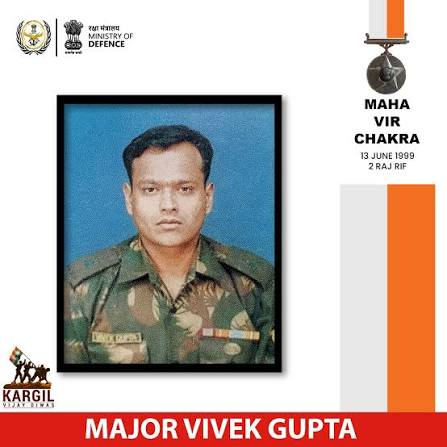
Major Vivek Gupta, MVC (Posthumous) - 2 Rajputana Rifles
By early June 1999, the Tololing feature in the Drass sector had become a major tactical bottleneck. Rising to over 15,000 feet, the peak provided enemy forces with uninterrupted observation of the Srinagar-Leh highway, allowing them to direct highly accurate artillery fire onto Indian convoys. Several initial attempts to dislodge the entrenched defenders had stalled due to the sheer, exposed inclines and devastating crossfire.
To break the deadlock, the 2nd Battalion, Rajputana Rifles (2 Raj Rif) was brought in to launch a decisive offensive. Major Vivek Gupta was assigned to command Charlie Company, tasked with spearheading the final assault on Tololing Top.
On the night of June 13, 1999, Major Gupta led his company up the freezing, near-vertical slopes. The approach offered zero cover. The moment the company broke the ridgeline, they were met with a wall of heavy artillery and automatic fire from mutually supporting enemy bunkers.
The intense barrage pinned the forward elements of Charlie Company down. Operating in sub-zero temperatures and thin air, any prolonged stall on the exposed rock face threatened the entire unit with heavy casualties and mission failure. Recognizing that the only way to survive was to close the distance, Major Gupta took immediate offensive action.
Under continuous suppressing fire, Major Gupta rallied his lead section and initiated a direct frontal charge against the entrenched positions.
The First Strike: He personally engaged the primary enemy bunker. Firing a rocket launcher to disorient the defenders, he immediately charged the fortification, engaging the occupants in close-quarter combat and neutralizing the position.
Sustaining Heavy Fire: During this initial breach, Major Gupta was struck by two bullets. Despite the severity of his wounds and heavy blood loss, he refused to fall back or allow the momentum of the assault to break.
The Second Bunker: Maintaining the offensive, he led his men toward the next bunker complex. He closed in on the position and engaged in brutal hand-to-hand combat, eliminating more enemy combatants. It was during this final push that he sustained additional, fatal gunshot wounds.
Before succumbing to his injuries on the battlefield, Major Gupta's calculated aggression and refusal to stall under fire successfully dismantled the enemy's forward defensive line.
Witnessing their company commander's decisive actions, the remaining soldiers of Charlie Company were highly galvanized. They pressed the advantage, overrunning the remaining bunkers and clearing the peak. By the morning of June 14, Tololing Top was fully secured by 2 Raj Rif.
The capture of Tololing was a critical turning point in the Kargil War, initiating a domino effect that led to the subsequent recapture of several adjacent peaks. For his tactical leadership, exceptional courage, and supreme sacrifice, Major Vivek Gupta was posthumously awarded the Maha Vir Chakra (MVC), India's second-highest military decoration.
7/14
Major Rajesh Singh Adhikari, MVC (Posthumous) - 18 Grenadiers
In May 1999, the Indian Army faced the daunting task of clearing entrenched Pakistani intruders from the heights of the Drass sector. One of the most critical early objectives of the Kargil War was the Tololing feature. Its capture was essential to removing the immediate threat to the Srinagar-Leh highway and regaining tactical momentum.
Major Rajesh Singh Adhikari, originally commissioned into the 2nd Battalion, Mechanised Infantry, was serving on a cross-attachment with the 18 Grenadiers. On May 30, 1999, he was tasked with leading his company to secure an initial foothold on a forward spur of Tololing, a vital step toward eventually capturing Point 4590.
The approach to the objective was brutal. Major Adhikari led his men up a treacherous, near-vertical mountain face covered in snow, operating at an altitude of approximately 15,000 feet. The extreme cold and thin air compounded the difficulty of the ascent.
As the company neared the forward spur, they were ambushed by intense fire. The enemy was well-fortified in mutually supporting bunkers equipped with Universal Machine Guns (UMGs). The heavy, sustained fire effectively pinned down the advancing Indian troops on the exposed mountainside.
Recognizing the tactical deadlock and the vulnerability of his men, Major Adhikari initiated an immediate counter-assault to break the ambush.
Engaging the First Bunker: He directed his Rocket Launcher detachment to lay down suppressive fire on one of the enemy positions. Simultaneously, Adhikari personally charged the other bunker. Breaking into the fortification, he engaged the defenders in close-quarter combat, eliminating two enemy personnel and silencing the position.
Establishing Covering Fire: To maintain momentum, he ordered his Medium Machine Gun (MMG) detachment to deploy behind a rocky outcrop. This provided critical covering fire, allowing his assault party to inch further up the steep incline toward the remaining defenses.
During the intense firefight to secure the perimeter, Major Adhikari sustained grievous bullet injuries. Despite severe bleeding and the extreme physical toll of the altitude, he categorically refused to be evacuated. He continued to issue orders and direct the tactical movement of his sub-unit from the front.
Determined to dismantle the remaining enemy resistance, Major Adhikari led a direct charge against the second primary enemy bunker.
He breached the position under heavy, concentrated fire.
He neutralized one more enemy occupant in close combat, ensuring the complete capture of the bunker complex.
This decisive action broke the enemy's forward defensive line on the spur. However, shortly after securing the position, Major Rajesh Singh Adhikari succumbed to his injuries on the battlefield.
Major Adhikari’s refusal to halt the advance, even when mortally wounded, secured the crucial initial foothold on the Tololing feature. His tactical aggression and neutralization of the forward bunkers inflicted heavy casualties on the enemy and forced them to withdraw from their defensive perimeter. This success directly facilitated the subsequent capture of Point 4590 by Indian forces, marking a major turning point in the Battle of Tololing.
For his exceptional leadership, supreme sacrifice, and conspicuous gallantry in the face of overwhelming odds, Major Rajesh Singh Adhikari was posthumously awarded the Maha Vir Chakra (MVC), India's second-highest wartime military decoration.
6/14
Lieutenant Balwan Singh, MVC - 18 Grenadiers
By early July 1999, capturing Tiger Hill had become a primary operational objective for the Indian Army. Standing at over 16,500 feet in the Drass sector, the peak offered Pakistani forces a panoramic vantage point to direct accurate artillery fire onto National Highway 1A, the critical supply route connecting Srinagar to Leh.
The task of neutralizing this stronghold was assigned to the 18 Grenadiers. Lieutenant Balwan Singh, who had been commissioned into the Army just four months prior in March 1999, was the commander of the battalion's Ghatak platoon—a specialized, heavily armed infantry shock troop unit tasked with spearheading the assault.
The operational plan for Tiger Hill involved a multi-pronged offensive. Lieutenant Balwan Singh and his Ghatak platoon were assigned the most treacherous route: a direct assault from the North-Eastern direction.
The Terrain: The designated path was not a standard climbing route. It consisted of a near-vertical, snowbound cliff face interspersed with deep crevasses and sheer drops. It was chosen specifically because the enemy considered it impassable, providing the Indian troops with a critical opportunity for a surprise attack.
The Ascent: Operating under intense, freezing conditions and continuous enemy artillery shelling, Lt. Singh led his men on a grueling 12-hour climb. The platoon utilized specialized cliff assault mountaineering equipment, driving pitons into the ice and rock to slowly advance up the precipice in near-complete silence.
Before commencing the climb, Lt. Singh reportedly told his men, "Tiger Hill pe Tiranga fahrake ayenge, chahe kuchh bhi ho jaye" (We will hoist the Tricolour atop Tiger Hill, come what may).
After navigating the vertical rock face for half a day, the Ghatak platoon successfully breached the summit's perimeter.
The sudden appearance of Indian troops from a sheer cliff face took the entrenched Northern Light Infantry (NLI) troops completely by surprise. However, the initial shock quickly gave way to panic and a desperate, heavy counter-attack by the entrenched defenders.
Sustaining Injuries: During the intense initial exchange of automatic fire and rocket-propelled grenades, Lieutenant Balwan Singh sustained severe gunshot wounds to his chest and legs.
Refusing Evacuation: Despite significant blood loss and the extreme altitude, he categorically refused medical evacuation. Realizing that momentum was critical to prevent the enemy from regrouping, he continued to direct his platoon's suppressive fire.
The Final Push: Unmindful of his severe injuries, Lt. Singh swiftly maneuvered to encircle the enemy fortifications. Leading from the front, he engaged the defenders in brutal hand-to-hand combat inside their bunkers, single-handedly neutralizing four enemy soldiers.
The sheer ferocity and unexpected direction of the Ghatak assault, compounded by Lt. Singh's relentless close-quarter engagement despite his injuries, broke the enemy's resolve. The remaining Pakistani personnel abandoned their positions and fled the summit.
The decisive actions of the Ghatak platoon under Lt. Singh's command paved the way for the 18 Grenadiers to fully consolidate their hold on Tiger Hill. The capture of the peak on July 4 effectively blinded the Pakistani artillery observers in the sector and marked a major turning point in Operation Vijay.
For his tactical acumen, exceptional leadership under fire, and absolute disregard for personal safety, Lieutenant Balwan Singh was awarded the Maha Vir Chakra (MVC), India's second-highest military decoration for gallantry. He survived his injuries, remained in the Indian Army, and subsequently rose to the rank of Colonel, commanding the same 18 Grenadiers battalion later in his career.
5/14
Rifleman Sanjay Kumar, PVC - 13 J&K Rifles
By early July 1999, the Indian Army's campaign to clear the Mushkoh Valley was heavily focused on Point 4875. The capture of this high-altitude feature was essential to eliminate the enemy's dominance over the valley and secure the transit routes below. Within this complex, a highly fortified objective known as "Flat Top" stood in the way of the 13th Battalion, Jammu and Kashmir Rifles (13 JAK RIF).
On July 4, the battalion initiated its assault. Rifleman Sanjay Kumar was designated as the leading scout of the attacking column. His role was to navigate the unforgiving terrain, identify enemy positions, and pave the way for the rest of the unit following closely behind.
As the column advanced up the steep, bare incline, they were suddenly pinned down by intense, sustained automatic fire. The enemy had entrenched themselves in sangars, heavily fortified defensive positions constructed from boulders and rocks—that provided a clear line of sight and robust cover against small arms fire.
With the advance completely stalled and his unit taking heavy fire, Rifleman Kumar recognized that the column was vulnerable to being wiped out on the exposed slope. Displaying sharp tactical awareness, he decided to break the deadlock.
Under the limited covering fire of his comrades, Kumar broke from cover and charged directly toward the first enemy sangar. During this frontal assault, he was struck by two bullets, one in the chest and another in the forearm.
Despite bleeding profusely from his wounds, Rifleman Kumar refused to halt his momentum. He closed the distance to the first sangar and engaged the enemy in brutal hand-to-hand combat. Overpowering the defenders, he neutralized three enemy soldiers and cleared the fortification.
Realizing that the second sangar was still laying down heavy fire on his platoon, Kumar did not wait for reinforcements. Demonstrating immense physical endurance, he picked up a captured enemy Universal Machine Gun (UMG) from the cleared bunker.
Bleeding and operating on pure adrenaline, he charged the second enemy position. The sheer aggression and suddenness of a wounded soldier charging with their own weapon completely disoriented the enemy defenders. They abandoned their heavy machine gun and attempted to flee the position, but Kumar engaged them with the captured weapon, neutralizing the fleeing combatants and securing the second sangar.
Even after securing the critical positions, Rifleman Kumar refused medical evacuation until the rest of his platoon moved up and firmly secured the objective at Flat Top. His decisive, independent action effectively broke the enemy's defensive perimeter, allowing the 13 JAK RIF to press their advantage and eventually capture Point 4875.
Evacuated for his severe injuries, Rifleman Sanjay Kumar survived the battle. For his exceptional initiative, tactical aggression, and disregard for personal safety in the face of overwhelming odds, he was awarded the Param Vir Chakra.
4/14
Captain Manoj Kumar Pandey, PVC (Posthumous) - 1/11 Gorkha Rifles
In the early stages of the Kargil War, the Batalik sector presented some of the most unforgiving terrain of the conflict. The mountains were steep, the ridges were narrow, and entrenched enemy positions had established a dominating arc of fire over the valleys below. Clearing these heights required coordinated infantry assaults up sheer inclines.
Captain Manoj Kumar Pandey of the 1/11 GR (1st Battalion, 11th Regiment) had already demonstrated sharp tactical maneuvering by pushing back intruders at Jubar Top. His unit's next objective was the strategically critical Khalubar ridge, a position vital to breaking the enemy's defensive line in the sector.
On the night of July 2, 1999, Captain Pandey was tasked with leading his platoon to clear a heavily fortified enemy stronghold on Khalubar. The advance required moving up a completely exposed ridgeline.
As the platoon closed in on the objective, they were suddenly subjected to heavy, enfilading fire from surrounding enemy positions. The crossfire effectively pinned the unit down, halting their momentum and threatening severe casualties if they remained stationary on the exposed slope.
Recognizing the tactical deadlock, Captain Pandey took immediate offensive action to break the ambush. He directed one section of his platoon to flank and engage the enemy positions on the right, while he personally led an assault team to clear the bunkers directly ahead.
Under intense machine-gun fire, Captain Pandey surged forward to dismantle the defensive line.
The Initial Breach: He charged the first enemy bunker, engaged in close-quarter combat, and neutralized two enemy soldiers, breaking the initial line of defense.
Sustaining Fire: As he moved to clear the second and third bunkers, the volume of enemy fire intensified. During this phase of the assault, Pandey sustained severe bullet wounds to his shoulder and leg.
The Final Bunker: Despite massive blood loss and severe injuries, he refused to fall back or wait for medical evacuation. He pressed the advance toward the fourth and final bunker. Unhesitatingly, he charged the position and hurled a grenade through the loophole, destroying the bunker.
In the final moments of clearing the fourth position, Captain Pandey was fatally struck in the forehead by a medium machine-gun burst.
Before collapsing, Captain Pandey’s final directive to his men was "Na Chhodnu" (Don't spare them).
Spurred by their commander's actions, the remaining soldiers of the platoon charged the remaining positions and successfully captured Khalubar. Captain Pandey’s calculated aggression and refusal to stall under fire were decisive in collapsing the enemy's hold on the Batalik sector.
For his tactical leadership, exceptional courage, and supreme sacrifice, Captain Manoj Kumar Pandey was posthumously awarded the Param Vir Chakra.