Today I chose restraint, not because we are unsure, but because the world is already standing too close to the edge.
When we published UVD, the reaction was not just technical. It was existential. Because if a neutral reserve layer exists that allows nations to settle without depending on a single dominant currency, then the existing order starts to feel less absolute. And when an order feels less absolute, insecurity rises. Insecurity turns into narratives. Narratives turn into escalation. You could feel how quickly the conversation moved from architecture to survival.
Let’s speak plainly. If a global system built around one central settlement axis suddenly faces a credible neutral bridge, markets reprice risk, alliances harden, rhetoric sharpens. A diminishing order fears irrelevance more than reform. And when fear enters monetary systems, instability follows. That is how chaos amplifies.
We did not build UVD to accelerate that chaos. We built it because the fragility was already there. Sovereign money is digitizing everywhere, but it is not becoming interoperable. Settlement remains discretionary. Liquidity can still be switched on or off by leverage. The pipes are political. That is the real Wild West hiding under polished surfaces.
When UVD was published, it exposed a possibility: a world where settlement is neutral, rule-based, and verifiable. That possibility is powerful. But if introduced without coordination, it can destabilize before it stabilizes. If the old order feels threatened before the new equilibrium is understood, you do not get reform. You get reaction.
Here is the red line, and it does not move: sovereignty at home, neutrality between nations.
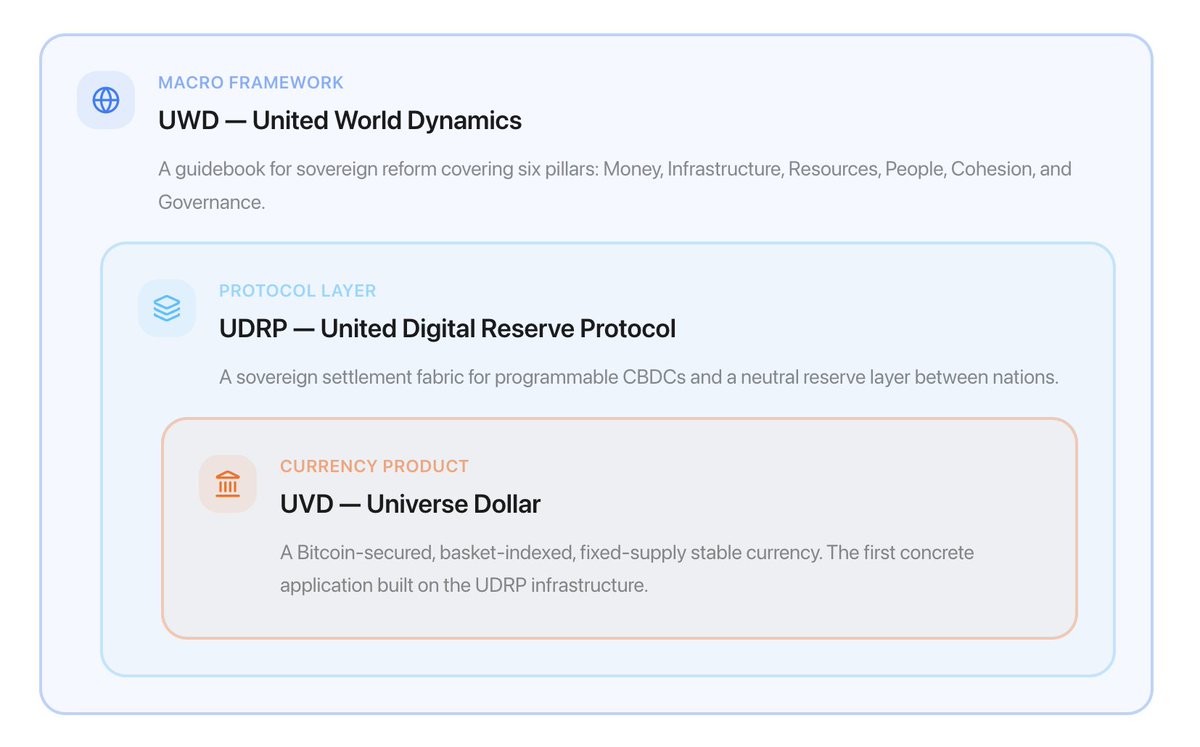
UVD is the neutral reserve layer. Not a world currency. Not an empire token. A bridge asset, common collateral, a reference that does not require any nation to kneel. UDRP is the settlement fabric around that bridge, allowing sovereign digital currencies to interoperate while keeping full domestic control over tax logic, privacy thresholds, capital controls, lending permissions. Corridors become explicit. Netting reduces strain. Collateral becomes provable. Rules become parameters instead of pressure.
UWD is the doctrine above it all. In a world of mobility and automated compliance, nations compete through attraction, not coercion. Benefits must rise. Friction must fall. Trust must be earned. Money, infrastructure, identity, governance, and foreign corridors must align as one operating system.
This is not about replacing one center with another. It is about ensuring that as the world evolves, it does not collapse to zero. Because if monetary trust implodes before a neutral standard is understood, the vacuum does not produce harmony. It produces fragmentation.
Yes, the code is ready. The app works. It can be released any day. But pressing launch into a moment of insecurity would amplify volatility. I do not want to throw fuel into a system already overheating. I want the world to read the architecture first. To see that this is a bridge, not a bomb.
Ad Infinitum means thinking beyond cycles of dominance and decline. It means building rails that outlive fear. It means refusing to accept that humanity’s horizon ends at currency wars and discretionary choke points. I am optimistic enough to believe incentives can be redesigned. Delusional enough to believe cooperation can scale. Serious enough to delay ignition until alignment exists.
Because if we stabilize settlement, we unlock something larger than finance.
We unlock coordination.
And coordination is what allows civilizations to build telescopes instead of trenches, reactors instead of rhetoric, corridors instead of conflicts. There is a universe to explore. Not metaphorically. Literally. But we will never reach it if our monetary nervous system keeps convulsing every time power shifts.
Lasting order is not fear. It is alignment. You do not expand horizons by humiliating others. You expand them by building structures where cooperation is rational and dignified.
The rails are built. The engine is ready. But first, the world must choose order over panic, structure over reaction, collaboration over fragmentation.
There is a universe above us waiting
We just need the ground beneath us to stop shaking long enough to build the ship.
Introducing UDRP – United Digital Reserve Protocol 🌐
When @uvd99 was published, the reaction made one thing clear: if a neutral reserve layer exists in a world that is already unstable, and there is no structured way for countries to coordinate around it, the transition will not be smooth. It will look like a jungle. In a jungle, settlement is dictated by power, not by rules. Liquidity becomes leverage. Stronger blocs dominate corridors. Smaller nations get squeezed. Trade turns political faster than it turns productive. That is what happens when an order weakens before a new framework exists.
So the real issue was never just UVD. The real issue was coordination.
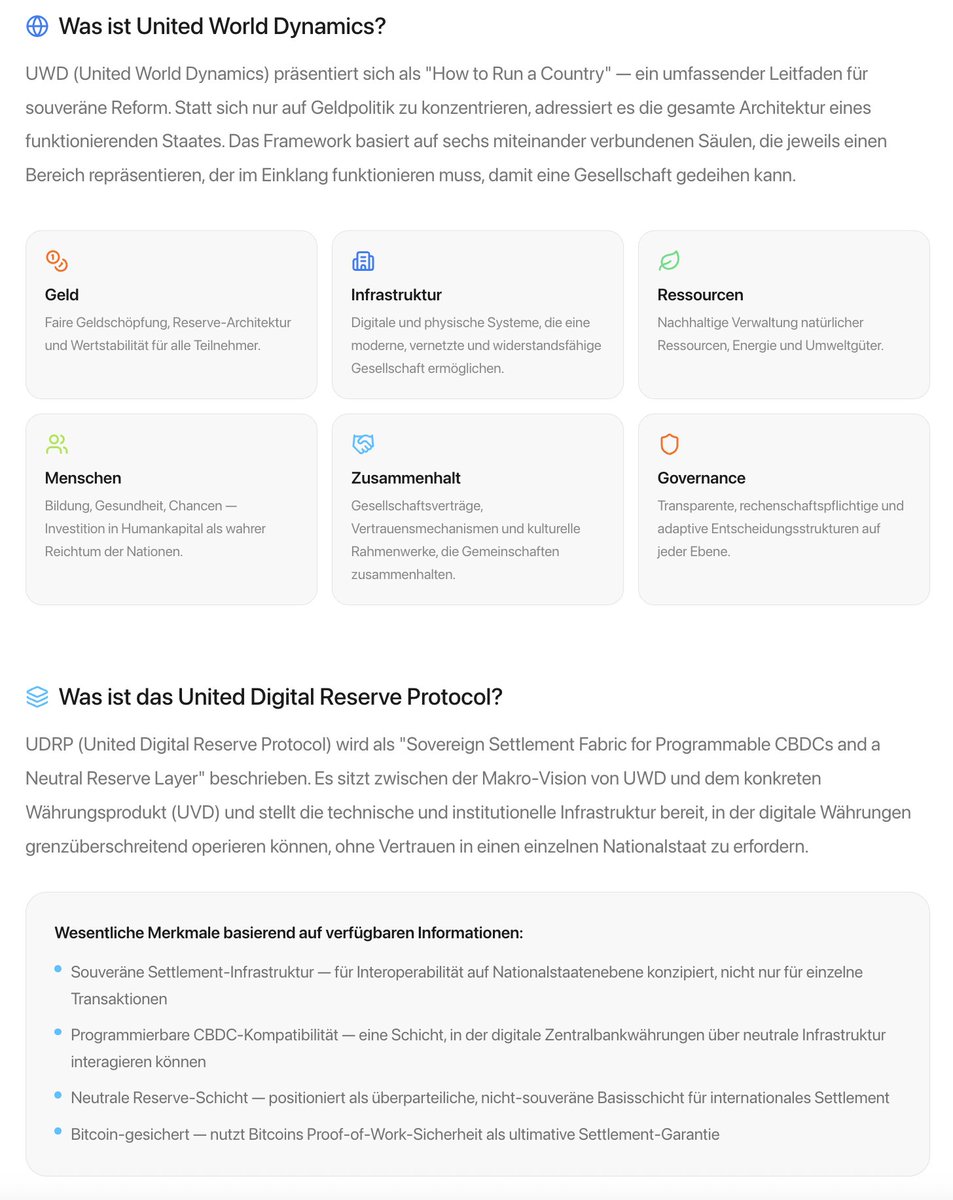
UDRP – United Digital Reserve Protocol – is the answer to that coordination problem. It is not a currency. It is not a central bank. It is not a supranational government. It is a sovereign settlement fabric that standardizes how digital national currencies interoperate while remaining fully sovereign.
UDRP is built on three layers. First, UVD as a neutral reserve and collateral bridge that sits between sovereign currencies when cross-border settlement requires a shared reference. Second, sovereign CBDC modules, meaning each country issues its own digital currency with full control over domestic policy such as tax logic, privacy thresholds, capital controls, lending permissions and fees. Third, a net settlement engine that clears obligations across corridors with programmable exposure limits, tariff rules and sanction logic.
What changes with UDRP is not domestic sovereignty. Every jurisdiction keeps control at home. What changes is the cross-border layer. Instead of discretionary correspondent banking and opaque intermediaries, settlement becomes corridor-based and rule-defined. Instead of settling every transaction gross and stressing liquidity, netting reduces systemic strain. Instead of hidden enforcement, tariffs and restrictions are explicit and machine-readable.
UDRP enforces one core invariant: sovereignty is preserved, but parameters must be explicit and verifiable. That means the world does not collapse into a monetary Wild West if neutrality increases. It means multipolarity has structure.
If UVD is the neutral bridge, UDRP is the architecture that prevents the bridge from becoming a battleground. It exists because neutrality without coordination is unstable. A multipolar world needs a multipolar settlement standard. Otherwise the strongest rules by default.
UDRP is the attempt to make cooperation cheaper than conflict before the jungle decides otherwise.
Humanity first. 💙
Introducing UWD – United World Dynamics ⚖️
When UVD and UDRP entered the public conversation, the hardest part wasn’t the technology. It was the implication: once money becomes more mobile and settlement becomes more neutral, the old tools of control stop working quietly. States can no longer rely on friction, paperwork, and invisible chokepoints to keep people and capital in place. And if a country’s real offer is weak, people will leave, talent will leak, and legitimacy will decay. That transition can either become chaotic, or it can become a disciplined upgrade of how a country works.
UWD – United World Dynamics – is that upgrade. It is not a currency. It is not a protocol. It is a sovereign operating doctrine: a practical guidebook for how nations remain stable and competitive in a world where mobility rises and compliance can be automated, so jurisdictions compete by offering real value to citizens. Benefits must rise, friction must fall, and trust must be earned.
UWD is organized as seven sovereign modules with a build logic that’s meant to be legible, not ideological: Money, Infrastructure, Resources, People, Cohesion, Governance, The World. The red line is simple: attraction beats coercion. For most of history, states retained people through barriers and permission. In a high-mobility world, that approach becomes brittle. Durable order comes from making participation rational: predictable law, usable infrastructure, low corruption surfaces, and systems that work in real life.
Here is how UWD connects to the rest. The monetary layer assumes UVD as a neutral reserve unit and UDRP as the settlement fabric for interoperable sovereign CBDCs. That is the “Money” module foundation: sovereign money at home, neutral settlement between nations, and a citizen interface where people can live normally while obligations remain enforceable without turning society into a panopticon. UWD then expands outward, because money alone doesn’t create legitimacy. Infrastructure has to be usable with fallbacks, not just “digitized.” Resources must be managed as intergenerational sovereignty, not consumption theater. People policy must treat belonging as a real incentive, with credible pathways and explicit tiers. Cohesion must be built through duty, culture, and targeted accountability, not blanket surveillance. Governance must have real feedback loops and symmetry, because a society collapses when rulers are exempt. And the world module reframes foreign policy as corridor parameters: measured cooperation, containment before escalation, and a multipolar equilibrium where prestige comes from competence, not intimidation.
UWD exists because neutrality and interoperability change the game. Once rails are cleaner and compliance is simpler, citizens can compare jurisdictions in near real time. The winners will not be the loudest. They will be the most legible, most reliable, and most worth building inside. UWD is a blueprint for becoming that kind of country, without demanding uniformity, without erasing culture, and without pretending technology perfects humanity. It’s incentives, executed as systems.
In short: UVD is the neutral reserve layer, UDRP is the settlement fabric, and UWD is the playbook for what a sovereign should become when those rails exist. It’s how you turn a potentially chaotic shift into a disciplined climb.
Because there is a universe to explore.
But no civilization reaches the stars while its internal systems leak trust, punish builders, and run on discretionary friction.
UWD is the doctrine of building a state that compounds instead of cracks, so the horizon expands on purpose, not by accident.
For Humanity! 💚
CIA is compromised by palantir and fake americans that fuel war for their own gain
both will go to zero, sorry USA 🇺🇸 but you allowed these people to ruin your country