We're an overtly Canadian company and unapologetically reject all the anti-American sentiment we're seeing. It's naive, pathetic, and immature.
This is an artificial narrative political elites are using to maintain power. We want nothing to do with it.
Very excited to welcome Ken Sim (i.e. the mayor of #Bitcoin City!) to @learningbtc_ca later this year and hear how his Bitcoin plans and aspirations can benefit Vancouver! 🇨🇦
So we're regularly noticing how unacceptably large Foundry has gotten and it would be good if Bitcoiners in general understand why we are where we are.
First, let's talk about what it is pools actually do, starting from the theoretical going all the way the practical.
In theory they make no difference to anything - they simply reduce variance.
Instead of earning $.X per year, you earn $.X/365 per day.
This is far more consistent and makes day to day operations easier and it's clear why someone would want to do this - assuming they're a smaller miner who is not capable of finding block frequently enough without pooling and splitting rewards with others.
This might be desirable to the point where you'd even pay a split to the coordinator (pool) because it's that valuable of a service.
To take it further, the absolute hands-down most common payout model for a pool to use is FPPS - this doubles down on the supposed benefit that is so compelling here. It stands for For Pay Pay Share which -in theory - means that miners get paid on a share to share basis (something they're submitting multiple times a minute) a highly predictable amount.
This means you not only have you abandoned dealing with lotto-variance (waiting until you find a block) or even standard pool variance (waiting until someone on the pool finds a block) but instead you're mining with a pool that grants you earnings multiple times per minute regardless of if the pool is finding any blocks or not.
This is variance reduction to such an extreme that the product becomes unbelievably expensive because pools have now put themselves in a position where they must pay miners for blocks that might - and very often don't - happen.
This was demonstrated beyond doubt with OCEAN (non-FPPS) released its numbers and they outperformed FPPS by over 30% in some cases during its first year of operation.
*Note: This is NOT a "You should mine on OCEAN" post. I am simply trying to explain why miners are making the decisions they are because it seems to be eluding almost everyone.
So miners are apparently opting for variance reduction to the point where they want to get paid no matter what for blocks that may or may not even exist with resolution all the way down to the share level.
But here's the part where the disconnect between theory and reality comes in.
Nearly all the miners on Foundry have absolutely zero need for this kind of variance reduction - or indeed any at all.
The publicly traded miners that make use of Foundry all have the ability to find multiple blocks a day without any third party whatsoever which is way more than enough.
As mentioned already, FPPS is an extremely expensive product that logically would only be required by a miner faced with 24 hourly energy bills who only has 100 Petahash or so. Again, the typical Foundry miner is 100 times the size of this coming in at almost 10 Exahash at the smaller end.
So if Foundry solves a particular issue - variance - and charges a fortune to do it, and its main customer is miners that could lotto-mine and find multiple blocks without incurring the costs of FPPS then what on Earth are they doing?
The naive answer is that they haven't done the maths. In some cases I actually know this to be true. You're an enormous miner and you do a deal with Foundry - they charge you 0.1% fee and you think that's equivalent to if you cut out the middle man entirely pretty much so it becomes worth it.
But with FPPS the fee is never the fee. That is the airport currency exchange sign that says "0% COMMISSION" and gives you something about 14% worse than market rate. Where is the money going?
I don't think most miners are actually making that mistake, at least not all of them.
It's time to explain the real reason here.
Compliance by proxy.
And this is what's key to understand.
History: Once upon a time a pool called GHash(.)io got above 40% of the hashrate (which Foundry is doing repeatedly at this point) and the miners all fled out of instinct to protect the network. You simply cannot have any single entity making 50% of the blocks that get added to the chain or anything approach that.
So why aren't miners doing it today? Are they that addicted to variance reduction when the calibre of miner that uses Foundry is perfectly capable of reducing their own variance anyway even though it's costing them a fortune?
Again the entire space needs to understand why history will not be repeating itself here and this where I find the greatest amount of self-delusion and dishonesty in this space.
Compliance by proxy was not a thing in 2016. At least not for miners.
Since then, someone has come along and turned what is completely unacceptable to the powers that be - Bitcoin mining and turned it into a completely sanitized, censorship prone shell of its former self - and *that* is the true motivation for "miners" paying these exorbitant fees.
Compliance is new. And it isn't a factor people are taking into consideration.
Whenever we point out how precarious the situation has become, there is the typical response - "If Foundry ever do <bad thing> then their miners will just leave".
It's time to put this cope-strategy to bed.
If a miner is perfectly capable of reducing their own variance to the tune of reliably finding multiple blocks per day themselves - why are they using a pool at all? Especially if that pool costs a fortune?
Or more crudely - If losing a tonne of money for no apparent reason isn't compelling enough to leave Foundry, then jeopardizing Bitcoin isn't going to be either.
The true motivation is all that matters, and its overwhelmingly just compliance. "Miners" of substantial size increasingly do not want anything to do with Bitcoin and want all their hashrate transformed from raw Bitcoins coming out of the blockchain fresh from a block into a nice clean product that their accounts and lawyers can tolerate regardless of the cost.
To take the counter position to my argument here, there are of course costs to rough-housing it and grappling with Bitcoin directly as MARA does and I don't want to pretend otherwise but I don't think they come anything like close to justifying the enormity of the revenue lost due to the extreme over-kill that is FPPS.
This is the only area in which I will take pushback from someone in one of the relevant companies as it's possible I am just wrong.
The following companies - BitFarms, Hut8, RIOT, WULF, HIVE, Cleanspark and a couple of handfuls of others are all - to the best of my knowledge - paying a fortune for the combined benefit of variance reduction (which they absolutely have no need of) and compliance by proxy.
If anyone from any of those companies can explain to me why I am wrong and that if/when Foundry's size results in them engaging in censorship or any other abuse of the network (heck, already requiring KYC and regular inspections of mining facilities is unacceptable and that's already been the case for Foundry miners for years) then why should anyone believe you would move to another pool or go the Mara route?
At present I believe that Foundry could continue its inexorable ascent to the 51% magic number we're all afraid of and the new cope will be "Well they haven't done <bad thing> yet" and we'll just keep moving the goal posts about what constitutes a bad thing.
At the moment "It's just KYC", "It's just mandatory inspections" and "It's just lost revenue."
All of that is unacceptable. "It's just transactions associated with Russia/Iran" comes next and the shareholders of publicly traded Bitcoin miners are unlikely to view censorship based on that criteria as being anything to worry about.
The old cope of "another miner will just include them and their business will survive while the censoring miners die" is complete and utter delusion.
Almost 100% of revenue from the chain is subsidy. Transaction fees are neither here nor there. And if we think the US Pubcos are all going to voluntarily go admit bankruptcy because they lost a few hundred bucks a week from mining blocks that censored blacklisted UTXOs then we are deluding ourselves.
I reiterate - miners are with Foundry because compliance is increasingly all that matters. This has resulted in enormous centralization of template construction that becomes a genuine attack vector at ~30% and has been consistently way above that for a long time now. 51% is a meme, and imo not a powerful enough one to inspire change if it actually comes to that.
Let's be honest. None of the miners on Foundry are leaving any time soon but the variance reducing product they offer that can be so trivially replicated elsewhere is not why any of them are doing what they are doing.
Foundry is the sole occupant within the regulatory moat that is Bitcoin mining in America and I don't see that as trivial to replicated at all.
And the reason I wish to sound the alarm 10,000 louder than I have been before this point is that the current US administration has run a campaign that specifically talks about centralization Bitcoin in the US.
The phrase "We will make all the Bitcoins in America" is exactly the worst possible thing you could want to hear given everything I've talked about in this post and not only is it not being rejected by Bitcoiners, it is being celebrated as a good thing.
Ideological rug pull. The hypershitcoinization you despise seeing.
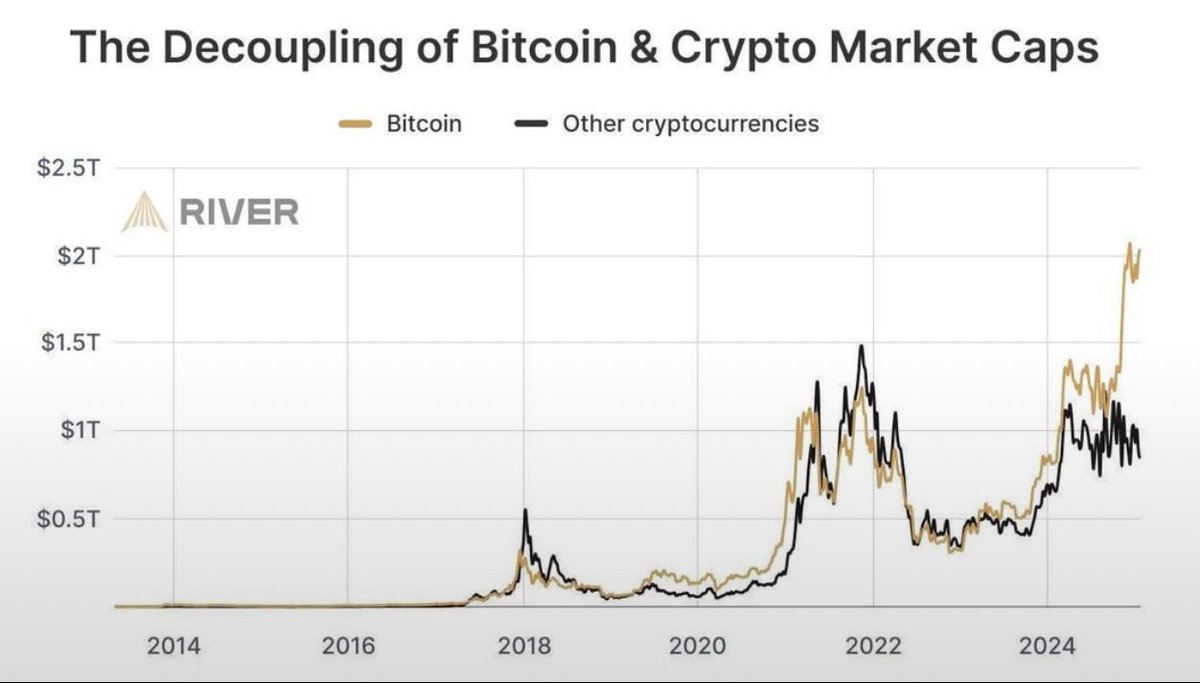
Saylor presented himself as a maxi but now pushes the perspective that lumping Bitcoin and crypto together (when years of work was done creating a line in the sand between them) is somehow going to be of benefit to Bitcoin.
Crypto *is* the attack. It's entirely comprised of watered-down, centralized, and controllable versions of Bitcoin that can be used a bait and switch on an unsuspecting public.
Conflating the two things is unforgivable. Imagining long standing enemies to be of tactical benefit no matter how short term is a mistake.
I'll ignore the entire context and highlight why even the one thing that's supposed to of benefit here is a huge loss:
The steelman is this: "Create a larger industry with more collective influence than could be achieved with Bitcoin alone."
(This assumes Crypto is enormous and not merely presenting itself as enormous. It's the latter for obvious reasons but shelve that for now...)
Crypto and Bitcoin do not have the same requirements to succeed.
Crypto requires constant approval from regulators as it cannot function without it at any scale. Sure you might get some crazy short term pumps, to the extreme you might get another DOGE that takes the fancy of one man-child billionaire who couldn't handle the ego-check that is Bitcoin. But you're never escaping joke/scam/gambling category like that.
Crypto has to be afforded legitimacy because that is how it pulls ahead of competition. You are an altcoin. You are not Bitcoin. That means you must compete with a million other altcoins, all of which are obviously scams to anyone with any discernment. Your value comes from getting listed on a big exchange or getting some stamp of approval from a regulatory body.
Bitcoin not only doesn't require this but is harmed by it. The construction of regulatory moats within Bitcoin's ecosystem is the beginning of the end. If I can summarize the entire mission of this account over the last decade it would be having been banging on about this one specific point:
Crypto dies when it gets made illegal. Bitcoin gets better.
This is anti fragility. And here's the second bit everyone forgets: Bitcoin gets made weaker and more fragile when its "users" operate within limits imposed on them by regulators.
Examples:
- "Mining" but delegating all block construction and custody of newly created coins to trusted third parties in order to pay significantly less tax
- "Green" mining (not really a thing yet but the purpose of Saylor's mining council was to 'voluntarily' attempt to pander to the psychopathic, hypocritical de-industrialists to appease them of course without regard paid to the eventual "I'm not touching you" style softly-mandated enforcement of all once-voluntary efforts. tldr: "Be a part of this or pay the price: you're getting taxed at 60% but don't worry, you get it all back when you do XYZ, but XYZ ofc isn't mandatory."
- KYCing yourself to buy your coins. (Creates two tiers of UTXOs, legit ones and "unclean" ones worth more/less depending on the situation. Anything that undermines fungibility makes Bitcoin less "money" and more "barter" with all the usual inefficiencies therein
- Third party custody for "hodlers": Using ETFs/MSTR etc to take advantage of the regulatory moat. Sure you're throwing money that would be spent on real Bitcoins into a black hole but you now you won't get sued by your shareholders! This has the effect of guaranteeing there are fake "Bitcoins" out there.
All of this is fixed over night with draconian, poorly thought out measures like China banning Bitcoin mining. That would have killed any crypto and was a massive win for Bitcoin.
What you absolute cannot do is mistake Bitcoin for some kind of tech stock that exists in regulatory purgatory that would benefit from becoming legitimized in the eyes of the people Bitcoin was brought to destroy. This includes all types of fiat grifters, from the central bankers to the crypto scammers. It's all the same scam.
You cannot play games and treat them as temporary allies without necessarily corrupting the culture within Bitcoin itself. ETFs should never have happened. Now that they have and we have a pro-crypto adminitration coming into the whitehouse, you'll have the "bluechip memecoins" along side.
Hostility towards all crypto including Bitcoin benefits Bitcoin in the long term and kills everything else not built to survive. Friendly treatment turns all of it into permissioned nonsense incapable of the serious mission here - and the ultimate insult is that Bitcoin never needed the friendly treatment in the first place.
The only way we can prevent Bitcoin from becoming a stupid crypto in the eyes of the world, from being treated as such, and becoming as such is by doing what we've been doing and rejecting compromises of the kind being placated in the video below.
Bitcoin was invented 16 years ago today!
On January 3, 2009, a mysterious engineer with the username ‘Satoshi Nakamoto’ created the open-source Bitcoin peer-to-peer electronic cash system. For the first time, people could send money online without needing banks or middlemen.
Economic production & tech advancement are not zero sum games. America doesn't 'lose' if something is invented abroad. Americans can invest & trade with foreigners & benefit together. This is not a competition for a trophy.
AI: “The Great Deflation Bomb”
AI will massively lower prices — the most since the mechanization of agriculture.
If government makes it easy to create jobs and lays off the money printer, AI will be a golden age.
But if government gets it wrong it will be a disaster.
It takes a tremendous amount of virtue to think independently of your incentives. Which is why you shouldn't trust altcoiners, VCs or fiat academics who are pushing their story.