Update:
I am not venturing into any stock ( though my watchlist is full of good names in smallcap names) because of obvious reasons. The liquidity is currently being poured into large cap names. So to try to hedge my portfolio drawdown( which is currently 10%), I am buying Futures in large cap Capital Market names and 1 Private Bank and 1 IT large cap name. It does nto feel good to be underperforming the Nifty index but we should pat our back because Nifty is still below ATH while our portfolio is much better than that since the last 1 year.
Please note: I will add to my holdings once I see momentum increasing. None of this is buy sell recommendation.
I am not posting charts now as the number of persistent movers have lessened a lot. Some of the leaders of the last leg like AI/DC and now recently the CDMOs have broken their latest swing lows.
I do not have any exposure to AI/DC names but have between 20-25% exposure in CDMO/API/generics .
I am trying to hedge this fall with Futures long in Capital Market stocks like BSE,MCX,CDSL. Also have some 8% exposure to EMS sector like Syrma , Avalon which is experiencing a negative price action. I have not reduced any exposure there yet as valuations still are not that stretched in EMS and CDMOs which I have.
But portfolio is still 6-8% down from this year's high it made in Sept.
I was not able to participate in Nifty run up because i booked my futures long way to early.
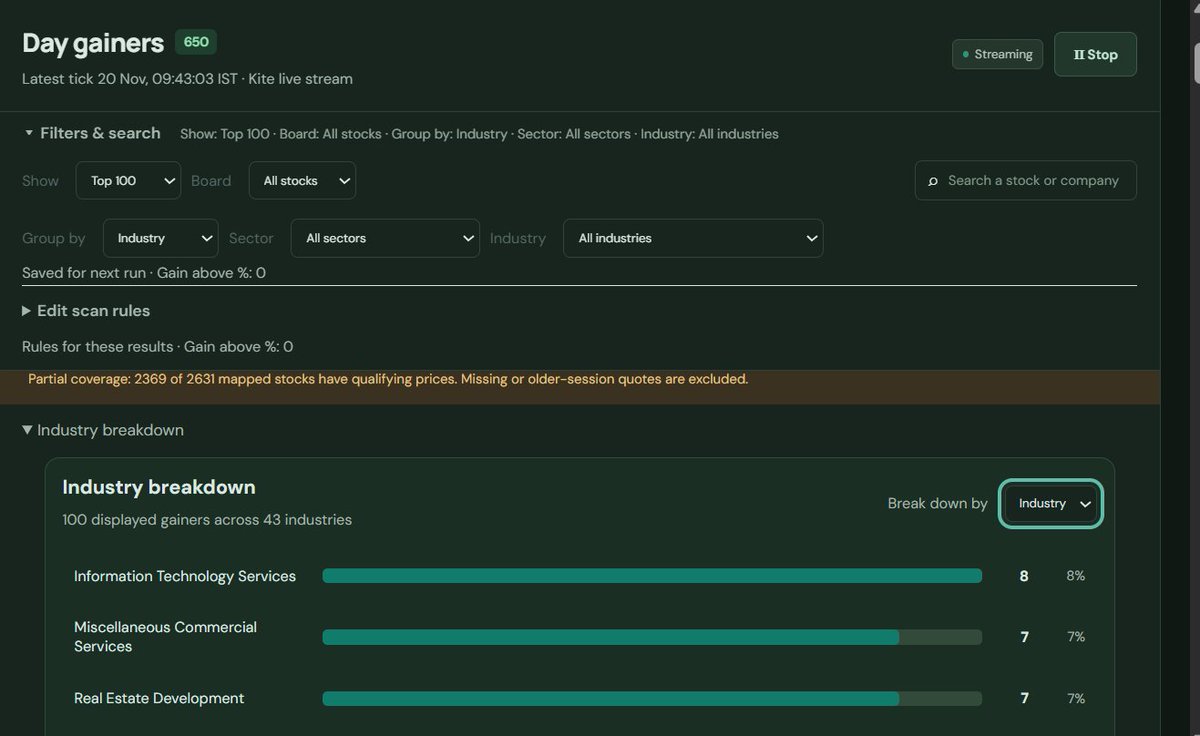
I am still tracking industry strength and trying to take advantage of that just like I am doing with nifty capital market stocks right now.
I hardly agree with his investment process but this is something he pointed out correctly. Commodity cycles are different than equity ones. Do not confuse them. They are not a cash generating asset.
One should not expect returns from Gold/Silver in medium term 6-12 months
It can even lower, who knows
My suggestion if for long term holders
Trading, short term returns, buying at bottom is out of my syllabus
If you are trying to find the bottom, you can wait
But if you want to build Gold/silver position for your portfolio or personal wealth
Go through SIP
This price fall can last 6-12-18 months
That's your accumulations zone
Because when the rally comes we all think pehle kyu ni liya
Because kabi lows pe lene ki aadat ni hai😅
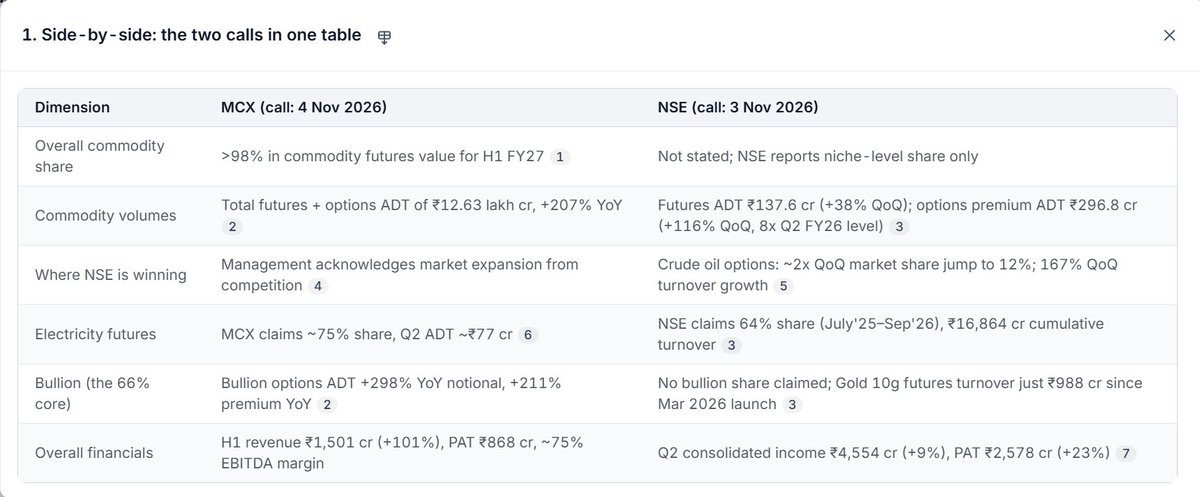
What #BSE did to #NSE is what #NSE can do to #MCX.
Markets are forward looking and commodity segment of NSE has potential to show triple digit % growth for considerable time taking away market share. One big optionality is if Brent crude (in addition to WTI) starts trading on NSE, options volumes can skyrocket.
Worst time to be a swing trader. No followthrough, themes strength getting more and more skewed. Hardly any followthrough. Either trade for intra or hold for more than 1 month.
The most important thing missing here for traders is probability. You can lose $1000 a 100 times and may go bankrupt before getting any chance to make a $5000.
Always protect your downside.
“If you put $1,000 in a stock, all you can lose is $1,000. And I've done that several times. But if you're right, you can make $5,000, $10,000, $20,000.”
~ Peter Lynch
US markets are in a no trade zone. Too early to go long and too late to go short. Oversold bounce is awaiting but the overall long term trend is down only.
NEGATIVE NEWS FOR EXCHANGES BROKERS
SEBI CONSIDERS LINKING LIMITS ON NEW MARGIN-FUNDED PURCHASES TO A STOCK'S FREE FLOAT, SOURCES SAY (EXCLUSIVE)
SEBI SAID TO TIGHTEN RULES FOR LEVERAGE STOCK BETS: REUTERS
#BREAKING
I agree. Stock market should never be your first choice to generate your income unless you are managing someone else's money.
Build assets using stock market.
Income first, assets later.
Why Swing Trading is dead for Middle Class in India?
If your only edge in trading is chart patterns taught by your trading experts, you will soon find out why you should give up the idea of trading markets
🧵
I am not posting charts now as the number of persistent movers have lessened a lot. Some of the leaders of the last leg like AI/DC and now recently the CDMOs have broken their latest swing lows.
I do not have any exposure to AI/DC names but have between 20-25% exposure in CDMO/API/generics .
I am trying to hedge this fall with Futures long in Capital Market stocks like BSE,MCX,CDSL. Also have some 8% exposure to EMS sector like Syrma , Avalon which is experiencing a negative price action. I have not reduced any exposure there yet as valuations still are not that stretched in EMS and CDMOs which I have.
But portfolio is still 6-8% down from this year's high it made in Sept.
I was not able to participate in Nifty run up because i booked my futures long way to early.
I am still tracking industry strength and trying to take advantage of that just like I am doing with nifty capital market stocks right now.
This is a structural beakdown for both KOSPI and US AI names. Begins with a gap down and closes at low.
There can be dead cat bounces but for any new uptrend, the structure is far too broken and will need a good amount of consolidation.
If US AI spending really goes slow, consider a big hit on US AI export names from India as well.
The strongest names leading Indian market throughout 2026 may get dethroned. Let us see who assumes the leading sector now. People are crying out for Large Cap IT names and relatively stable valuations in NIFTY.
This is a wise perspective, and I really appreciate it. Most retail traders start this way, but many give up after their first major setback.
The stock market can become a casino if you treat it like one. People often imagine only two outcomes: getting rich or going bust. But there is a third path: managing risk, thinking in probabilities, and building an edge over time.
First, learn to stay afloat. Then learn to swim. Reaching the shore comes later.
Three Bull Markets, Two Bear Markets & The Making of an Investor
Wealth creation in the markets is a process. It takes time, experience, patience and, most importantly, survival.
I genuinely believe that most investors need to go through at least three bull markets to understand what it takes to create meaningful wealth.
First Bull Market: The Learning Begins
You enter the markets relatively late, usually when everyone around you is making money. You buy aggressively, see 25–30% returns on your portfolio and start believing that making money in equities is relatively easy.
Then the cycle turns. A correction follows, profits evaporate, and you realize that the market doesn't move in one direction. You learn your first big lesson: paper profits are not the same as wealth creation.
Second Bull Market: Experience Replaces Excitement
This time, you are more experienced but also more cautious. You have seen a bear market, so fear prevents you from buying aggressively, even when opportunities are staring at you.
You still make decent money, but perhaps not as much as you could have.
However, something important changes. You begin understanding sectors, business models, management quality, valuations and, most importantly, cyclicality.
You learn that not every company grows at the same pace, not every sector participates in every bull market, and not every correction is an opportunity to buy blindly.
You also learn the importance of position sizing, capital preservation and having the conviction to sit through volatility.
One line you will almost certainly find yourself saying again and again: "I should have bought more back then!"
Third Bull Market: Experience Meets Opportunity
This is where things start changing.
You have seen enough cycles to understand market behaviour. You know which businesses deserve higher allocations, which sectors have structural tailwinds and which companies are merely riding a temporary cycle.
You are no longer chasing every stock that moves 20%. You know what you want to own and, more importantly, why you want to own it.
When opportunities emerge, you are willing to deploy capital aggressively because your understanding and conviction have improved. You wouldn't be afraid to deploy 15-20% on a single stock.
This is where meaningful wealth creation can happen.
But here is the catch: To participate meaningfully in your third bull market, you must first survive two bear markets!
A few lessons worth remembering:
Don't confuse a bull market with investing skill. A rising tide can make almost everyone look like a genius.
Your first few years should be about learning how businesses and markets behave, not maximizing returns.
Understand cyclicality. A great business can still deliver poor stock returns if you enter at the wrong point in its cycle.
Don't get carried away by someone else's returns. Everyone has a different entry point, risk appetite, capital base and investment journey.
Capital preservation matters. You cannot compound if you are permanently out of the game. Position sizing and stop-loss go hand in hand!
Build conviction through research and experience, not through social media narratives.
Most importantly, stay invested in the learning process. The market rewards those who evolve.
And one final thought.
Even if you replace the term "Bull Market" with "Sector Rotation", the theory remains exactly the same.
You may miss the first opportunity, participate cautiously in the second and eventually learn how to identify and capitalise on the third.
It takes time. Stay in the game long enough to understand the game.
Don't rush the process. The objective is not to make money in every bull market. The objective is to become a better investor with every passing cycle.
Be in the game long enough to become the fame and the flame!