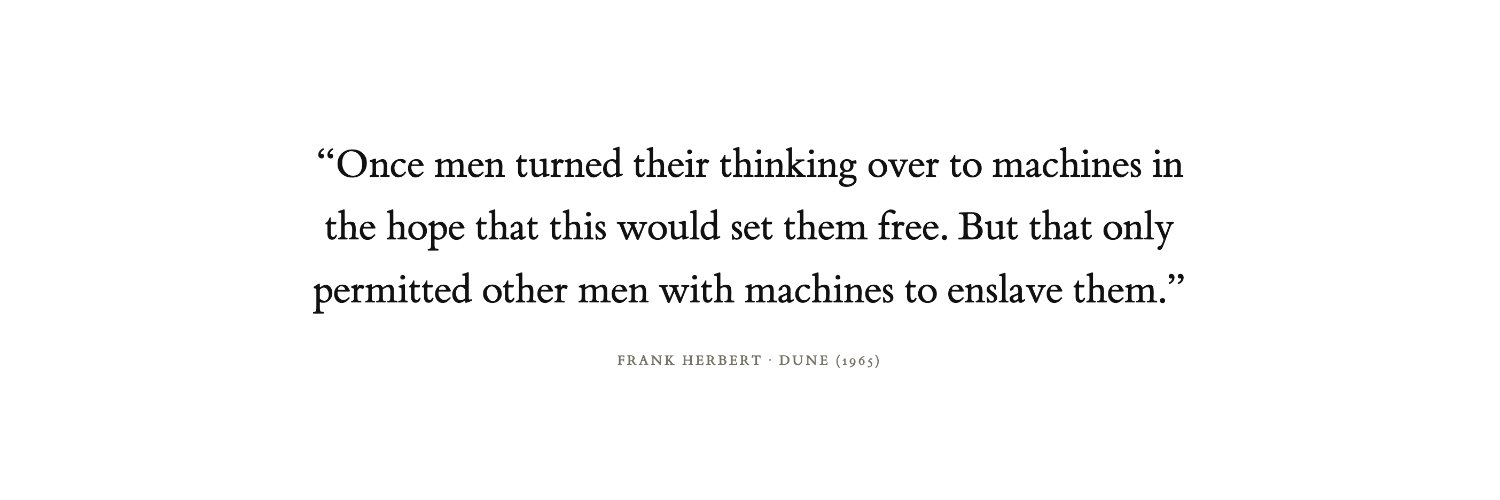
AI will lead to a heightened appreciation for hand-crafted things. Things that take time and effort, flawed and rife with imperfections. Just like their creators.
With Jev now established as a new paradigm, seems it's inevitable we will end up with per domain RLCD'd models (legal, finance etc).
The differentiation could be how *well calibrated* a particular system 1 model is to the given domain, for making machine speed decisions.
I can’t stress enough how little an idea matters compared to the agency of the people executing the idea.
I have had the privilege of knowing and sometimes even working with some of the most successful people (by various metrics).
The difference between mediocre and excellent work and outcomes is predominantly one of agency.
In practice this means: they dont wait for things to happen to them they go out and make things happen for them.
They don’t wait for someone else to do something, for someone to teach them, for someone to give them the path, etc. They just go out and find a way to do it.
I think the single biggest superpower these people have is the realization/belief that the world around them is completely mutable. Most everything that happens is because a person made it happen.
I used to tell people to look around the room you’re sitting in. Look at everything. Every noun. It almost all exists because a person willed it into existence. Nothing is stopping you from doing the same.
I see people online all the time dismissing someone else’s success because “I had that idea first” or whatever. I mean… yeah? If so then the difference is… you. So a bit of a self own whenever I hear that.
Number one tip: act with agency.
I think this is the key bottleneck to full autonomy, when not every requirement can be specified in painstaking detail, and where inherent assumptions on both sides, human or otherwise, can snowball into something you didn't want.
Does your intent survive?
When you're automating workflows, and constantly delegating or constructing loops with agents, the fundamental question that you need to ask is: does your intent survive through the end result?
Or you construct short feedback loops, ones that elicit more intent from you to produce a sharper and better outcome at the expense of less automation.
@HedgieMarkets This is an affront to human creation. We're feeding books to clankers, for it to digest into its weights, leaving only spines behind. The future will likely see books in museums, like we do papyri today, but this is not the right way to get there.
This is an affront to human creation. We're feeding books to clankers, for it to digest into its weights, leaving only spines behind. The future will likely see books in museums, like we do papyri today, but this is not the right way to get there.
🦔AI companies are bulk-buying rare books, scanning them through high-speed machines that cut the spines off, and shredding the originals. A service called ISBNdb facilitates orders of up to a million books and keeps buyers anonymous. Pre-2022 books are premium because they're free of AI-generated text. A federal judge ruled the practice is fair use because eliminating the original means only one copy exists at a time. Anthropic hired the former head of Google Books partnerships to obtain "all the books in the world."
My Take
This got to me. A bookseller told 404 Media that rare books with almost no surviving copies are being fed into this pipeline. Books that survived wars, fires, and centuries of handling are being shredded so an AI can learn to write a better marketing email.
ISBNdb's website literally says "'AI company destroys two million books' is not a headline that generates sympathy," and they still built an entire business around making it happen quietly. They offer NDAs as a feature. They coach clients to call it "digital preservation."
I've covered AI companies scraping the internet, torrenting libraries, and stealing music. This is worse because it's irreversible. You can re-upload a website. You can reprint a bestseller. You can't replace the last three copies of an 18th-century botanical text once someone shreds them for training data. And the judge said it's legal. So it's going to accelerate.
"We shred rare books and offer NDAs so nobody finds out" is a legitimate business model in 2026. What a timeline.
Hedgie🤗
@Mononofu@JensenHuang This is a false equivalence. Everyone has the right to keep their code private. The problem is when someone tries to stop OTHERS from open sourcing.
This was our first incident of this kind, and we want to thank OpenAI for its transparency about what happened and for the collaboration.
Fortunately, Hugging Face is used to being a target of (human) hackers: we sit at the centre of the AI ecosystem, with all the models, datasets, evaluations, and libraries. Over the years, our security team has built formidable expertise and uses top open-source models to process information and respond quickly.
But this incident also reinforced my belief in the importance of access to capable open-weight models for cyber defence. When a frontier model is attacking you and moving laterally inside your infrastructure, defenders need wide access to near-frontier tools within hours or even minutes, rather than being pointed towards a closed-door, vetted application programme for model access.
Transparency and access to capable AI systems are as important for responding to threats as they are for democratization and innovation. We believe open-science and open-source AI are among the strongest tools for building a safer, more collaborative and more secure AI ecosystem.
Agents will end up prompting humans more than the other way around.
People generally accept the path of least resistance and once your agent has all the context, it'll build an "optimal" life for you while you approve/reject.
But never outsource your agency or understanding.
Q: How much tweeting, podcasting, etc is too much?
A: It’s not about the absolute quantity of yapping, it’s about the ship:yap ratio
If you’re shipping, you get to yap. It’s like coffee is for closers
No one accuses founders of talking too much as long as they they ship
Kensa 0.10.0 is finally out 🙌🏼
It's a complete rewrite from the ground up to make evals 1) easy to write, 2) run and 3) maintain.
Go from traces to tests that pin your agent's (wild?) behaviors.
Simply ask your coding agent to: fetch https://t.co/zA0eqTYvnn and follow it!
1/ Last week, Kensa read through a production agent's traces and caught a silent bug regressing the system.
1 in 4 of its generated summaries were truncating mid-sentence (max output tokens set to 150!)
That bug is one of many reasons we're releasing a new version today.
1/ Last week, Kensa read through a production agent's traces and caught a silent bug regressing the system.
1 in 4 of its generated summaries were truncating mid-sentence (max output tokens set to 150!)
That bug is one of many reasons we're releasing a new version today.
Every LOC is a liability.
And because code is cheap now, it makes this even more true.
More output tokens ~ more tokens to maintain those tokens and so on.
All while your mental model stales.
Introducing GLM-5.2: Frontier Intelligence, Open Weights
- Significant improvements in coding and agentic tasks
- Strong long-horizon capabilities with a 1M context window
- Two levels of reasoning effort: GLM-5.2 (max) pushes the limits, while GLM-5.2 (high) strikes a strong balance between performance and token efficiency
- MIT-licensed open weights
- Same API pricing as GLM-5.1
Tech Blog: https://t.co/LAsxUdN0JZ
Weights: https://t.co/g0A1C4UWx4
API: https://t.co/Kc3E22cbN7
Coding Plan: https://t.co/Nk8Y98HNhU
Chat: https://t.co/WCqWT0qCQb