$5 BILLION.
@SilentSwap just crossed $5B in privacy volume.
What started as an idea to make privacy simple, non-custodial, and accessible across chains has now processed over $5,000,000,000.
No shortcuts. Just building, scaling, and proving that privacy has a place in the future of crypto.
Huge thank you to everyone who has used SilentSwap, integrated with us, supported us, and helped us get here.
$5B down. We’re just getting started.
Sorry guys - a 747 can’t disappear into a building. And the jet engines would have hit the grounds outside the pentagon long before the nose entered. The pentagon is 77’ tall & 747 is 66’ to top of tail.
This was the greatest memecoin trader ever recorded onchain
- $11,593 invested
- 103.33 TRILLION $SHIB accumulated
He made $8.9B at the intraday ATH, 770,000x on paper at the absolute peak
never actually cashes out the billions
Shibtoshi, the anonymous whale behind the trade, his original wallet:
0x1406899696adb2fa7a95ea68e80d4f9c82fcdedd
But this story starts long before SHIB
- discovers Bitcoin in 2011 after a poker game in Las Vegas
- makes an early ~$30K BTC OTC purchase
- trades through LocalBitcoins and Paxful
He actually never considered himself a traditional trader
August 1, 2020: $SHIB launches
Shibtoshi buys on day one, first transaction:
- 70.14B SHIB
- 0.146 WETH
- $59.70
he spends the next 67 days accumulating a total:
- 16 Uniswap swaps
- 103.33T SHIB
- 37.82 ETH spent
~$11,593 using ETH value
then he holds
October 27 intraday ATH:
$0.00008616
the original 103.33T SHIB position would be worth ~$8.90 BILLION
but Shibtoshi never withdrew all those billions, he just never even had the liquidity to do it
his explanation: “that’s not real money”
You know a multi-billion dollar market value doesn’t mean you can market sell billions without destroying the price
his exit strategy instead:
- sell small amounts
- size sales against daily volume
- avoid nuking the chart (respect that)
- keep most of the position
And he later used crypto as collateral instead of selling everything
2022: he goes from whale to founder
June 2022: launches SquidGrow
- name inspired by Squid Game + EverGrow
- admits he wasn’t an experienced coder
- first contract accidentally launches as a honeypot
- project relaunches the next day
later builds:
- Inkubate
- SGS Trade
- Knox Locker
- SilentSwap
his approach to the SHIB fortune is also unusual
Today $SHIB price $0.00000449
market cap is $2.64B
94.8% below ATH
if the original 103.33T SHIB position were still together: ~$464M
even after SHIB falling 95% from ATH he still made 40,000x
67 days of accumulation and years of not fully selling
We don’t have traders like this anymore.
INTEL $INTC JUST REPORTED AN $11 BILLION LOSS IN THE SAME QUARTER IT BEAT ON EVERY METRIC
Revenue grew 25%. Operating income swung positive. Adjusted EPS doubled estimates.
The entire $11B GAAP loss traces to one non-cash line built on the strangest accounting quirk in the market right now:
Intel holds shares in escrow for the US Department of Commerce 🇺🇸 under its CHIPS Act agreement. Accounting rules treat those shares as a derivative liability, so as the escrowed shares gain value, Intel must book the increase as a loss.
The Q2 charge: $12.5B.
Strip it out and Intel earned $2.2B. On paper, Intel lost $11 billion largely because its own stock became more valuable.
🚨 BREAKING:
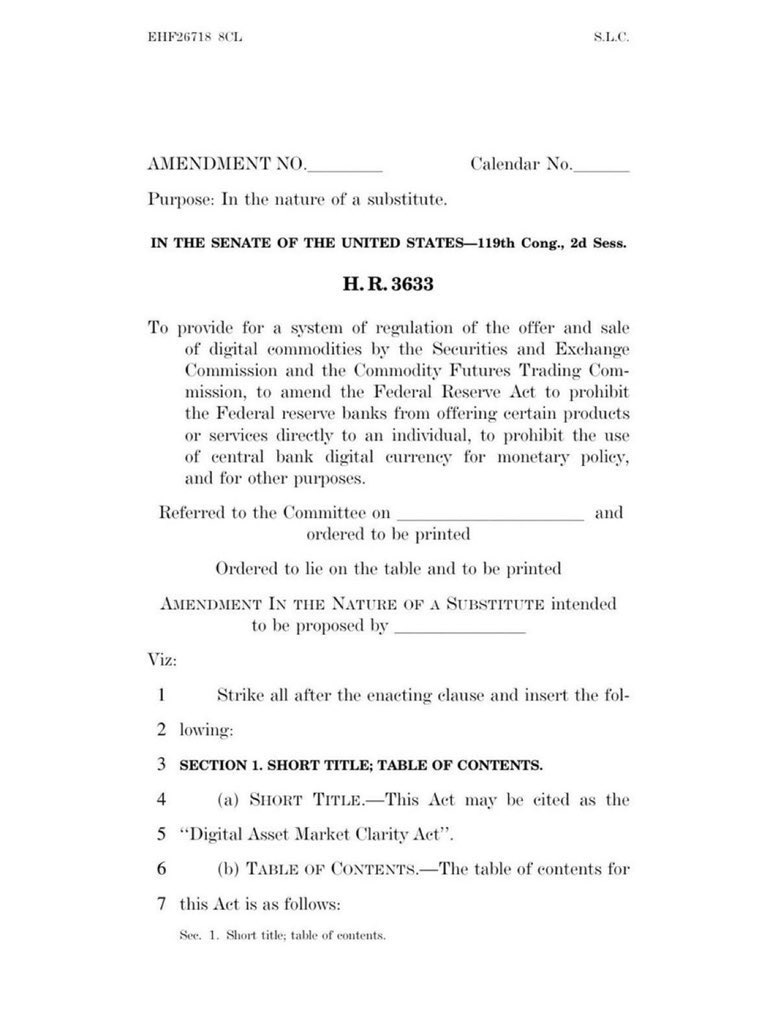
🇺🇸 U.S. CONGRESSMAN JUST SAID US SENATE WILL PASS THE CRYPTO CLARITY ACT NEXT WEEK
IF APPROVED, THIS ACT COULD INJECT TRILLIONS INTO THE MARKET
PREVIOUSLY, PRESIDENT TRUMP SAID HE WILL SIGN IT "IMMEDIATELY"
THIS IS EXTREMELY BULLISH FOR CRYPTO!!
#BREAKING 🚨 BOOOOM 💥💥
BINANCE FOUNDER CZ DROPS A BOMB: "AI AGENTS WILL TRANSACT 1,000X MORE THAN HUMANS!" AND GUESS WHAT? "AI IS GOING TO USE CRYPTO!" 💪 I’M ALL IN ON THIS! AI IS SET TO DOMINATE THE NEXT BULL MARKET!
WHAT A LEGEND! 🌟
🚨 WOW: Billionaire Chamath Palihapitiya says the media lied to millions about President Trump, admits he was “totally wrong,” and says the media fabricated narratives to assassinate Trump’s character.
Elon Musk literally sat down for a 45-minute talk with Y Combinator that explains how to build world-changing companies better than any business school on earth. This is the advice he gave a room full of young founders:
1. Don't try to build something great. Try to build something useful.
Everyone obsesses over greatness. Musk says that's the wrong target. "I didn't originally think I would build something great. I wanted to try to build something useful. I didn't think I would build anything particularly great. Seemed unlikely, but I wanted to at least try." Aim for useful first. Greatness, if it comes, is a byproduct.
2. When you can't get in the front door, build your own door.
Before Musk started his first company, he tried to get a job at Netscape. "I sent my resume into Netscape and nobody responded. I tried hanging out in the lobby to see if I could bump into someone, but I was too shy to talk to anyone. So I'm like, this is ridiculous, I'll just write software myself." He didn't set out to be a founder. He became one because no one would hire him.
3. He slept in the office and showered at the YMCA.
The origin of his first company was not glamorous. "We couldn't even afford a place to stay. The office was 500 bucks a month, so we just slept in the office and showered at the YMCA." He couldn't afford proper internet either, so he drilled a hole through the office floor and ran a cable to the internet provider downstairs. That was the founder of the future richest man on earth.
4. Keep the chips on the table.
When Musk sold his first company, he received a $20 million cheque. His bank balance went from $10,000 to $20 million overnight. Most people would have stopped. He put almost all of it straight back into his next company. "I kept the chips on the table." He did the same thing decades later, over and over. He hates money sitting idle. Money is fuel for the next mission.
5. Start with the mission, then work backwards to make it a business.
Musk didn't start SpaceX to make money. He went on the NASA website to find out when humans were going to Mars, and there was no plan. So he decided to build one. "There had been no prior example of a rocket startup succeeding. A small chance of success is better than no chance of success." The mission came first. The business model came later.
6. He started SpaceX expecting to fail.
He is brutally honest about the odds. "SpaceX started in mid-2002 expecting to fail. Probably 90% chance of failing. When recruiting people, I said, we're probably going to die, but small chance we might not die." The first three launches failed. The fourth one worked with no money left. "If the fourth launch hadn't worked, it would have been curtains. We made it by the skin of our teeth."
7. Break every problem down to physics.
This is the core of how Musk thinks. "First principles means break things down to the fundamental elements that are most likely to be true, then reason up from there, as opposed to reasoning by analogy." His example is rockets. Everyone priced them based on what old rockets cost. Musk asked what a rocket is actually made of, priced the raw metals, and found the materials were only 1-2% of the historical price. The rest was inefficiency he could attack.
8. When told something takes 24 months, break it down and do it in six.
Last year xAI needed a giant computer to train its AI. Suppliers said it would take 18 to 24 months. "It's like, well, we need to get that done in six months or we won't be competitive." So he broke it into parts. Needed a building, so he found an old factory. Needed power, so he rented generators. Needed cooling, so he rented a quarter of America's mobile cooling capacity. He slept in the data centre and ran cabling himself. It got done.
9. Watch your ego-to-ability ratio.
Musk's single sharpest piece of advice for young founders is about staying honest with yourself. "A major failure mode is when your ego-to-ability ratio gets too high. Then you break the feedback loop to reality." Keep the ego small, internalise responsibility for everything, and stay ruthlessly connected to what's actually true. "You want to close the loop on reality hard. That's a super big deal."
10. Chase work, not glory.
His closing philosophy ties it all together. "It's so hard to be useful. The area under the curve of total utility is how useful you've been to your fellow human beings times how many people. If you aspire to do true work, your probability of success is much higher. Don't aspire to glory, aspire to work."
He was ridiculed for years. The press called him "internet guy attempting to build a rocket company." He agreed it sounded absurd. He did it anyway, because a small chance of doing something useful beat no chance at all.
Here's the thing though....
Musk became the most followed founder alive because everything he does happens in public. The launches, the failures, the talks like this one. The companies made him powerful. The personal brand made his every word travel around the world before he finishes saying it.
We build massive distribution and grow personal brands on X and beyond without our clients lifting a finger.
If you're a founder or VC looking for that kind of exposure, book a call below.
We average 1.5M views a week.
https://t.co/UoXuYlkBQq