The “intent to pixels” reality @elonmusk
predicted is here for videos, storytelling & scenario generation! This Cao Cao warship first milestone is wild. I think physical AI/robotics digital twins makes sense as the next destination simulate the world in pixels first, then make it real with Optimus. What do you think?
I think the following roadmap seems like a real possibility!
Storyboarding in Grok @imagine was pretty fun. I really like how the agents help visualize some of the important historical events.
I was trying to iterate through the clothing and voices from the ancient Chinese drawing to reflect on the historical fact and it was fun to interact with.
@EmmetPeppers@donalddhoffman Reality at meta level! "Meta level" reality isn't a separate layer sitting on top; it's the recognition that the distinction between map and territory, observer and observed, or simulation and base may dissolve at sufficient depth
@donalddhoffman Congratulations @donalddhoffman and colleagues for your exceptional work to challenge the norm and go beyond the space-time model with very scientific rigor! All the best with the Trace institute and future of the research!
Just listened to Lex Fridman's latest with Don Lincoln and it got me thinking… The @LHCnews is incredible, but to unlock next high l energy physics experiments, we'd need energies millions of times higher. Then I realised, nature's already running those experiments. So I asked @grok in the car: what if we used the Moon as a giant cosmic ray detector? No atmosphere, massive surface area, perfect natural collider. We ran a quick trade study; lunar array beats satellites hands down. And with @SpaceX Starship + @NASAMoonBase return to the Moon, this is actually becoming realistic. Made a clean physics-poster style infographic breaking down the energy gap, trade study, and what new physics it could unlock with @GeminiApp What do you think? should we turn the Moon into humanity's next great particle detector?
Here's my conversation with Don Lincoln about some of the biggest open questions in physics, including dark energy, dark matter, the matter-antimatter imbalance, quantum vacuum, quantum foam, and the quest to unify the laws of physics.
Don is a particle physicist at Fermilab who has spent decades working at the frontiers of high energy physics. He is also a great teacher & writer. I highly recommend his courses & books. One of my favorite lecture series he has given is The Evidence for Modern Physics where he breaks down the experiments that validate some of the weird laws of physics we have, and what it would take to validate even the weirder ones.
It's not enough to come up with a beautiful theory. You also have to show through experiment that the theory is likely to be correct. This process often doesn't get the love it deserves, even though it's often the most important and difficult part of the scientific process.
I ❤️ physics.
The conversation is here on X in full and is up everywhere else (see comment).
Timestamps:
0:00 - Introduction
0:49 - Unifying the laws of nature
15:20 - General relativity
32:27 - Electroweak force
44:09 - How particle colliders work
1:02:12 - Higgs boson discovery
1:12:32 - Theory of everything
1:42:17 - Physics of empty space
1:49:41 - Antimatter
2:10:31 - Dark energy
2:14:20 - Dark matter
2:42:56 - Future of physics
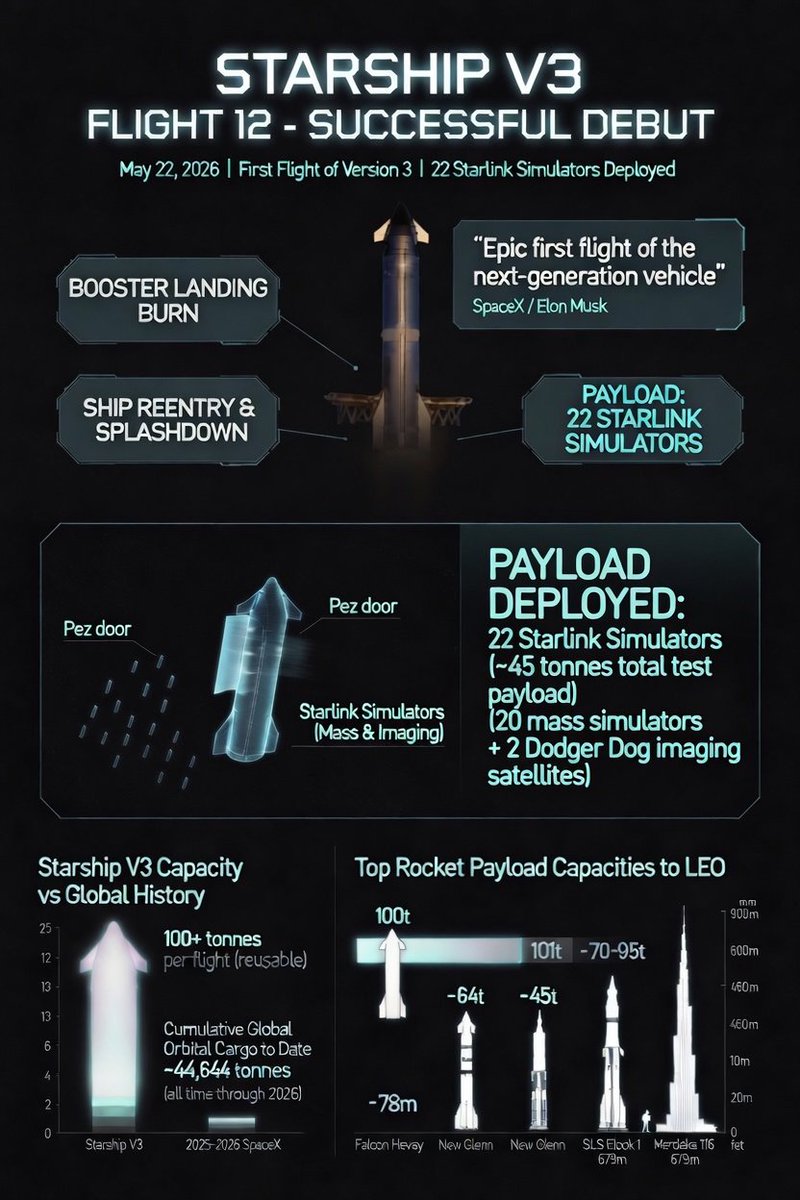
Starship V3 — Flight 12
✅ Successful debut
✅ 22 Starlink Simulators deployed
✅ ~45 tonnes total test payload
Designed for 100+ tonnes to LEO reusable.
Let that sink in.
Congratulations @SpaceX team 🌕🚀
An OpenAI model has achieved a major breakthrough in mathematics, by disproving a central conjecture in discrete geometry that was first posed by Paul Erdős in 1946.
This is the first time AI has autonomously solved a prominent open problem central to a field of mathematics.
This is a top design philosophy and engineering best practice. Tesla owners know it well: the entire experience from getting in the car, driving, charging, and enjoying entertainment, to getting out, is remarkably frictionless and requires almost zero unnecessary input.
This is phenomenal! Everyone needs to watch this video. it’s such a powerful story of Audrey and how @Neuralink’s transformational technology is genuinely changing quality of life.
With any new technology, humans tend to default to bias and negative connotations around potential outcomes. But with the right balance, these innovations spark real progress and deserve to flourish. Always look at the bright side!
After a car accident left her paralyzed from the neck down, Audrey didn’t think she would be able to draw or paint again.
20 years later, she became the first female participant in our clinical trials. Now, she uses her brain-computer interface to create art with her mind.