This feels like cheating.
A developer just open-sourced HolyClaude a single Docker container that gives you Claude Code, a browser-based web UI, 5 AI CLIs, a fully configured headless browser with Playwright, and 50+ dev tools all running with one command.
Claude Code, Gemini CLI, OpenAI Codex, Cursor, and TaskMaster AI in the same container, switching between them is one tab press away no other Docker image does this.
The setup that used to take 1-2 hours of installing, debugging Chromium crashes, fixing permission issues, and configuring process supervision is now just docker compose up -d and you open your browser.
Your existing Claude Max or Pro subscription works out of the box, no extra cost, credentials never leave your machine.
100% Open Source. MIT License.
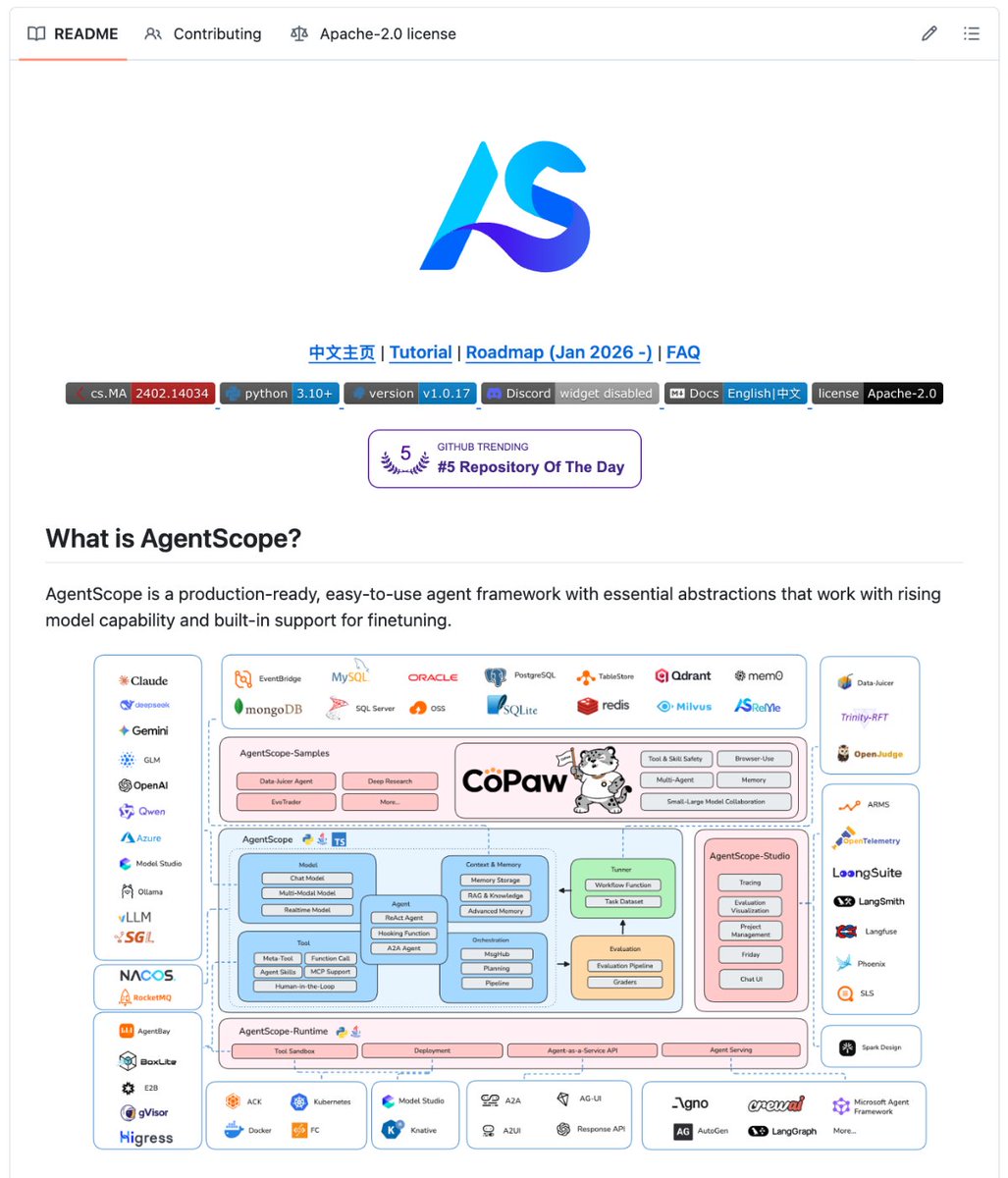
🚨 BREAKING: CHINA just released a Python framework for building AI agents. 100% OPEN SOURCE.
It has visual agent design, MCP tools, memory, RAG, and reasoning. All built in. All working together.
It's called AgentScope.
You describe your agent system. It builds the architecture, wires the tools, and runs the whole thing. You come back and there's a working multi-agent pipeline. Not a prototype. Not a demo. The actual system.
Not a wrapper.
Not a chatbot builder.
A full Agent-Oriented Programming framework that thinks in agents from the ground up.
Here's what it does out of the box:
→ Visual agent builder so you design your entire system before writing a single line of code
→ Native MCP tool support, plug any external tool directly into any agent in your pipeline
→ Built-in memory so every agent remembers context, decisions, and history across sessions
→ RAG pipeline ready to connect your own documents, databases, and knowledge bases
→ Reasoning modules that let agents plan, reflect, and self-correct without human input
→ Multi-agent coordination so your agents collaborate as a system, not a pile of isolated API calls
Here's how it thinks:
You define your goal. AgentScope maps the agent roles. Each agent gets its tools, its memory, its reasoning layer. They coordinate. Results flow back up. You get a finished output.
A single complex task might route through a planner agent, a researcher agent, a coder agent, and a critic agent, each doing its job, then converge into one clean deliverable.
Here's the wildest part:
AgentScope is built by Alibaba DAMO Academy. The same lab behind Qwen. They didn't assemble this from existing pieces. They designed the entire framework from first principles around how agents actually need to think, remember, and work together. Most frameworks give you building blocks. AgentScope gives you an architecture. The community has already started plugging it into data pipelines, research workflows, and full automation systems the team never planned for.
100% Open Source. Apache 2.0 License.
GeoSentinel is an open source platform for tracking global movement in real time.
It combines flight tracking, vessel data, and geospatial intelligence into one monitoring system.
It's useful for aviation, maritime, and geopolitical OSINT.
https://t.co/s7SV8ZDEyN
@AJEnglish@grok is there a chance that Turkey made it look like they exploded the vessel (to reduce American pressure) while in reality they just bombed a fake vessle and are now trying to reverse engineer it?
Mind blown: A Chinese quant college student builds an AI swarm engine in 10 days flat, explodes GitHub with 13,000+ stars, and scores $4,000,000 in funding!
Introducing MiroFish is the multi-agent simulator that's revolutionizing predictions for trading, PR, and more.
What is MiroFish?
It's a digital sandbox where thousands of AI agents with individual memories and behaviors interact like a real society.
Feed it any scenario (news leak, policy change, or even a classic novel's missing ending), and it simulates crowd reactions, debates, and outcomes to forecast real-world events.
The Creator's Story:
> In late 2025, fourth-year student Guo Hanjiang coded the core using AI assistants.
> It went viral overnight, landing him 30m Yuan (~$4m) from Shanda Group.
> He ditched the dorm, started a company, and now leads the charge.
Key Applications:
.Trading: Input financial news or reports, watch simulated market panics and price swings for predictive insights.
.PR Testing: Companies/Politics run draft statements to spot backlash and refine messaging.
.Creative Experiments: Loaded a lost-ending Chinese novel, agents role-played characters and generated a logical finale.
.Easy setup: Deploy via Docker in minutes with any LLM API key.
Pro tip: Simulate something wild like Elon Musk tweeting about Dogecoin 2.0 and spawn agent traders, influencers, and investors, generate real-time video clips of the frenzy to test moonshots or crashes risk-free.
Traders are already winning big: Check this one on Polymarket - $120,000+ net profits from spot on SPX 500 bets, powered by MiroFish sims on historical data.
His profile: https://t.co/uFu4RwNitn
For effortless gains, try Kreo copy trading: Auto-mirror pros like him and ride their edges.
Try here: https://t.co/5aAg87o8ji
Add his wallet: [0x17559efac103ac7f361be37ec0b93888d4c55aac] to [https://t.co/tWKZaJYAMg] and start track/copy him.
Repo: https://t.co/Rh3q1IuewP
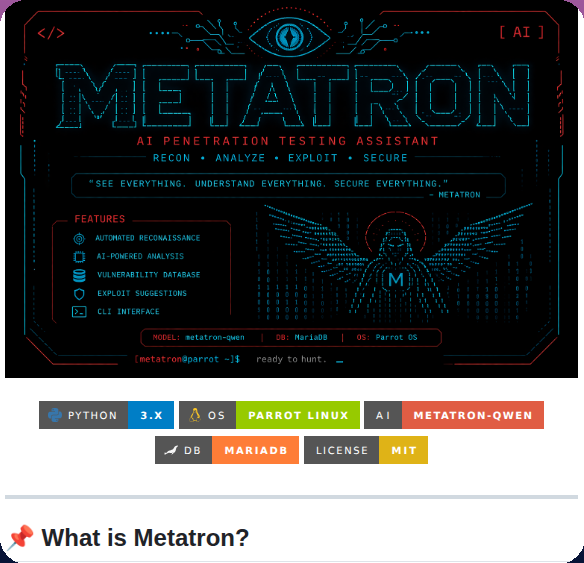
I built an open-source library of 700+ cybersecurity skills for AI coding agents -- covers DFIR, threat hunting, cloud security, and more https://t.co/vM5SgmXCrO
🚨 BREAKING: A developer just built a private search engine that checks Google, Bing, and 70+ sites at once without spying on you.
It's called SearXNG.
Think of it as your own private Google but you own it.
If Google is a search engine, SearXNG is every search engine.
What's inside:
→ Pulls results from 70+ sources at once (Google, Bing, Yahoo, Brave, DuckDuckGo)
→ Zero tracking, zero profiling, zero ads following you around
→ Pick exactly which engines it searches per category
→ Deploy with one Docker command on any $5 server
→ 276 contributors keeping it updated worldwide
Instead of feeding your search history to Big Tech every single day…
Host your own instance and search everything without becoming the product.
AGPL-3.0 License. 100% Opensource.
(Link in the comments)
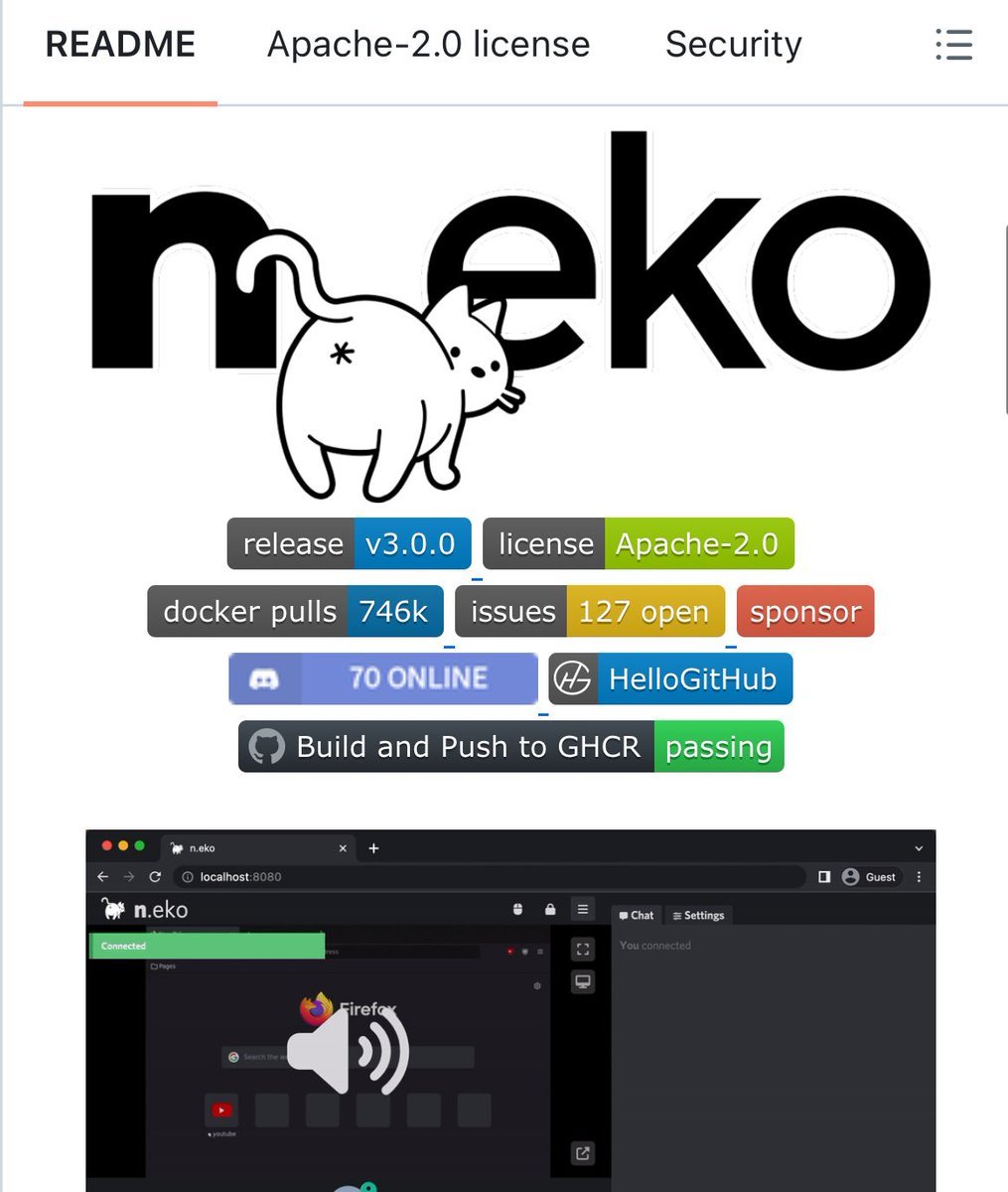
🚨 Someone built a full virtual computer that runs inside your browser.
No downloads. No installs. No VMs. Just a Docker command.
It's called Neko. It runs a complete desktop environment inside a Docker container and streams it to your browser using WebRTC.
Not a screen share. Not a remote desktop. A real computer running in a container that you control from any browser tab.
No VNC lag. No RDP setup. No TeamViewer watermarks. Just smooth, real-time video and audio.
Here's what this thing can do:
→ Run Firefox, Chrome, Brave, Edge, Tor Browser, or Opera in an isolated container
→ Run full desktop environments like XFCE or KDE
→ Multiple users can watch and control the same session simultaneously
→ Built-in audio streaming. Watch videos together with perfect sync
→ Persistent sessions. Close the tab, come back later, everything is still there
→ GPU acceleration for smooth rendering
→ Embed it in your own web app via API
Here's why people are losing their minds over this:
Watch parties. Open a movie, invite friends, everyone sees the same screen in real-time with synced audio. Open source alternative to Hyperbeam.
Throwaway browsing. Need to visit a sketchy site? Do it in a disposable container. Nothing touches your real machine. Pair it with Tor Browser and a VPN for full anonymity.
Team collaboration. Debug code together. Brainstorm on a shared whiteboard. Give a live demo where your audience can actually click around.
Secure jump host. Access internal company apps from anywhere without a VPN. Only video leaves the container. No cookies, no tokens, no data on the client.
Here's the wildest part:
The backstory. The creator built this because https://t.co/FEdEkGNdbS shut down and he just wanted to watch anime with his friends. Discord kept crashing. His internet couldn't handle streaming. So he built an entire virtual browser platform from scratch.
One Docker command to start:
docker run -d -p 8080:8080 m1k1o/neko:firefox
Open localhost:8080. You now have a full browser running in the cloud that anyone can join.
17.3K GitHub stars. 1.2K forks. 2,133 commits. 57 contributors.
100% Open Source. Apache 2.0 License.
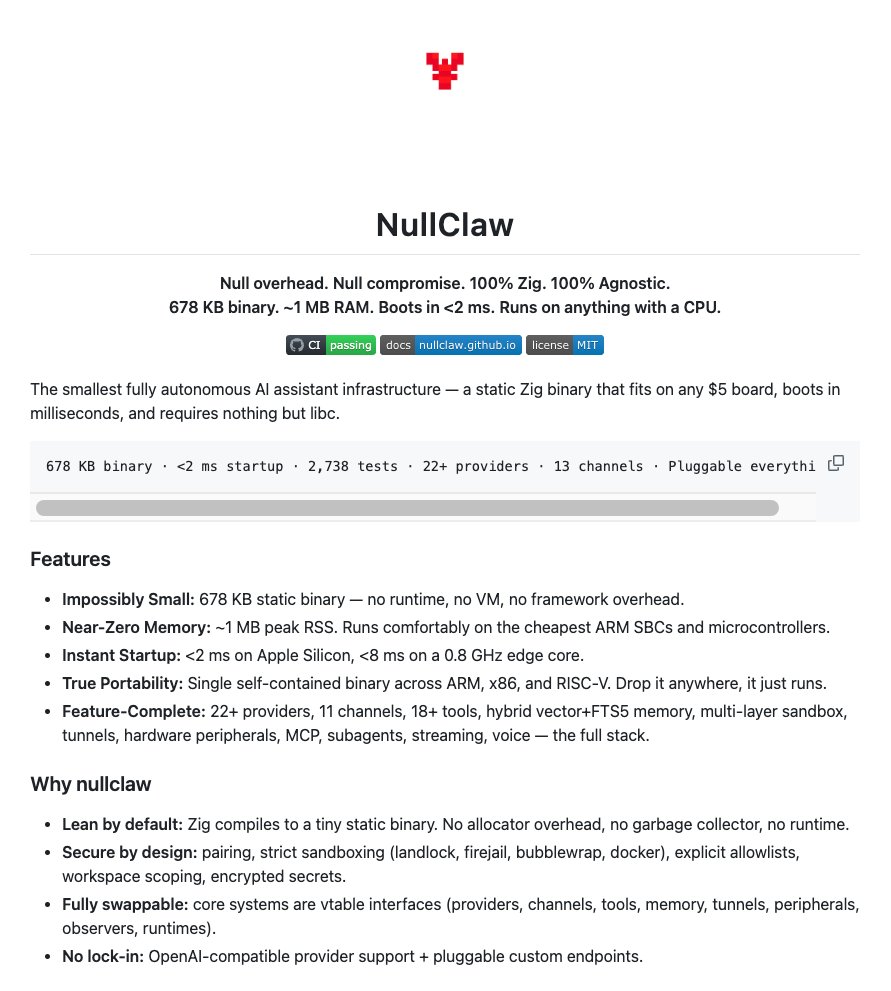
🚨 BREAKING: Someone just rebuilt the entire AI assistant stack in Zig.
It's called NullClaw. The binary is 678 KB. It uses ~1 MB of RAM. It boots in under 2 milliseconds.
No runtime. No VM. No framework. No garbage collector. Just raw Zig.
Here's why this is absurd:
→ OpenClaw needs a $599 Mac Mini and 1 GB+ RAM
→ NanoBot needs 100 MB+ RAM and Python
→ PicoClaw needs 10 MB RAM and Go
NullClaw runs on a $5 board with 1 MB of RAM.
Same functionality. 0.1% of the resources.
Here's what's packed into that 678 KB:
→ 22+ AI providers (OpenAI, Anthropic, Ollama, DeepSeek, Groq, etc.)
→ 13 chat channels (Telegram, Discord, Slack, WhatsApp, iMessage, IRC)
→ 18+ built-in tools
→ Hybrid vector + keyword memory search
→ Multi-layer sandboxing (Landlock, Firejail, Docker)
→ Hardware peripheral support (Arduino, Raspberry Pi, STM32)
→ MCP, subagents, streaming, voice, the full stack
Here's the wildest part:
Every subsystem is a vtable interface. Swap any provider, channel, tool, memory backend, or runtime with a config change. Zero code changes.
It even encrypts your API keys with ChaCha20-Poly1305 by default.
2,738 tests. ~45,000 lines of Zig. Zero dependencies beyond libc.
100% Open Source. MIT License.


![slash1sol's tweet photo. Mind blown: A Chinese quant college student builds an AI swarm engine in 10 days flat, explodes GitHub with 13,000+ stars, and scores $4,000,000 in funding!
Introducing MiroFish is the multi-agent simulator that's revolutionizing predictions for trading, PR, and more.
What is MiroFish?
It's a digital sandbox where thousands of AI agents with individual memories and behaviors interact like a real society.
Feed it any scenario (news leak, policy change, or even a classic novel's missing ending), and it simulates crowd reactions, debates, and outcomes to forecast real-world events.
The Creator's Story:
> In late 2025, fourth-year student Guo Hanjiang coded the core using AI assistants.
> It went viral overnight, landing him 30m Yuan (~$4m) from Shanda Group.
> He ditched the dorm, started a company, and now leads the charge.
Key Applications:
.Trading: Input financial news or reports, watch simulated market panics and price swings for predictive insights.
.PR Testing: Companies/Politics run draft statements to spot backlash and refine messaging.
.Creative Experiments: Loaded a lost-ending Chinese novel, agents role-played characters and generated a logical finale.
.Easy setup: Deploy via Docker in minutes with any LLM API key.
Pro tip: Simulate something wild like Elon Musk tweeting about Dogecoin 2.0 and spawn agent traders, influencers, and investors, generate real-time video clips of the frenzy to test moonshots or crashes risk-free.
Traders are already winning big: Check this one on Polymarket - $120,000+ net profits from spot on SPX 500 bets, powered by MiroFish sims on historical data.
His profile: https://t.co/uFu4RwNitn
For effortless gains, try Kreo copy trading: Auto-mirror pros like him and ride their edges.
Try here: https://t.co/5aAg87o8ji
Add his wallet: [0x17559efac103ac7f361be37ec0b93888d4c55aac] to [https://t.co/tWKZaJYAMg] and start track/copy him.
Repo: https://t.co/Rh3q1IuewP](https://pbs.twimg.com/media/HDUdR1NWsAAxl9L.jpg)









![slash1sol's tweet photo. Mind blown: A Chinese quant college student builds an AI swarm engine in 10 days flat, explodes GitHub with 13,000+ stars, and scores $4,000,000 in funding!
Introducing MiroFish is the multi-agent simulator that's revolutionizing predictions for trading, PR, and more.
What is MiroFish?
It's a digital sandbox where thousands of AI agents with individual memories and behaviors interact like a real society.
Feed it any scenario (news leak, policy change, or even a classic novel's missing ending), and it simulates crowd reactions, debates, and outcomes to forecast real-world events.
The Creator's Story:
> In late 2025, fourth-year student Guo Hanjiang coded the core using AI assistants.
> It went viral overnight, landing him 30m Yuan (~$4m) from Shanda Group.
> He ditched the dorm, started a company, and now leads the charge.
Key Applications:
.Trading: Input financial news or reports, watch simulated market panics and price swings for predictive insights.
.PR Testing: Companies/Politics run draft statements to spot backlash and refine messaging.
.Creative Experiments: Loaded a lost-ending Chinese novel, agents role-played characters and generated a logical finale.
.Easy setup: Deploy via Docker in minutes with any LLM API key.
Pro tip: Simulate something wild like Elon Musk tweeting about Dogecoin 2.0 and spawn agent traders, influencers, and investors, generate real-time video clips of the frenzy to test moonshots or crashes risk-free.
Traders are already winning big: Check this one on Polymarket - $120,000+ net profits from spot on SPX 500 bets, powered by MiroFish sims on historical data.
His profile: https://t.co/uFu4RwNitn
For effortless gains, try Kreo copy trading: Auto-mirror pros like him and ride their edges.
Try here: https://t.co/5aAg87o8ji
Add his wallet: [0x17559efac103ac7f361be37ec0b93888d4c55aac] to [https://t.co/tWKZaJYAMg] and start track/copy him.
Repo: https://t.co/Rh3q1IuewP](https://pbs.twimg.com/media/HDUdSndWgAEv7CG.jpg)