“2026 is just the beginning,” Professor Rockström added. “It will inevitably get worse. It will get worse and worse and worse to the point where, I’m afraid, we’ll be passing the limits of adaptation.”
#climate#planetarybounderies
https://t.co/OOR8eTHCfQ
Sverige : "Anders Johansson uppmanar därför folk till att se över sin hygien, som många gjorde under covid-19-pandemin, för att sakta ner smittspridningen."
Kalifornien: Bär mask.
. @poteto said we don't read the code anymore, we read the verification. She's right, and it got me thinking about what that looks like in .NET https://t.co/xHtuEhH4WS
As one of the original co-authors of PHP, I’m used to seeing PHP take its share of heat whenever a high-profile vulnerability makes headlines—most recently with PHP2Shell (CVE-2026-109618 / CVE-2026-109619).
Critique is healthy, and runtime security always needs to improve. However, treating this as a "PHP problem" misses a much bigger shift happening across the entire software industry right now.
We are entering an era where autonomous AI agents are fundamentally changing vulnerability discovery and exploitation. Researchers and adversaries alike are using agents to audit millions of lines of complex, low-level C, C++, and JIT runtime code—uncovering deep-seated memory corruption bugs that sat hidden for years, and compressing the time from discovery to working RCE exploit from weeks to hours.
Look at just the past few weeks across other major ecosystems:
- Node.js & .NET (Node2Shell / CVE-2026-111497): A critical out-of-bounds write in the native Brotli compression decoder bundled in Node.js (and also requiring out-of-band patches in .NET 8, 9, and 10), enabling unauthenticated RCE simply by sending a malformed compressed HTTP payload.
- Java (Java2Shell / Java4Shell / CVE-2026-114938): A critical heap buffer overflow in OpenJDK’s HotSpot JVM hardware-accelerated Base64 decoder (java.util.Base64), exposing default enterprise Java stacks to unauthenticated RCE via crafted Base64 strings.
- Python (CVE-2026-112900): A critical 9.2 CVSS unauthenticated RCE in the ubiquitous Pillow library triggered by crafted image uploads.
None of these are flaws in developer application code—they live deep in the foundational runtimes, standard libraries, and native dependencies that every modern stack relies on.
The takeaway: every mature runtime carries legacy C/C++ or JIT attack surface that AI agents can now probe at unprecedented scale. The real lesson for all of us—regardless of stack—is that we have to use these same agentic capabilities defensively: to audit core runtimes continuously, harden memory-unsafe boundaries, and shrink patch-deployment windows to match machine-speed exploitation.
‼️ ALERT -- PHP warns of CRITICAL security flaws affecting ALL supported versions.
Security fixes are scheduled for TODAY, November 19.
One expected fix addresses another RCE flaw under specific configurations.
Details here ↓ https://t.co/2XCvPkX5KD
🚨 Microsoft’s agent-framework package on PyPI was compromised. Malicious versions 1.26.1 and 1.26.2 use Python startup hooks to steal Azure, GitHub Actions, and other CI/CD credentials.
Technical analysis + IOCs →
https://t.co/5DKWVikz9S
‼️ BREAKING: A critical pre-auth remote code execution flaw has been found in nginx, the web server on millions of sites.
Attackers can run their own code on a server without logging in, even one serving only static files, if HTTP/2 is on.
Turning off HTTP/2 blocks it for now.
‼️ UPDATE: Security firm Calif says it took over Jira, Confluence, Jenkins and Keycloak servers with Java4Shell, without even logging in.
The flaw sits in the code Java uses to decode Base64, a common way to send data as text. A short malformed string makes it write past the end of its memory.
Calif's researcher says OpenAI's Codex helped him find the bug in an hour and build a working exploit in two more, for under $200 in AI costs.
Oracle shipped a patch tonight. Calif is holding back its exploits until people have patched.
You wouldn't dream of deploying unreviewed, unmonitored code to your production servers, yet we routinely allow third parties to do exactly that in our visitors' browsers.
The Optimizely incident was a near miss, and far too close for comfort. We need to do better.
https://t.co/tV3TBzfAqn
Someone @gitlab may want to look into why they are loading malicious scripts on their website. (Check the track.js script loaded from 1688360[.]cc.)
https://t.co/hVrfr7T22n
A brief history of AI Coding since Nov 2025:
Nov 2025: Opus 4.5 releases, OpenClaw gets built
Dec 2025: community agrees that models get good enough to handle 95% of coding tasks
Jan 2026: Ralph loops get popular, early efforts on loops/orchestration
Feb: Everyone feels knackered, too much strategic decision-making, fears around cognitive debt begin
Mar: Skills explosion as community converges around easy-to-share processes (superpowers already ahead of the game here)
Apr: most SOTA devs haven't written a line of code in months
May: "The unreasonable effectiveness of HTML" - more interest in richer review surfaces
Jun: "Loop Engineering" wins vaguepost of the year, signals more hype around process
Jul: Every talk in every conference becomes "here is my software factory"
Aug: Opus 5 speaks incomprehensibly, interest in ASD-STE100 peaks
Sep: Grok Bot gets popular, more interest in long-running "manager" threads which retain context and delegate work
Oct: The promised speed gains haven't materialised, "dark factory" feels a long way off still
Nov: No-slop manifesto releases, reading the code still appears essential
TL;DR: no-one is writing code anymore, and we are still figuring out what that means
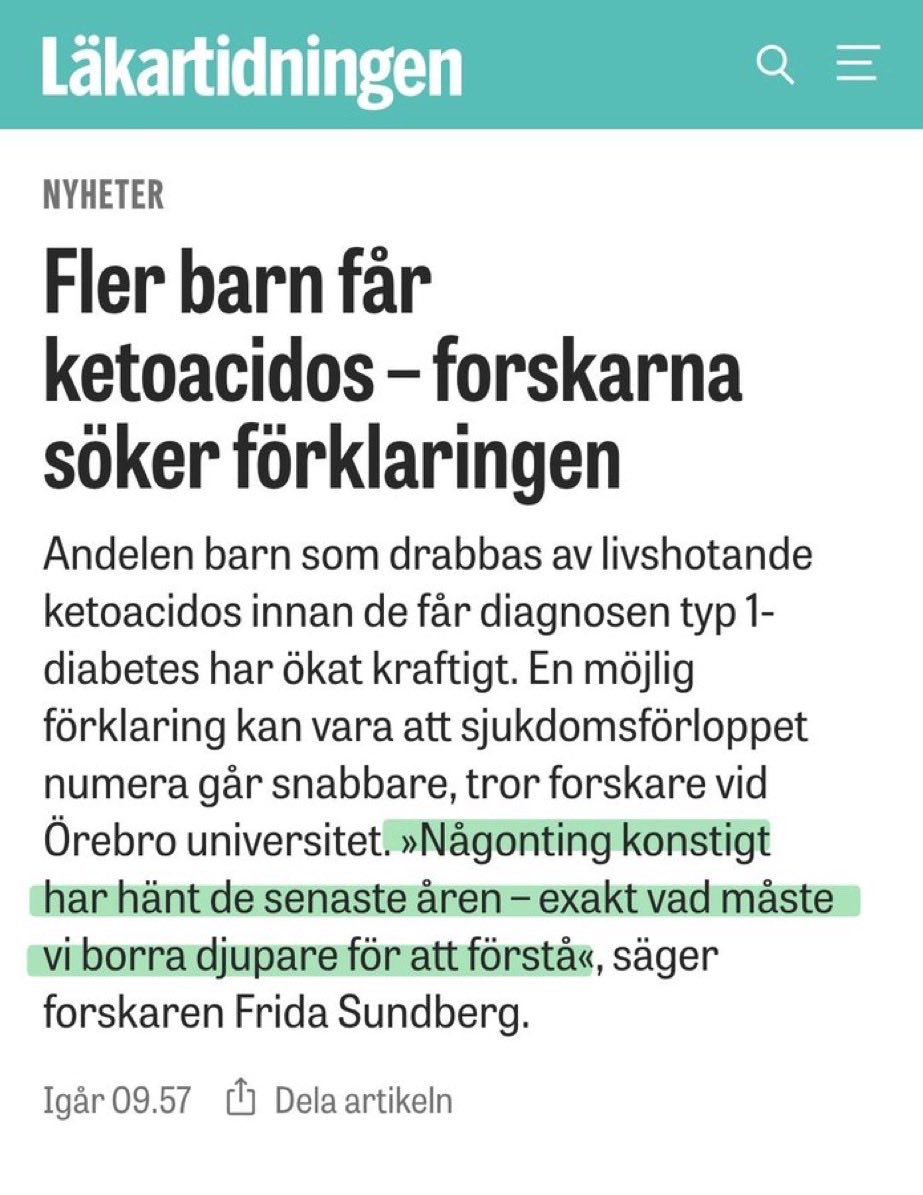
It’s Covid.
In the last two years alone, 3 (!) children in my extended family have suddenly developed diabetes type 1. For decades nothing, now three. They just don’t want to admit it’s Covid because that means they failed a whole generation.
TOTALT MYSTERIUM.
Covid orsakar diabetes typ 1 hos barn men ökning i statistiken av diabetes typ 1 hos barn och ett aggressivare förlopp sedan covid introducerades i deras liv kan omöjligt ha orsakats av covid.
🇵🇸 🇺🇳 Overwhelming support for Palestine’s resolution on permanent sovereignty of the Palestinian people over their natural resources:
🟩 151
🟥 7 (Colombia, Israel, Micronesia, Naoero, Palau, Paraguay, and United States)
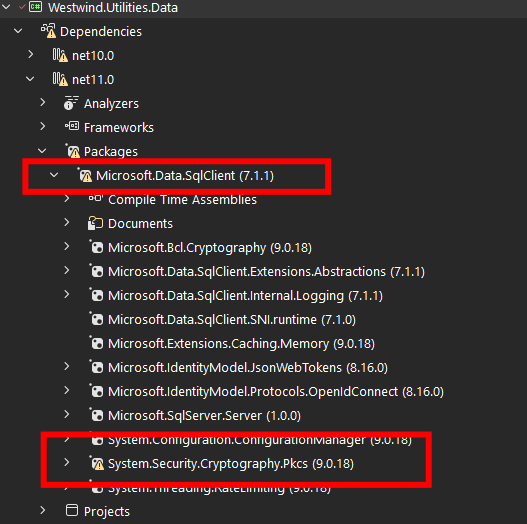
It's amazing to me that Microsoft doesn't bother to update a package that gets flagged for security for so long. This thing has been showing a vulnerability for months.
How hard is it to republish with updated and non-vulnerable dependencies?
@yandodov@mattpocockuk I agree. You don't have to rename it for every new tool/technique/pattern you start using. If you must, you can call it AI assisted DevOps, I guess.