Hokusai’s Great Wave has taken over Brussels’ Grand-Place, recreated with more than 700,000 flowers.
For the 2026 Brussels Flower Carpet, Japanese artist Hiro Sugiyama reinterpreted Katsushika Hokusai’s *The Great Wave off Kanagawa* as a monumental 1,680 m² (18,083 sq ft) floral installation.
The Flower Carpet is on view at the Grand-Place through August 16.
Disneyland's Skyway opened June 23, 1956, less than a year after the park itself, carrying guests roughly 1,200 feet between Fantasyland and Tomorrowland.
Built by Switzerland's Von Roll Ltd., it was the first Von Roll Type 101 detachable monocable aerial ropeway installed in the United States. The gondolas traveled at about 4 mph, with a one-way trip lasting roughly 3½ minutes and reaching a maximum system height of about 60 feet.
The attraction carried its final guests on November 9, 1994. Disneyland publicly cited declining popularity and the need to redirect employees to other attractions, although a Von Roll inspection had also reportedly discovered metal fatigue requiring costly repairs.
Seven months earlier, on April 17, a 30-year-old man deliberately exited a gondola about 20 feet above the ground near Alice in Wonderland and landed in a tree. He suffered only minor injuries, then sued Disneyland for more than $25,000, claiming he'd fallen from the ride. Before the case went to trial in 1996, he admitted that he'd purposely jumped, and the lawsuit was dropped.
That wasn't the Skyway's only dramatic incident. On April 5, 1983, a powerful gust of wind knocked the cable from a guide wheel, leaving 104 passengers stranded as high as 40 feet above Disneyland. Anaheim firefighters spent roughly 2½ hours evacuating them with ladders and cherry pickers; fortunately, no one was seriously injured.
An NVIDIA powered farming machine uses Al vision and precision lasers to eliminate weeds in milliseconds without herbicides and without harming crops, a potential shift toward chemical free agriculture
Using spider silk and plant fibers, the common tailorbird can stitch leaves together to create a deep, cup-shaped nest that is lined with soft materials.
In the bustling streets of Navi Mumbai, India, a group of teenagers (mostly 17–18 years old) from the youth-led environmental team Urvari saw stray dogs struggling in the heavy monsoon rains.
Determined to help, they collected plastic waste from their neighborhoods and created "eco-bricks" by tightly packing non-recyclable plastic bags and wrappers into used plastic bottles. It took around 150 of these sturdy "bottle bricks" (equivalent to about 40 kg of plastic) to build one durable, raised shelter—elevated off the wet ground, weather-resistant, and easy to place in parks or safe corners.
They installed their first ones at places like Rajiv Gandhi Udyan, giving street dogs a dry, safe spot during the downpours. What started as a small Plastic Free July project showed how youth power and creativity can tackle two big problems at once: plastic pollution and animal suffering.
Meanwhile, in Zacatecas, Mexico, at the Zacatecas Educational Institute elementary school, 35 young students (guided by their teacher) launched a similar mission. They gathered recycled materials from home—plastic bottles, cardboard, old sheets, wood scraps, and cloth—and built cozy, insulated dog houses designed to protect stray dogs from cold nights and rain.
The goal was double: create safe havens for abandoned animals and promote recycling in their community. Once finished, the children proudly donated the shelters to the local non-profit Albergues Lazos Caninos, a rescue group that cares for strays in the region. Their creative project went viral, inspiring others to see trash as treasure for helping voiceless creatures.
In the earliest design phase, The Land Pavilion was going to consist of seven greenhouse structures, each presenting a different Earth biome (mountains, desert, water, etc.).
The concept came from an early version of The Land developed by Imagineer Tony Baxter in the late 1970s. Baxter himself described the pavilion as a collection of enormous glass/crystal structures, each containing different Earth habitats, ranging from high mountains to deserts and swamps.
The signature attraction was called “The Blueprints of Nature.” Guests would first encounter an Audio-Animatronic host called the Landkeeper in a theater presentation, then board suspended vehicles themed as hot-air balloons. Baxter compared the ride system to Peter Pan’s Flight. The attraction would carry guests through imagery involving the four seasons and ultimately through or above the pavilion's various environments.
One version of the storyline involved the balloon being caught in a snowstorm high in the mountains, after which guests would essentially follow the journey of water, from snow to melting water through different ecosystems and eventually evaporation.
The concept changed when Kraft became the pavilion sponsor. The emphasis moved away from broad ecology and Earth's ecosystems toward agriculture, food production and nutrition. Blueprints of Nature disappeared, and the principal ride evolved into the boat attraction Listen to the Land, which opened with EPCOT Center on October 1, 1982 and later became Living with the Land.
The Chicago White Sox paid tribute to “the world’s most famous White Sox fan,” Pope Leo XIV, last night with over 40,000 “Pope Hats,” a first pitch thrown by Sister Mary Jo Sobieck of the Dominican Sisters of Springfield and a 5th inning “sign of peace” while taking on the Cincinnati Reds.
#sox #whitesox #chicago #popeleoxiv #popeleo @whitesox
Video: Courtesy of White Sox Scoreboard and Sox TV
Proof that Disney hasn’t turned off ALL the water features! It’s crazy that this is a view inside a theme park. A little Gorilla Falls atmosphere for your day (sans gorillas).
In 2008 we were staying at the Grand Floridian and after dinner we decided to take the monorail over to the Magic Kingdom. There was nobody else on the platform when the train pulled in, and I think the train was empty too, so the pilot waived us up to the front so that we could ride in the cab. A great pixie dust moment for us since this wasn’t a standard practice at the time.
Guests used to experience the cab ride as a perk early in WDW history but after a minor collision in 1974, guest access was shut down for a while. Disney gradually started giving guests the perk again, but it was based on the captain’s discretion.
The ride in the front cab gave us a spectacular view, even at night, of the lagoon and resort area, even though it was a short ride. There was a bench below the front window so we actually sat in front of the pilot, who was back a little bit next to the wall, driving the train. Pretty amazing.
On July 5, 2009, the Pink and Purple monorails collided at the Transportation & Ticket Center, killing a 21-year-old pilot named Austin Wuennenberg, and the practice was permanently discontinued. It’s a real shame but we’re grateful to have had the experience. Reportedly, cast members privately observe the anniversary of the crash every year.
Elvis Presley’s performance of “Suspicious Minds” during the Aloha From Hawaii concert on January 14, 1973, is one of the most iconic moments of his later career. Broadcast live globally via satellite, the show was a monumental media event. Originally released as a studio single in 1969, “Suspicious Minds” became Elvis’s 18th and final #1 hit on the Billboard Hot 100 during his lifetime. Its passionate delivery in Honolulu cemented its status as one of his signature performances.
The Aloha From Hawaii broadcast was a historic television milestone and was promoted at the time as reaching an estimated 1–1.5 billion viewers in over 40 countries, making it one of the most ambitious live television events ever staged. Originally written by Mark James in 1968, the song evolved into one of Elvis’s signature recordings at American Sound Studio. Unsatisfied with the studio version’s mid-song fade-out, Elvis performed the song live with a seamless transition into a faster finale. To ensure perfection for the global broadcast, he even staged a full dress rehearsal the day before wearing his iconic “American Eagle” jumpsuit. Elvis also donated the proceeds from the show's souvenir album to the Kui Lee Cancer Fund, adding a charitable legacy to one of the most memorable performances of his career.
The old tropical waterfall at Disney’s Polynesian Village Resort featured over 75 different species of plants, including 1,500 anthuriums, banana trees, bromeliads and ferns. The rockwork for the waterfall was created by Fred Joerger (Disney Imagineering’s “resident rock expert”) who also worked on rock-scenery in other early Walt Disney World attractions.
The floor around the waterfall garden originally featured a checkerboard tile pattern (blue and green square tiles) and smaller wall-tiles surrounding the feature. The waterfall lobby included a unique smell and sound environment (running water, tropical plants, humidity) that many long-time guests say triggered a distinct “arrival at the Polynesian” sensation, a detail that became part of the resort’s appeal.
The indoor waterfall lobby was removed in 2014 as part of a major renovation, with Disney citing health & safety concerns, the need to open up guest flow, and to create more social/meeting space in the lobby.
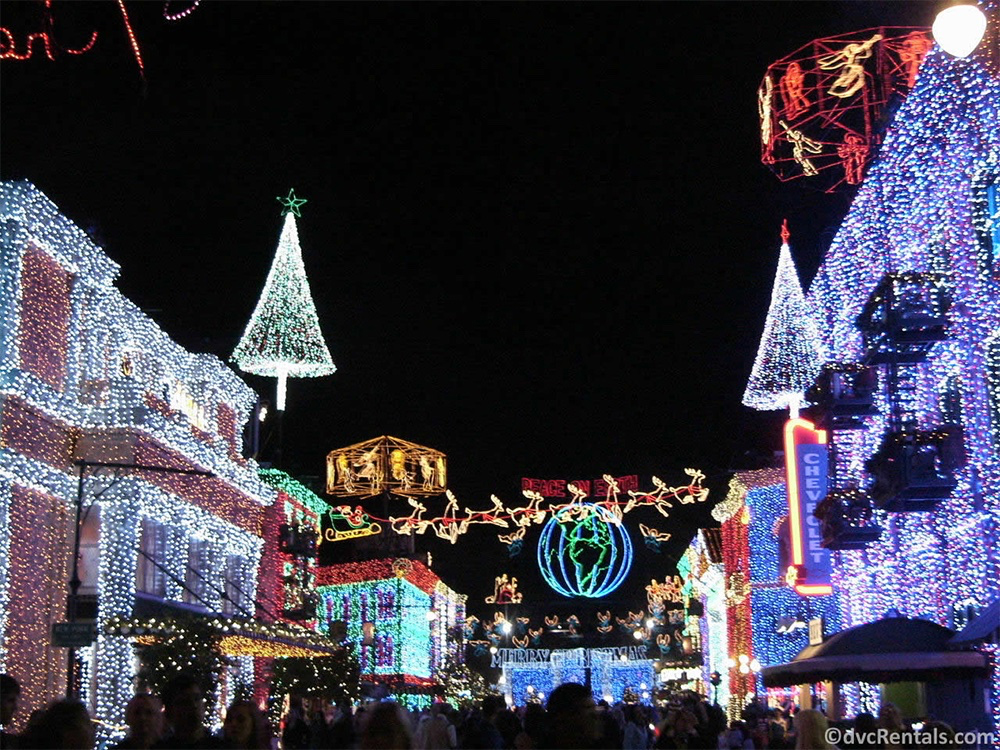
Holidays at Disney’s Hollywood Studios are still just not the same without the Osborne lights. We got to see them several times, and they were impressive.
The lights started as a private backyard light show by Jennings Osborne in Little Rock, Arkansas. By 1993 it had grown to over 3 million lights, including a 70-foot tree and two rotating carousels of lights, so large it caused traffic problems for his neighbors.
When Disney invited the display to Orlando for the 1995 holiday season, it was installed on the park’s “Residential Street” back-lot (calling it the "Osborne Family Spectacle of Lights"), later moving to Streets of America, and eventually grew to more than 5 million lights, and included synchronized “dancing” sequences matched to music.
The display used over 10 miles of rope lighting and 30 miles of extension cords, held together by more than 2 million cable ties. At full scale, the lights required about 800,000 watts of electricity each night. In 2006, the show was upgraded with approximately 1,500 dimmer/relay circuits so the lights could be synchronized (“dance”) to holiday music. When the display was moved from the “Residential Street” back-lot to the “Streets of America” section (in 2004), artificial “Florida snow” machines (about 33 machines) were added as an atmospheric effect.
In 2015 Disney announced that holiday season would be the last because of the construction of Galaxy’s Edge. The majority of the lights were donated to the Give Kids the World Village in Kissimmee. Although many Disney fans believe some of the Osborne Lights eventually found their way to Silver Dollar City in Branson, Missouri, neither Disney nor Silver Dollar City has ever confirmed that any of the original display was transferred there.