Amazing article on our recent work by @kevinroose from The New York Times (@nytimes), this quote captures the essence well:
"Eventually, if you take advantage of the web, the web will start shutting its doors."
https://t.co/ur0e0jm5P2
@annekharrington 🌟 Excited to share the full preprint for our work exploring learning in continual learning is now out. Also check out this amazing article by @YutongBAI1002 covering our findings!
Paper: https://t.co/khHTSudXtj
Code: https://t.co/xQ1izLa1DB
https://t.co/ssZwVV9Y3P
@annekharrington 🌟 Excited to share the full preprint for our work exploring learning in continual learning is now out. Also check out this amazing article by @YutongBAI1002 covering our findings!
Paper: https://t.co/khHTSudXtj
Code: https://t.co/xQ1izLa1DB
https://t.co/ssZwVV9Y3P
✨Excited to share new @LaudeInstitute project, where we ask: When does continual learning actually require learning?
We test 8 adaption methods as the world shifts and find ones best at learning new facts are worst at unlearning what's now outdated.
https://t.co/Ej9inYD5T3
🌟Much more on the project page, full experimental results, interactive figures, and a first look at agentic continual learning, with lots more coming soon!
Link: https://t.co/kqEAKudvBu
Proud to have worked on this with some exceptional people: @annekharrington, Michael Murphy, Anastasia Borovykh, Zeyu Yun, Sridhar Kamath, @0x_ara, @trevordarrell, @JitendraMalikCV & @YutongBAI1002
In AI 2027, we predicted that AI would take over the world or irreversibly concentrate power.
In AI 2040: Plan A, we've laid out our positive vision for what should happen instead.
✨Excited to share new @LaudeInstitute project, where we ask: When does continual learning actually require learning?
We test 8 adaption methods as the world shifts and find ones best at learning new facts are worst at unlearning what's now outdated.
https://t.co/Ej9inYD5T3
Thrilled to receive a grant from @LaudeInstitute! Our new project asks: When does continual learning require learning?
Methods for continual learning in large language models (prompting, fine-tuning, reinforcement learning, and context compression) are usually studied in isolation. We propose a framework that lets us evaluate them together on the same sequential benchmarks. We find that the data and task conditions are the biggest factor in which method succeeds.
Project Page: https://t.co/PW56I3EUUZ
More updates coming soon!
Beyond text. Beyond static data.
Today, Adaptive Data is now multimodal.
Bringing advanced data optimization to image datasets.
Data built the last generation of AI. Adaptive Data is building the next.
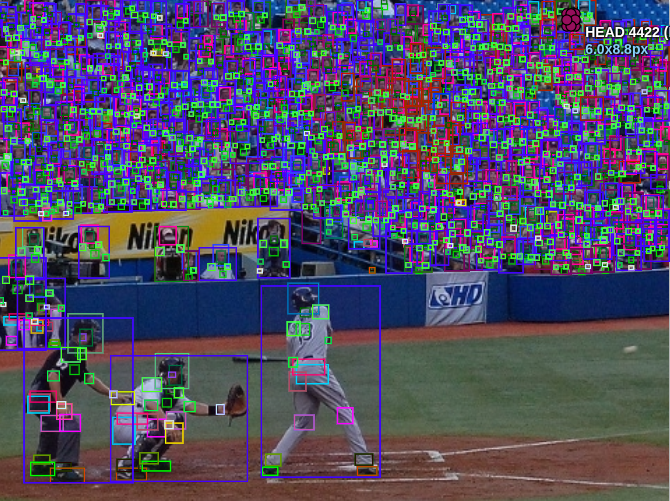
@skalskip92 You might not believe it, but I simply manually annotated over 2,000,000 human body parts with ultra-precise detail. Probably no one else could do that.
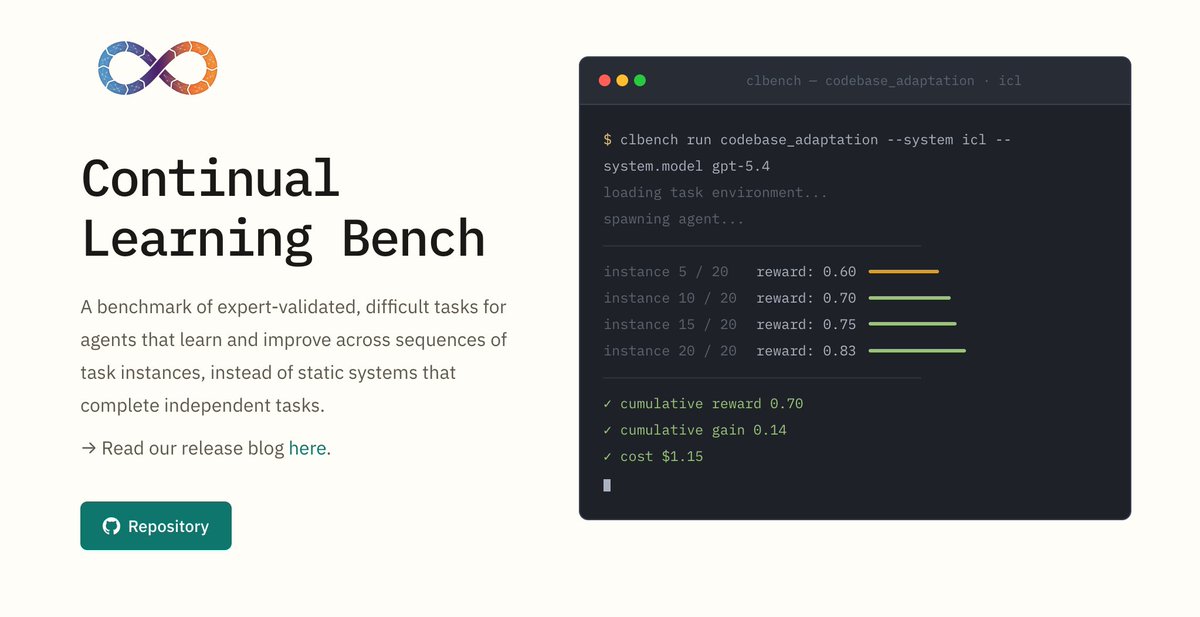
Today, we’re releasing Continual Learning Bench 1.0: the first, realistic benchmark for measuring how AI systems can improve in online settings.
Benchmarks today assume models are stateless. Each example is independent, and once a system finishes a task, it moves on as if nothing happened.
But deployed AI systems should learn from experience. We tested 10+ frontier systems against novel, expert-validated tasks and find there’s still plenty of headroom for learning. (1/n)
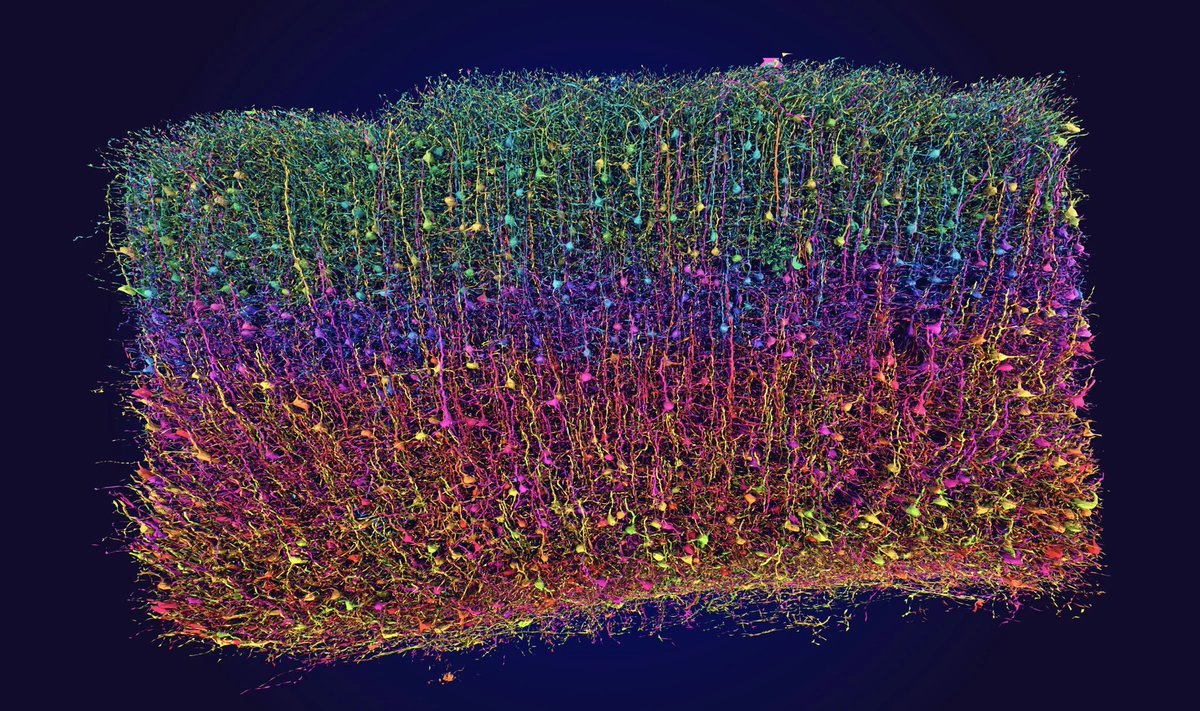
Led by a team at @AllenInstitute, Princeton and @bcmhouston, the Machine Intelligence from Cortical Networks (MICrONS) program "seeks to revolutionize machine learning by reverse-engineering the algorithms of the brain." https://t.co/WRQbprBB7K
New preprint! w/ @m_heilb
We found that, even in sheer natural scene viewing, human visual cortex predicts—hierarchically in central vision, and at higher levels peripherally—reconciling classical predictive coding with recent evidence from animal models & AI (e.g. JEPA) 1/10
Today we're releasing Trinity-Large-Thinking.
Available now on the Arcee API, with open weights on Hugging Face under Apache 2.0.
We built it for developers and enterprises that want models they can inspect, post-train, host, distill, and own.
High-resolution image and video generation is hitting a wall because attention in DiTs scales quadratically with token count. But does every pixel need to be in full resolution?
Introducing Foveated Diffusion: a new approach for efficient diffusion-based generation that allocates compute where it matters most.
1/7🧵