heading to icml in seoul 🇰🇷
🦙excited to co-host an alpaca farm island tour, lunches and food market events around frontier ai, physical ai and ai for science..
if you’re in these spaces, would love to chat, dm me
Introducing HydraDB.
The graph native context infrastructure for agents. Purpose built to deliver precise context & observability into why agents act the way they do.
We've always believed graphs are the best way to manage AI context, but they've been too expensive to scale or impractical for storing full context. Until now.
@hydra_db combines in memory, NVMe, and object storage into a single graph layer, making context delivery faster, cheaper, and more precise.
We want context delivery to be extremely fast, 1000x cheap, and highly precise. Give your agents a brain.
with @reactorworld you can now deploy the newest models with a few lines of code.. we @Sky9Capital are excited to be on this journey with the best folks to do this
Today Reactor is coming out of stealth. We’ve raised $59M in Seed and Series A funding, led by @lightspeedvp, with participation from @AmplifyPartners, @wndrco, @Sky9Capital, and @FPVventures.
Reactor is the platform for building in the World Model era: the infrastructure that lets developers build with them at global scale for the first time. Stream from a frontier World Model to your app, in real time, all in under 10 lines of code.
World Models represent the next major shift in AI: pixels, audio and actions are generated on the fly, in real-time, in response to user inputs, and to the environment. Every time computing has made a shift from passive to interactive, entire industries appeared that didn't exist before. We're standing in front of such moment again.
Over the last 6 months, we’ve assembled an all-star team with alumni from Apple, Meta, Google, Luma AI, Netflix, and Replicate. We're already partnering with some of the biggest names and labs in the world, and hundreds of developers are already building on Reactor.
The World Model era starts now.
Real-time World Models are the next AI frontier.
Today, we're taking the first step towards this reality: our early preview lets you experience worlds generated in real-time, running on our global low-latency infrastructure.
Try it now: https://t.co/h0XDYsHcGB
Today, we are thrilled to officially launch RadixArk with $100M in Seed funding at a $400M valuation. The round was led by @Accel and co-led by @sparkcapital.
RadixArk exists to make frontier AI infrastructure open and accessible to everyone. Today, the systems behind the most capable AI models are concentrated in a small number of companies. As a result, most AI teams are forced to rebuild training and inference stacks from scratch, duplicating the same infrastructure work instead of focusing on new models, products, and ideas.
RadixArk was founded to change that. We are building an AI platform that makes it easier for teams to train and serve the best models at scale.
RadixArk comes from the open-source community. We started with SGLang, where many of us are core developers and maintainers, and expanded our work to Miles for large-scale RL and post-training. We will continue contributing to both projects and working with the community to make them the strongest open-source infrastructure foundations for frontier AI.
We would like to thank our long-term partners, contributors, and the broader SGLang community for believing in this mission. We're also grateful to @Accel and @sparkcapital, NVentures (Venture capital arm of @nvidia), Salience Capital, A&E Investment, @HOFCapital, @walden_catalyst, @AMD, LDVP, WTT Fubon Family, @MediaTek, Vocal Ventures, @Sky9Capital and our angel investors @ibab, @LipBuTan1, Hock Tan, @johnschulman2, @soumithchintala, @lilianweng, @oliveur, @Thom_Wolf, @LiamFedus, @robertnishihara, @ericzelikman, @OfficialLoganK, and @multiply_matrix among others.
Thanks for the exclusive interview with @MeghanBobrowsky at @WSJ about our vision.
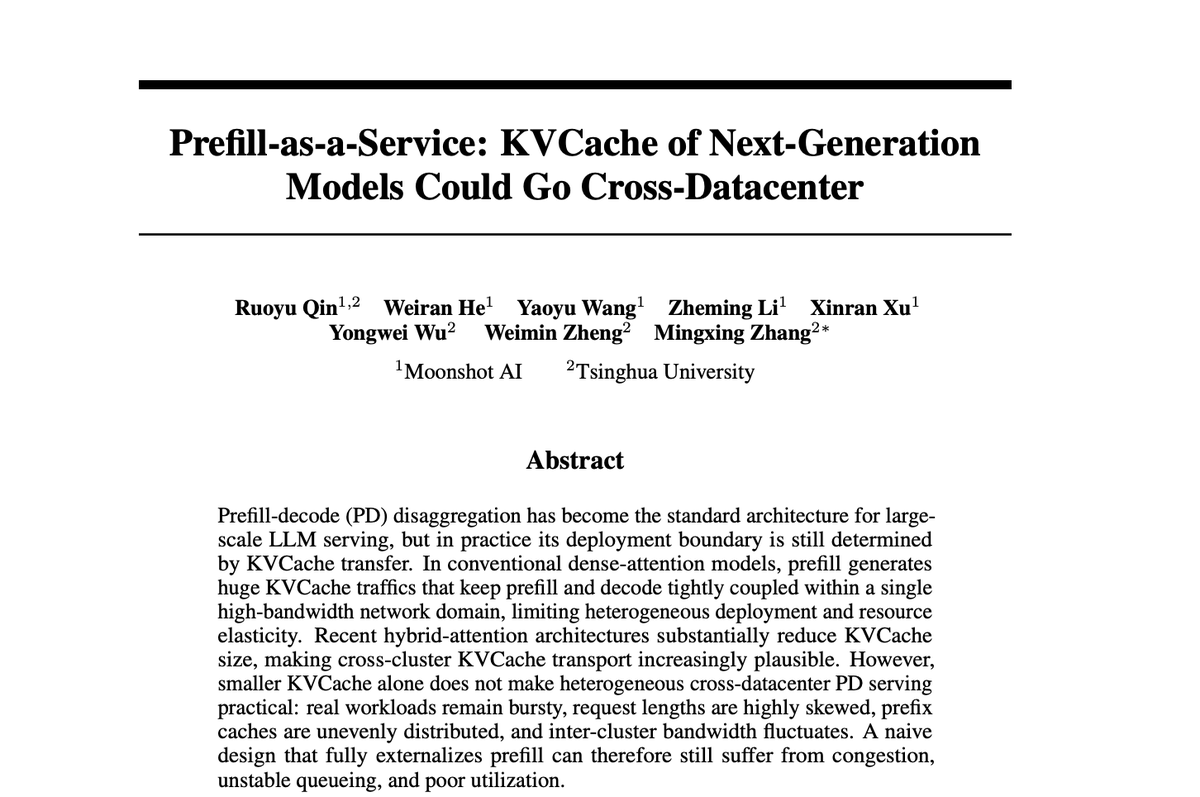
We push Prefill/Decode disaggregation beyond a single cluster: cross-datacenter + heterogeneous hardware, unlocking the potential for significantly lower cost per token.
This was previously blocked by KV cache transfer overhead. The key enabler is our hybrid model (Kimi Linear), which reduces KV cache size and makes cross-DC PD practical.
Validated on a 20x scaled-up Kimi Linear model:
✅ 1.54× throughput
✅ 64% ↓ P90 TTFT
→ Directly translating into lower token cost.
More in Prefill-as-a-Service: https://t.co/If8fA3t9Og
hosted a successful whitepaper reading circle last weekend as an @aiplus_hq conference side event ! broke down frontier multimodal training methods (MatFormer and Kimi K2.5) with @bernettorlando. big thanks to @0x_ara and @sky9capital for the space !
@WPReadingClub@ethanmlam 2. Kimi K2.5 - Visual Agentic Intelligence Is the Next Step: moves beyond text-only agents toward systems that see, reason, and act in visual worlds. A useful reference for where multimodal agents are heading.
https://t.co/qtTwY0hKWK
tomorrow, i'm co-hosting a reading group to break down two papers from opposite ends of the model design scale with @WPReadingClub and @ethanmlam
we will discuss MatFormer and Kimi 2.5. MatFormer nests smaller models inside larger ones, powering Gemma 3n's on-device multimodal AI. Kimi K2.5 fuses vision and language from day one to build agents that see, reason, and act in parallel
sign up here: https://t.co/oQLPrbwGF6
join us at 1.30PM to discuss whether we need models that shrink to fit, scale to do everything, or both.
1. MatFormer - Nested Transformer for Elastic Inference: Introduces a nested Matryoshka Transformer where a single trained model contains smaller fully functional versions of itself. The architecture behind Gemma 3n's ability to run frontier-level multimodal AI in 2GB on a phone. Raises big questions about whether we need separate model sizes at all.
https://t.co/PF69EXMal9