How much can you improve a small model in 18 days on 144 GPUs?
Meet DaisyRose-27B, RadixArk's first open-weight model! It is trained with RL on Qwen3.8-27B, with 1,200 curated long-horizon agent tasks for 18 days on 144 H200s. Powered by Miles and our own training backend, we stretched agent sessions up to 1M tokens and raised the Terminal-Bench 4.1 score from 5.6% to 12.0%.
See how we pull it off ⬇️
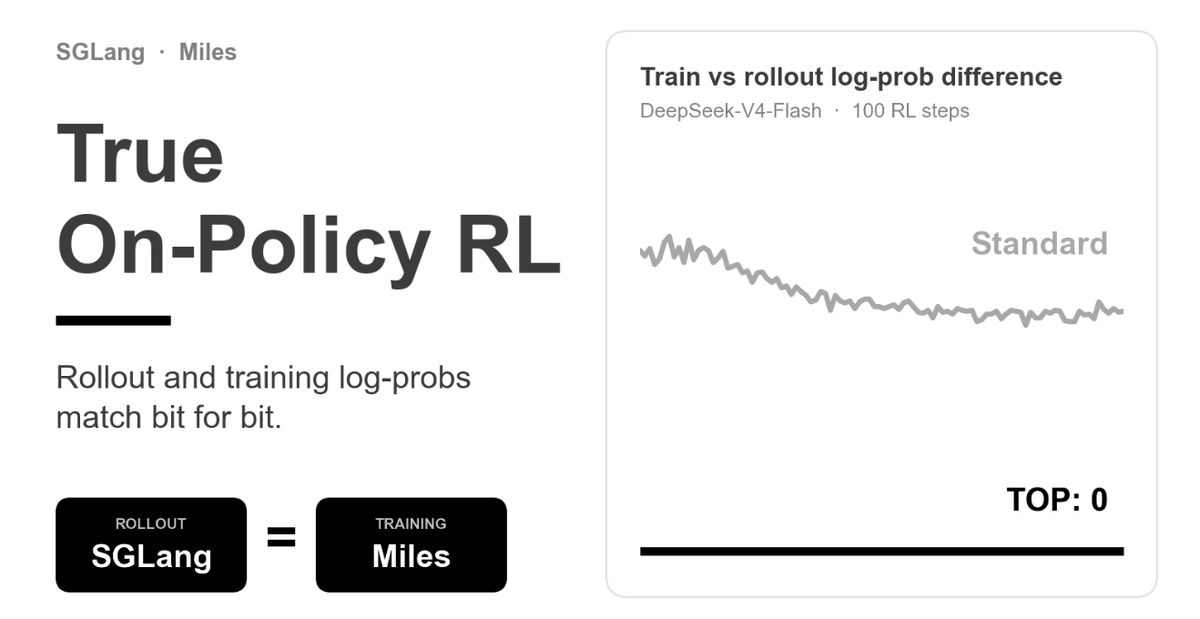
New from our Miles team. The blog walks through what it takes to make the trainer reproduce the rollout bit for bit, what that costs per kernel, and why it matters once your RL goes async.
True On-Policy RL: Bit-Exact Rollout and Training with SGLang and Miles
Last year we made SGLang batch-invariant. The Miles team at @radixark carried that into training: every op has one numerical contract on both sides, so the trainer gives each sampled token exactly the probability the rollout did.
Blog highlights:
• Bit-exact across DeepSeek-V4, GLM-5 and Qwen3 families
• Async RL: with kernel mismatch gone, uncapped TOP + routing replay trains stably with no cap on the importance weight
• 0.90–0.93× whole-step throughput vs standard on 64 H200s
• An agent ported DeepSeek-V4.1-Flash in under 8 hours from our model-support skill
Read the full blog below 👇
Two new ways to run DaisyRose-27B locally.
Thanks to the MLX community, you can now run it on Apple silicon!
https://t.co/Pv5uEr4f7Z
Our own GGUF is ready too, for llama.cpp, Ollama, LM Studio, and more: https://t.co/Sgppt1EpsP
How much can you improve a small model in 18 days on 144 GPUs?
Meet DaisyRose-27B, RadixArk's first open-weight model! It is trained with RL on Qwen3.8-27B, with 1,200 curated long-horizon agent tasks for 18 days on 144 H200s. Powered by Miles and our own training backend, we stretched agent sessions up to 1M tokens and raised the Terminal-Bench 4.1 score from 5.6% to 12.0%.
See how we pull it off ⬇️
What an incredible two days in San Francisco!
Congratulations to the entire SGLang community on a hugely successful first Summit. From the major announcements to the technical discussions and connections made, there's so much momentum behind open-source AI infrastructure.
Proud to be part of this community and help build what's next! 🚀
2,000+ people. Two days. The first SGLang Summit.
Together, we announced SGLang v1.0, released Miles v0.2, and launched the SGLang Consortium with nine founding members: @nvidia, @AMD, @intel, @Google, @Meta, @thinkymachines, @Cloudflare, @modal, and @radixark.
SGLang is now used by 332 organizations. At Meta, it powers production inference for products serving billions of users. Teams from Modal, Cloudflare, LinkedIn, and others shared their production lessons.
Across 90+ technical talks and six hands-on workshops, the community explored what comes next for inference, reinforcement learning, and AI agents.
To everyone building, deploying, and contributing: thank you for making this possible.
Explore the announcements, engineering lessons, and moments from SGLang Summit 2026 in the link below.
Congrats to the @pika_labs team!
Pika Enact generates sub-second causal chunks, and each chunk reads a KV cache of earlier ones. Chunk length and steps per chunk set how fast the scene can respond.
Really cool work!
Today, we’re excited to share Enact, a research preview of scenes that respond to you.
Enact represents a new way of making AI video, one that’s designed to mimic the experience of directing on set. Built on Pika H3 Flex, it allows a creator to interact with “actors,” manually re-stage a scene, and manipulate the camera—all in real time.
We think this is the beginning of a new paradigm for creation. Read more and reach out for a demo below.
How much can you improve a small model in 18 days on 144 GPUs?
Meet DaisyRose-27B, RadixArk's first open-weight model! It is trained with RL on Qwen3.8-27B, with 1,200 curated long-horizon agent tasks for 18 days on 144 H200s. Powered by Miles and our own training backend, we stretched agent sessions up to 1M tokens and raised the Terminal-Bench 4.1 score from 5.6% to 12.0%.
See how we pull it off ⬇️
Miles powers the training-system tier of Infrathon: 5 tasks across LLM distillation, agent RL, and image/video generation.
System-level tasks like these turned out to be where long horizons matter most. Agents kept finding gains deep into their 24-hour runs.
Glad to see Miles become a testbed for what long-horizon agents can do.
[1/4] 🚀 Introducing Infrathon (https://t.co/z1ntXVmAMQ)
Can LLM agents autonomously improve real-world AI infrastructure, make new discoveries, and outperform human-designed baselines on long-horizon, open-ended optimization tasks?
AI infra optimization requires repeated implementation, profiling, and testing. Agents must preserve correctness, recover from failed experiments, and keep searching when early attempts stall. Existing evaluations often focus on specific components or shorter runs.
Together with @uwnlp, @allen_ai, @radixark, and @PyromindHS, we introduce Infrathon: a benchmark of 25 real-world, open-ended AI infrastructure optimization tasks spanning operators, modules, and end-to-end training or serving workflows, with 12–24-hour budgets.
One example: Claude Opus 5.5 increases mean KV-cache compression from 6.82× to 19.86× while improving video quality.
�� Homepage: https://t.co/z1ntXVmAMQ
📝 Blog: https://t.co/fVXL5fcjmp
📄 Paper: https://t.co/MvrnEjZG5L
🤗 Hugging Face Daily Papers: https://t.co/vW5CMsSEzc
💻 Code: https://t.co/7Cj2a0nxZq
📦 Dataset: https://t.co/qf8sOJBJSe
🐳 Docker Hub: https://t.co/zRxMFEgxZk
Impressive work from @baseten!
We're collaborating to bring these low-latency optimizations into @sgl_project, making the improvements available to the broader community.
Today we’re sharing our latest results in pushing low-latency performance for Deepseek v4.1 Flash. It’s running at ~2,500 tok/s on Vera Rubin, batch size 1, TP4, 1.9ms per step
It’s up to 1.7x faster than our GB300 numbers, and we’re working with @sgl_project and @radixark to get it all into OSS.
Here’s what @TriDao2 and @stel4th shared at the SGLang summit last week:
Great to have @LipBuTan1 join @ying11231 at SGLang Summit to discuss the future of silicon and what it means for AI infrastructure.
Thanks @intel for being part of the conversation!
Together with @NVIDIAAI, we ran Miles with every sandbox on Vera CPUs.
In tests under load, average episode time fell by 11%—bringing samples back sooner for training.
Faster tool execution matters when you’re training agents to run code, test it, and learn from the results.
Faster GPUs make CPU speed matter more in agentic RL.
In Miles tests under load, @nvidia Vera CPUs cut average episode time by 11%. Less waiting for tools means samples return sooner.
Results + methodology: https://t.co/VvZIOb0SaR
More details below🧵