Remembering the great Charlie “Bird” Parker who was born on this day in 1920. Considered the greatest jazz saxophonist of all time, Parker was the principal stimulus of the modern jazz idiom known as bebop, and he was one of the primary revolutionary geniuses in jazz.
Parker was a blazingly fast virtuoso and introduced revolutionary harmonic ideas into jazz, including rapid passing chords, new variants of altered chords, and chord substitutions. Primarily a player of the alto saxophone, Parker’s tone ranged from clean and penetrating to sweet and somber.
Here, he is performing “Hot House” with Dizzy Gillespie on trumpet, Sandy Block on bass, Charlie Smith on drums and Dick Hyman on piano live in 1952.
On this day in 1958, Art Kane gathered 57 of the greatest jazz musicians in front of a Harlem brownstone for what became one of the most iconic images in music history.
Originally titled “Harlem, 1958”, the photo was published as the centerfold of Esquire’s January 1959 issue, celebrating the Golden Age of Jazz.
From Count Basie to Dizzy Gillespie, Mary Lou Williams to Thelonious Monk, the picture captured not just a generation — but an era.
A single frame, a lifetime of music.
Remembering the great Rahsaan Roland Kirk who was born on this day in 1935. Known for his onstage vitality, during which virtuoso improvisation was accompanied by comic banter, political ranting, and the ability to play several instruments simultaneously, Kirk was a post-modernist before that term even existed.
Usually, he appeared on stage with all three horns hanging around his neck, and at times he would play a number of these horns at once, harmonizing with himself, or sustain a note for lengthy durations by using circular breathing. He used the multiple horns to play true chords, essentially functioning as a one-man saxophone section. Kirk was also an influential flute player. He employed several techniques, including singing or humming into the flute at the same time as playing. Another was to play the standard transverse flute at the same time as a nose flute. Kirk also made use of non-musical devices, such as alarm clocks, sirens, or a section of common garden hose.
Some observers thought that Kirk’s bizarre onstage appearance and simultaneous multi-instrumentalism were just gimmicks, especially when coming from a blind man, but these opinions usually vanished when Kirk actually started playing. His unusual techniques were not adopted when he was an adult professional trying to find an edge in a competitive business but were taken up when he was a teenager trying to find his musical voice.
One particularly exciting aspect of his life is his activism. In 1970, Kirk formed an activist group which he dubbed the Jazz and People’s Movement, with the purpose of lobbying television networks to broadcast more jazz and black musicians. And in order to ensure the networks took the call seriously, the JPM seized the television studios by storm during the taping of major prime-time programs.
Here, he is performing “Three For The Festival” with George Gruntz on piano, Guy Pedersen on bass and Daniel Humair on drums live in Amersfoort, Holland in 1959.
Remembering the great Rahsaan Roland Kirk who was born on this day in 1935.
Here, he is performing “Satin Doll” on two saxophones at once. He is accompanied by Rahn Burton on piano, Henry Pearson on bass and Richie Goldberg on drums live in France, 1972.
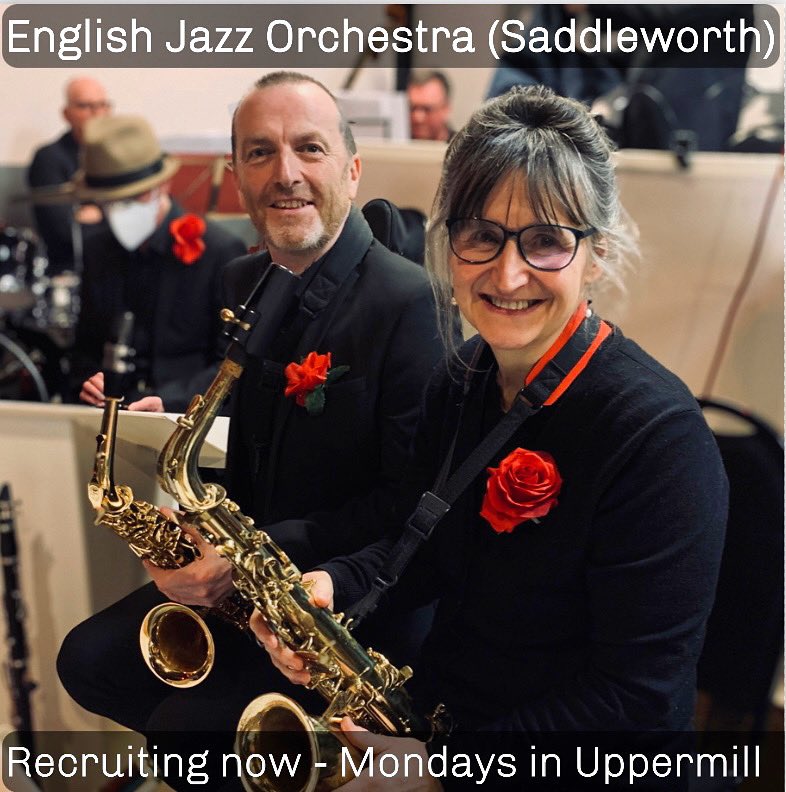
English Jazz Orchestra is recruiting! 🎵
Join our Saddleworth Band, rehearsing on scheduled Monday evenings at Uppermill Methodist Church OL3
Contact us for more details:
Email: [email protected]
Text/WhatsApp: 07481 565 166
#saddleworth#oldham
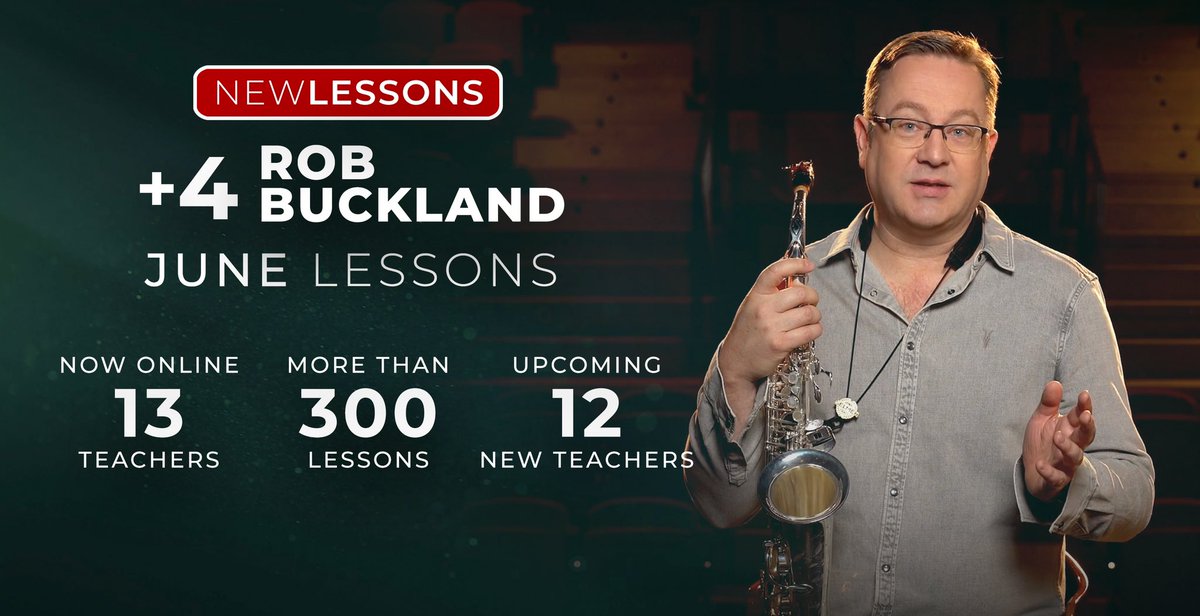
JUNE LESSONS AVAILABLE +4
ROB BUCKLAND
· Sonic perspectives • · Personality, connection and narrative • · A three-dimensional approach to sound • · Developing projects
at https://t.co/xdmSxFpdYu