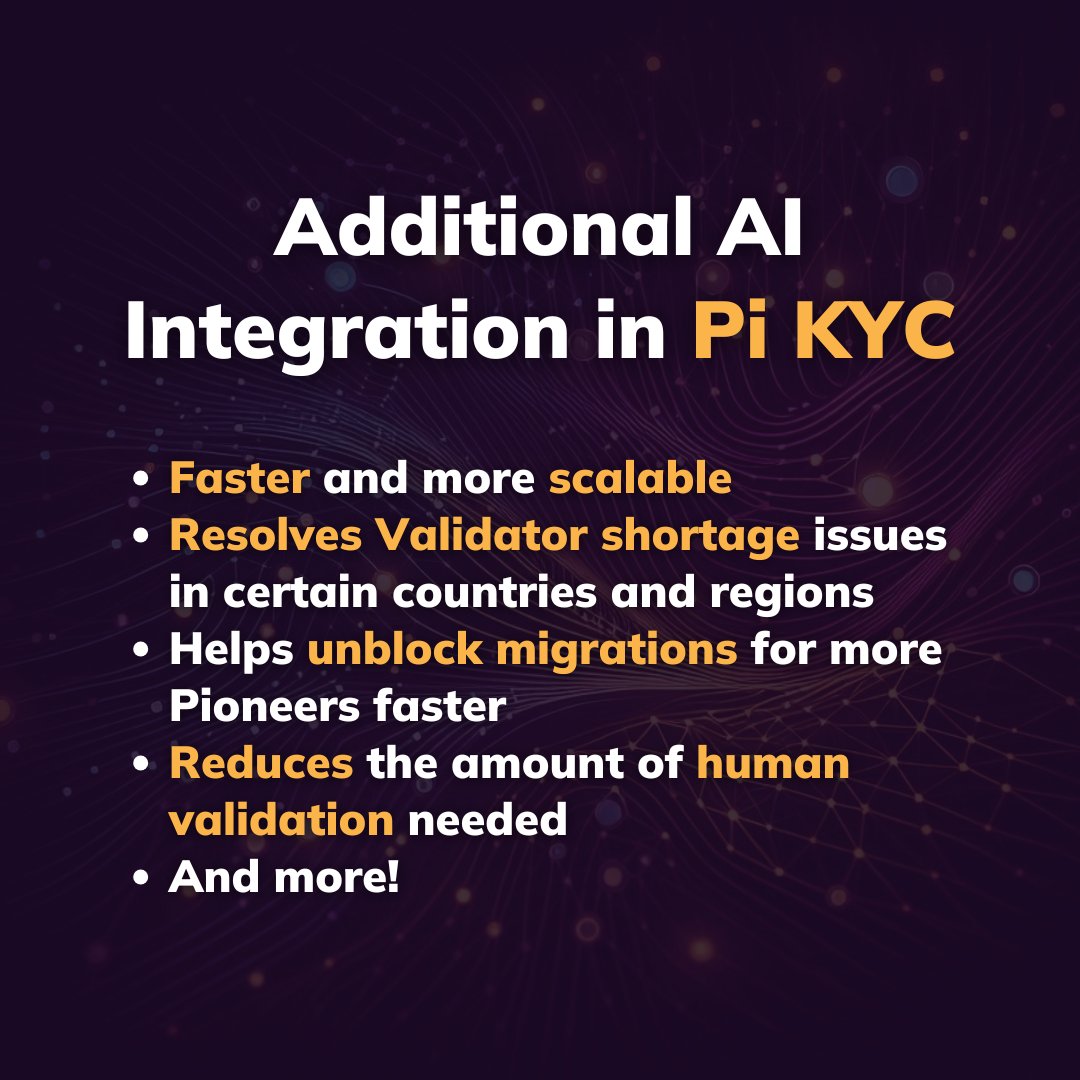
Most AI systems still need good human input.
Automated training can scale.
But it struggles with:
Ambiguity
Nuance
Real-world judgment
That’s why human-in-the-loop systems still matter.
Not as a fallback. But as a core layer.
The challenge isn’t whether human input is needed.
It’s how to get it:
At scale
With quality
From real people
That’s the bottleneck, and Pi Network has already built the solution: the large-scale, globally distributed workforce of identity-verified human participants already active inside the Pi ecosystem.
https://t.co/uB1vllBMJU
Network Update: The Pi Mainnet has successfully upgraded to Protocol 22!
Node operators, please ensure your systems are up to date and stay tuned for instructions regarding the upcoming v23 upgrade.
There are over 18 million identity-verified users on Pi.
But there is one clear difference between Pi’s users and others.
1 million verified users on Pi ≠ 1 million users on other networks.
Most networks measure growth in accounts.
Few measure it in verified users.
There’s a difference.
Pi recognized the importance of identity verification early on and that unverified account creation is simply not enough. Verified identities are needed for any meaningful transactions, especially in real-world economies.
Any time an asset (like crypto, fiat currency, property, etc.) is transferred, it raises a basic question of identity: who is sending it, and who is receiving it. If those identities aren’t clear, it becomes difficult to trust that the transfer is valid or that it went to the right person.
Therefore, Pi Network has built a fully KYC-verified Mainnet ecosystem.
Because when users are verified:
Spam drops.
Trust increases.
Utility becomes more reliable.
To complete first or second migrations, Pioneers must set up Pi Wallet two-factor authentication (2FA) through Step 3 of the Mainnet Checklist.
This step is required to further strengthen account and wallet security before real Pi is transferred, an irreversible and immutable blockchain transaction.
To complete 2FA, Pioneers may need to add a trusted email address if one has not been set up yet.
Over 119,000 Pioneers have completed second migrations of their transferable balances so far, as the gradual rollout continues.
Explore the full update below ⬇️
https://t.co/jF30vH1mLE
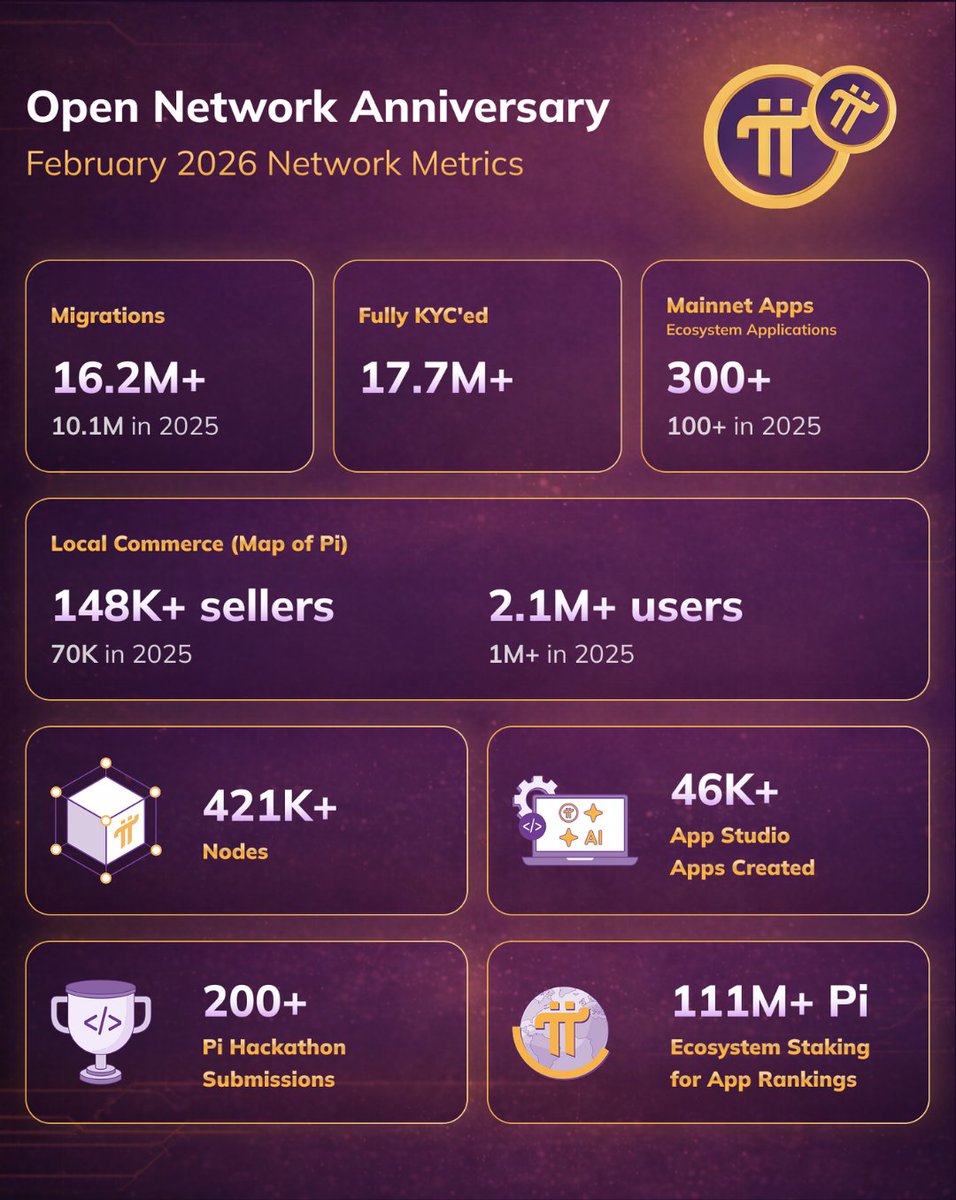
Since the launch of Open Network, Pi has continued expanding across multiple dimensions of the ecosystem—from KYC and Mainnet migrations to developer activity and overall network participation. These milestones reflect the steady progress made possible through the collective contributions of Pioneers, developers, businesses, and KYC validators around the world.
Check out some of the key ecosystem growth metrics achieved during the past year since Open Network launched!
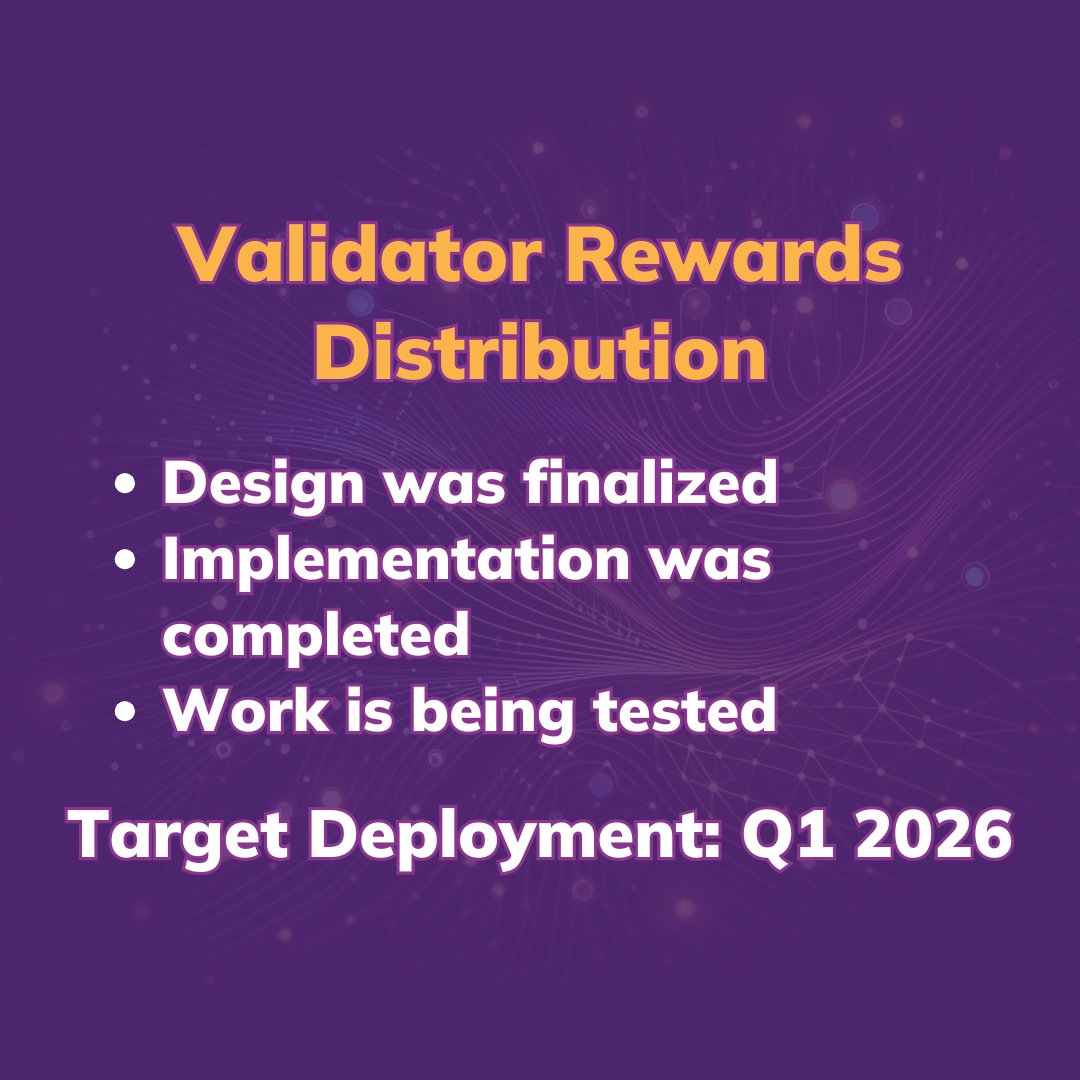
KYC validator rewards distribution continues to make progress in line with the previously announced timeline! Its design was finalized, implementation was completed, and currently the work is being tested. Testing is incredibly important, as it affects the distribution of Pi payments to KYC validators for their work in the KYC process of millions of Pioneers. The target remains deployment by the end of this quarter (March 2026).
Update on KYC validator rewards: The work on distributing rewards for validator contributions has been ongoing and is making progress. It is targeted for deployment by the end of Q1 2026.
The first validator rewards distribution requires a significant amount of work to assess and analyze the immense volume of KYC validation task data accumulated since 2021.
Learn more https://t.co/359GmWicTW
Decentralized exchange (DEX) and automated market maker (AMM) functionalities are available on the Testnet, allowing developers and Pioneers to experiment directly with token swaps, liquidity pools, and other decentralized finance tools. Developers can also now create test tokens on the Pi Testnet blockchain, while such functionality is restricted on Mainnet during the testing period. These releases in a testing environment allow developers to extend Pi Network’s capabilities in a utility-focused and Web3 way, and it onramps Pioneers safely and gradually.
Learn more in the Pi mining app!
Note that Pi Network will perform a scheduled upgrade Thursday, 9/25 from 8–10 AM PDT. Sign-ins and sign-ups are temporarily disabled during this period. Thank you for your patience.
Under the leadership of Hon’ble PM Shri @narendramodi ji and FM Smt. @nsitharaman ji, the #NextGenGST reforms approved by the GST Council are truly commendable.
These transformative measures will simplify the lives of citizens, make business easier, and accelerate local manufacturing and entrepreneurship.
Heartfelt gratitude to the Hon’ble PM and thanks to the Hon'ble FM for these welfare-oriented decisions that will make India’s economy stronger and more inclusive.
लखनऊ में तीन साल का बच्चा लोहे की ग्रिल पर गिर गया जो सिर के आर पार हो गयी.
परिवार बच्चे को लेकर आनन फानन में प्राइवेट अस्पताल पहुंचा जहां ऑपेरशन का खर्ज़ 15 लाख रुपए बताया गया.
परिवार इतना पैसे देने में सक्षम नही था. इसके बाद बच्चे को लेकर लखनऊ के सरकारी अस्पताल KGMU पहुंचे. जहां डॉ अंकुर बजाज और उनकी टीम तत्काल बच्चे को ऑपरेशन थिएटर ले गयी.
रात को ही वेल्डर को बुलाया गया जिसने ग्रिल काटी. डॉक्टरों की टीम ने बेहद जटिल ऑपेरशन कर बच्चे की जान बचाई. और खर्च आया केवल 25,000 रुपए.