Thank you to my co-authors @maxdonelan, @CDavidRemy1 and Heather More for guiding and contributing to these projects, and my PhD committee for their insightful reviews.I look forward to your comments and questions. (5/5)
Feedforward control (which is able to fully activate muscles) was about 4x faster than feedback control in small animals, and around 2x faster in large animals. Our results suggest that animals of all sizes have to rely on feedforward control for fast responses. (4/5)
In a world filled with misinformation, Jaya Viswanathan, MS, PhD, takes on the unique challenge of educating the public about neuroscience in an accessible, engaging, and accurate way.
Discover her insightful approach in this Neuronline article.
▶️ https://t.co/yuOD4ECsia
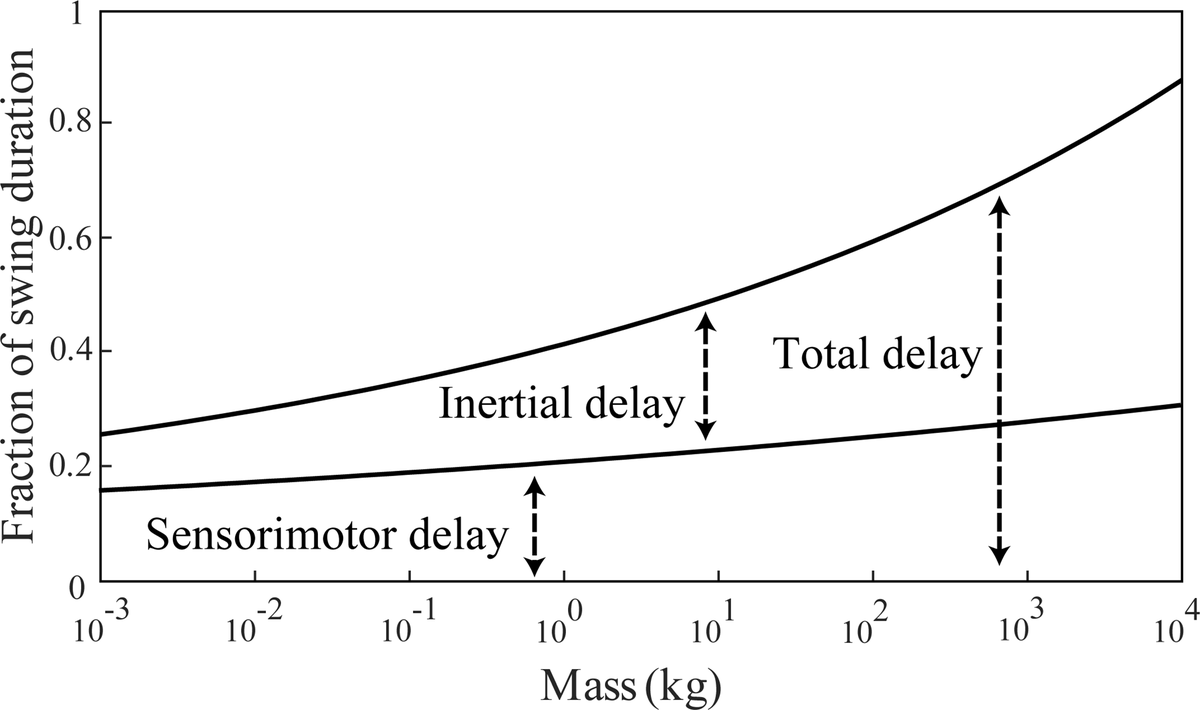
Response time requires 30% of swing duration for a 5 gram shrew but 80% for a 5 ton elephant. These estimates are conservative. These relatively slower response times in larger animals may hinder effective motor control. We'd love to hear your thoughts. Thanks for reading! (9/9)
Happy to share my new paper with @maxdonelan in @plosone. We studied how the inertia of body segments and muscle torque capabilities affect response time, as animal size changes. (1/9) #PLOSONE: Scaling of inertial delays in terrestrial mammals https://t.co/b2iQEwG5Ni
Consider an animal moving at its maximum sprint speed when it trips. To prevent a fall, it has to reposition its forelimb through 30 degrees within 1 swing duration. Here’s how sensorimotor & inertial delay compare to the available time (8/9):