The Law of Detachment in Islam – Tawakkul
You did your part. You made du’a. You tried.
But now… it’s out of your hands.
Let me show you the most powerful form of surrender you’ll ever learn.
Tawakkul doesn’t mean giving up.
It means giving it to Allah. Let go of the timeline. Let go of the method.
Let go of the obsession
You can love something deeply and still detach. Because in Islam, you don’t place your heart in the gift
You place it with the Giver.
The tighter you cling, the more it hurts when it leaves.Detachment isn’t cold. It’s trusting Allah so much that you can say:
“If it’s for me, it will come.
If not, may Allah protect me from it.”
You want the job. The marriage. The healing.
The answer. You do your part. But then you say:
“Ya Allah… I trust You more than I trust my desires.”
That’s Tawakkul.
If Hajar (AS) clung to what made sense, she wouldn’t have run.
If Musa (AS) clung to logic, he wouldn’t have stepped into the sea.
If Ibrahim (AS) clung to fear, he wouldn’t have faced the fire.
They detached.
They trusted.
And Allah came through.
The moment you let go, the anxiety softens.
The storm calms.
Your chest expands. Why?
Because you’ve handed your burden to the One who never sleeps.
Repeat after me:
What’s written for me will find me.
What’s delayed is not denied.
What leaves was never mine.
My Rabb is enough.
This is the Law of Detachment in Islam.
It’s not apathy. It’s not weakness either
It’s faith in action.
Try. Pray. Show up.
Then release it and watch what Allah writes in its place.
Sometimes letting go is how the blessing comes. Tawakkul
The Qur’an Diagnosed Your Anxiety 1400 Years Ago
People talk about therapy. Trauma. Anxiety. But long before psychology had a name— The Qur’an already knew your pain.
Here’s what it says and it might just heal something inside you
The way Allah honors women in the Qur’an will leave you in tears.
The more I read the Qur’an,the more realize: No one sees, hears and loves us like Allah does. If you’re a woman, PLEASE read this.
My Ustadh told me something one evening that completely shifted the way I viewed hardship.
We were talking about setbacks - missed opportunities, closed doors, things that just didn't go our way. Someone had just shared how they didn't get into a job they're really passionate about. You could see the weight in their voice. Disappointment laced every word.
That's when Ustadh said:
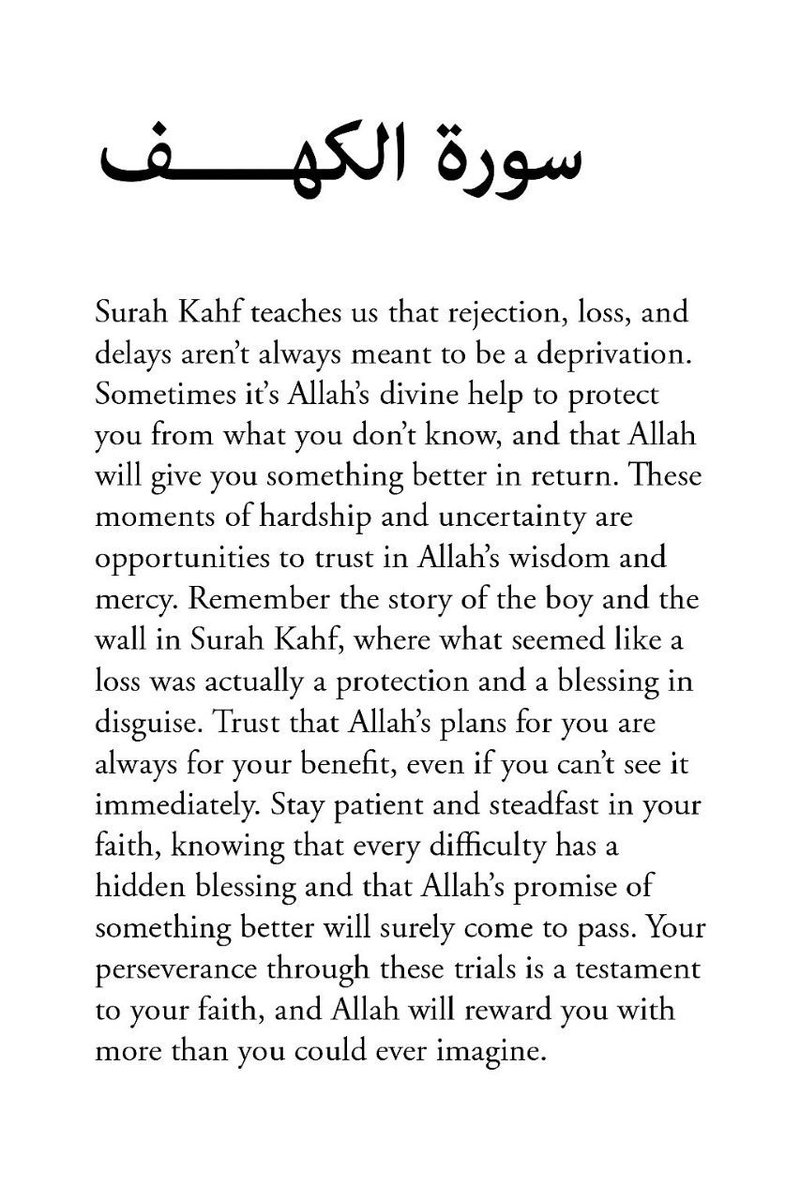
"You know the story of Musa and Khidr?"
We all nodded.
He said:
"Everyone loves the part where Khidr explains why he broke the boat, killed the boy, and rebuilt the wall. Because suddenly, the pain makes sense. The confusion becomes clarity. But do you realise something?"
He paused.
"Musa only got the explanation because it was a lesson. The people who owned the boat, the parents of that child, the town that rejected them-they never got told. They just had to live with what happened."
The room was quiet.
Then he said:
"Sometimes in life, you don't get the Khidr moment. You don't get to find out why something happened. You just get the qadr. The closed door. The loss. The silence. And your test is whether you can still trust Allah without needing the explanation."
He leaned forward and said:
"It's easy to have sabr when the story wraps up neatly. But the real test is:
Can you have tawakkul when you're still in the middle of the story?"
I remember sitting with those words long after the class ended.
Because we all wait for our Khidr moment, the point where everything makes sense. But sometimes, that moment doesn't come in this life. And still, we are asked to trust.